- Enterprise AI Executive
- Posts
- 18 AI playbooks for executives
18 AI playbooks for executives
Plus, key takeaways to help you level up fast.

Lewis Walker
June 02, 2026

Welcome executives and professionals. I reviewed 121 AI playbooks from the past month. These 18 matter for executives:
BEST PRACTICE INSIGHT

Image source: Microsoft
Brief: Microsoft published a 52-slide guide to selecting, scaling, and operating AI agents across the enterprise. The playbook spans six steps across four structured sections for implementation.
Breakdown:
Understand the Assist → Execute shift and why agent initiatives require different operating models. Align adoption patterns with firm priorities.
Use the 5×5 diagnostic to assess current state across five capability drivers. Compare against target maturity to identify scale-breakers.
Define the right Center of Excellence model, from centralised to federated, aligned to your adoption pattern to enable scale.
Follow a 90-day execution plan: select your pattern(s), assign ownership, identify your scale-breakers, and begin execution.
Why it’s important: You don't need a bigger model. You need a better operating model. AI agents are moving from assisting humans to executing work. This shift changes how you govern, own, and operate agents. There is no “one size fits all” framework for all agent initiatives.
BEST PRACTICE INSIGHT

Image source: Anthropic
Brief: Anthropic released a 35-page security framework for deploying autonomous AI agents in the enterprise, as frontier AI now compresses the time between a vulnerability and its exploit from months to just hours.
Breakdown:
Zero Trust rests on three ideas: never trust and always verify; assume a breach has occurred; and grant least privilege.
The guide details how to apply Zero Trust to agentic deployments while addressing threats with practical mitigation steps.
Topics include establishing secure enterprise capabilities such as identity and authentication, observability, and more.
An 8-phase approach deploys agents securely, from defining agent boundaries through to measuring what matters.
Why it’s important: For CISOs and security leaders the compliance deadlines are real, the threat landscape is moving, and retrofitting controls after an incident costs more than building them now. The framework in this document gives teams a concrete starting point.
BEST PRACTICE INSIGHT

Image source: McKinsey & Company
Brief: McKinsey explored how leading firms are redesigning delivery around near-continuous execution, with humans reviewing by day and agents building overnight, achieving 3-5x productivity gains and up to 60% smaller teams.
Breakdown:
Daily sprints replace the two-week cycle: humans set guardrails and review outputs as agents code and test overnight.
Codifying requirements and guardrails in machine-readable form removes handoff friction, so agent pipelines to run end to end.
Knowledge graphs form an AI memory layer across the SDLC, turning weeks of SME interviews into minutes of agent answers.
Teams of 8-12 give way to pods supervising agents, moving people to architecture, domain modeling, and oversight.
Why it’s important: Software delivery is becoming a system humans supervise rather than staff. Enterprises that rewire the operating model around standard workflows and a shared knowledge layer can compress cost and timelines; while those bolting agents onto legacy stacks stall.
BEST PRACTICE INSIGHT & CASE STUDIES

Image source: Anthropic
Brief: Anthropic released a 24-page guide for deploying Claude Cowork across enterprises, covering use cases, rollout timelines, lessons from Anthropic and other organizations, and more.
Breakdown:
Chapter 1 explains how Claude Cowork is differentiated for high-effort knowledge work through speed, scale, and quality.
Chapter 2 outlines a five-level maturity model, from early experimentation to driving Claude Cowork adoption at enterprise scale.
Chapters 3 and 4 break down deployment timelines, practical actions, and what success looks like at each stage of maturity.
Chapter 5 shows how Anthropic teams use Claude Cowork across finance, strategy, legal, sales, and product management.
Why it’s important: Enterprises should aim to make every employee more productive while building toward the next stage of AI adoption. Connecting systems to complete real work is possible from day one. Give internal champions room to build, then scale their workflows across teams.
BEST PRACTICE INSIGHT & CASE STUDIES

Image source: OpenAI
Brief: OpenAI interviewed executives at Philips, BBVA, and other firms, converging on a shared reality: scaling AI is less about “rolling out AI” and more about the conditions where people trust, adopt, and improve it over time.
Breakdown:
The fastest path to adoption wasn’t a technical rollout, it was building literacy, confidence, and permission to experiment safely.
AI scaled when teams could redesign workflows, and teams moved faster when security, legal, compliance, and IT were involved early.
Organizations that earned trust defined what “good” meant early, invested in evaluation, and delayed launches when standards were not fully met.
The most durable gains came from hybrid workflows, using AI to strengthen expert reasoning and review, not just increase throughput.
Why it’s important: The organizations pulling ahead aren’t simply moving faster. They’re moving more deliberately. OpenAI's guide is not a set of predictions or promises, but an evidence-based view of what has consistently worked in practice, including a 12-point checklist for executives.
MARKET & BEST PRACTICE INSIGHT
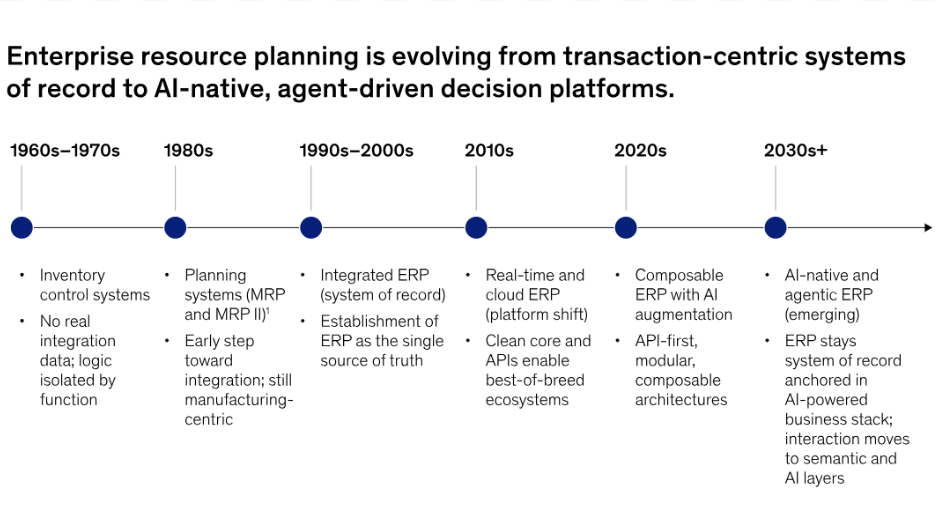
Image source: McKinsey & Company
Brief: McKinsey examined how AI is disrupting ERP, as early adopters of AI-integrated ERP systems are already gaining a competitive edge, reporting EBIT improvements of 5 percent or more.
Breakdown:
The “SaaSpocalypse” view argues AI agents replicate ERP capabilities and data moves into microservices instead of rigid tables.
Others believe ERP backbones remain essential, with AI agents operating on top of stable architectures for compliance and reliability.
AI agents could reduce ERP implementation effort by more than 50%, breaking the traditional linearity between productivity and headcount.
McKinsey also explores why enterprises will continue ERP modernization, while value creation increasingly shifts from build to buy.
Why it’s important: While the extent of disruption remains uncertain, ERP ecosystem players will need to reinvent delivery models and solutions to stay relevant. Enterprise customers should actively experiment with emerging AI capabilities and reconsider long-standing approaches to ERP.
BEST PRACTICE INSIGHT

Image source: Bain & Company
Brief: Bain outlined why shared services still matter, which over two decades have reduced costs by 20-40% while improving quality in mature firms. AI won’t replace them but will reshape how they’re sequenced and scaled.
Breakdown:
AI raises ambition for support functions, but scale, standardization, and process improvement remain essential foundations in AI.
For many enterprises, shared services are the fastest path to the process and data foundations AI requires while accelerating labor arbitrage.
The shift first or AI first decision depends on process-level economics, AI maturity, data readiness, and delivery capacity.
The issue isn't whether AI replaces shared services but how they will evolve from a transaction factory into an AI deployment hub.
Why it’s important: For most large enterprises, the choice is not between shared services and AI but how to sequence them effectively. Shared services build the operational foundation; AI builds on top of it. Companies that succeed know when to shift, when to standardize, and when to automate.
BEST PRACTICE INSIGHT

Image source: Boston Consulting Group
Brief: BCG outlined how AI and analytics give strategists an edge in identifying growth opportunities, helping companies find new adjacencies, anticipate customer shifts, and spot competitive threats early.
Breakdown:
Mining patent citation networks using NLP can reveal unexpected applications for existing technologies, unlocking new markets.
AI analysis of reviews, forums, and call transcripts can surface shifting consumer sentiment and flag emerging customer priorities.
Training reasoning models on competitor investor days, research funding, and hiring data can reveal strategic shifts before they reach the market.
Agentic AI can monitor startup formations and scientific publications to map emerging disruptors and estimate likely disruption timelines.
Why it’s important: AI and analytics are becoming even more central to growth strategy. Firms can scan for adjacencies, track competitors, and monitor disruption to build advantages. Those that don't risk being outpaced by rivals who shape the competitive landscape on their own terms.
MARKET & BEST PRACTICE INSIGHT

Image source: Accenture
Brief: Accenture research surveying executives across 2,000 companies found that AI momentum is outpacing data readiness, with only 7% of firms, “data reinventors,” having built the foundations needed to scale advanced AI.
Breakdown:
Most organizations rely on siloed, static data built for human experts, and advanced AI is exposing these limitations faster than ever.
Only 6% of companies have a unified logical data view today, versus 30% of data reinventors, revealing how wide the readiness gap has become.
Data reinventors hold an estimated 4.5 percentage point EBIT margin advantage, equivalent to a margin uplift of up to 1.6x over three years.
Reinventors follow a continuous loop: capturing trusted data, contextualizing it with shared meaning, then reinvesting those gains.
Why it’s important: Most enterprises are scaling AI on data foundations that were never built for it. The 7% that have invested in AI-ready data are already pulling ahead on margins and decision quality, and as advanced AI becomes standard, that gap will only widen.
BEST PRACTICE INSIGHT

Image source: World Economic Forum
Brief: WEF and Capgemini argue that the central challenge for AI agent adoption is not capability but authorization, introducing the Agent Capability and Authorization Profile (ACAP) for governed, scalable deployment.
Breakdown:
Firms can describe what agents are capable of but consistently struggle to define what they should be authorized to do in a given workflow.
ACAP is a living authorization record that connects enterprise policy, system design, and operational oversight in a single auditable profile.
Risk is often architectural rather than model-driven. The same agent can present very different risk profiles depending on tool access and context.
A single model-level vulnerability can propagate across an agent portfolio, making deployment-level authorization critical at scale.
Why it’s important: Most governance frameworks were built for traditional software, not systems that interpret context and act autonomously. As agent adoption accelerates, the gap between what AI can do and what firms have authorized it to do becomes the defining risk ACAP is designed to close.
MARKET & BEST PRACTICE INSIGHT

Image source: HCLTech
Brief: HCLTech published a 38-page AI adoption report based on insights from 467 senior executives, including CAIOs, CIOs, CTOs, and CDOs, examining how they view CEO and board-level understanding of AI.
Breakdown:
87% said CEOs and boards underestimate the investment risk tied to AI and that not every initiative will bear fruit.
85% said CEOs and boards underappreciate that leading in AI may require medium-term margin pressure due to capital outlays.
83% said CEOs and boards do not adequately understand that the risk of underinvesting in AI may be existential for the organization.
The report also explores broader enterprise AI adoption challenges and what leading organizations do differently.
Why it’s important: While AI adoption is accelerating, the ability to translate investments into value remains uneven. AI challenges extend to the very top of the org chart. In fact, in some ways, HCLTech’s data shows the CEO and board may be the source of organizations’ biggest AI pain point.
BEST PRACTICE INSIGHT

Image source: Cognizant
Brief: Cognizant’s Chief People Officer Kathy Diaz outlined how enterprises can redesign careers, roles and skills from the inside out, and how the firm is applying those changes internally first through its Client Zero approach.
Breakdown:
Mapping how tasks within professions are changing reveals three patterns: old roles, new tasks; old work, new ways; and entirely new roles.
Rebuild careers around trajectories instead of rigid job structures. Cognizant consolidated ~90 legacy groups into ~20 job families.
The most valuable roles in AI-native firms are, in many cases, held by individuals rather than managers. Invest in individual contributor tracks.
Cognizant's skills approach builds a more comb-shaped professional: someone with deep skills across multiple areas (image above).
Why it’s important: AI is creating one of the most defining moments for talent strategies in decades, prompting organizations to rethink how work is structured, how skills are developed and how careers evolve. Leaders who move with clarity and intent will be better positioned to unlock long-term value.
MARKET & BEST PRACTICE INSIGHT

Image source: Teneo
Brief: Teneo’s 23-page report warns billions are at risk in data center development. By engaging communities early, AI infrastructure developers can de-risk project delivery, reduce local opposition, and accelerate approvals.
Breakdown:
Over $1 trillion in US AI infrastructure spending faces rising public opposition, putting deployment and costs (~10%) at risk.
Half of all planned projects are delayed or cancelled, with 77% of impacts occurring during the permitting and approvals process.
Data center developers can avoid delays and save billions by building social license early through ongoing community engagement.
Developers should implement socio-economic benefit programs and address data center energy concerns.
Why it’s important: Investing between 0.03% and 0.05% of total project costs in targeted community engagement and investment initiatives can help mitigate the risk of billions in losses, and protect the data center pipeline to help guarantee compute capacity for scaling enterprise AI.
MARKET & BEST PRACTICE INSIGHT

Image source: Bain & Company
Brief: Bain & Company explored the opex shift from headcount to tokens, raising questions many leadership teams are not yet asking. These are not implementation issues. They’re structural.
Breakdown:
Many technology leaders now picture a future opex mix of 70-80% headcount and 20-30% token costs by 2028-2029.
Executives need to find unbudgeted millions. Token spend doesn't fit a conventional line item and requires an approval chain that doesn't exist.
Early data suggests the top 5% of users (those you can’t afford to throttle) often consume more tokens than the other 95% combined.
What does your talent pipeline look like when teams are 3 people, not 15? How do you run a dual operating model without tearing the org apart?
Why it’s important: The question is not whether the opex shift is directionally correct, but whether organizations can survive the transition. Companies will face overlapping costs, organizational whiplash, and periods where headcount and token spend rise together before efficiencies appear.
MARKET & BEST PRACTICE INSIGHT

Image source: Microsoft
Brief: Microsoft analyzed trillions of anonymized Microsoft 365 productivity signals and surveyed 20,000 workers. As AI agents take on execution, the key question is whether organizations are built to capture the value created.
Breakdown:
AI expands access to high-value work, with 49% of Microsoft 365 Copilot chat use now for analysis, decisions, and problem-solving.
How people work with AI depends on engagement and agent use, creating four new modes: delegation, collaboration, asking, and discovery.
Many workers are ready for AI, but organizations still lag behind, leaving skilled employees blocked by limited readiness and support.
Organizational factors, culture, manager support, talent practices, account for 2x more of AI’s impact (67%) as individual behavior (32%).
Why it’s important: Many leaders focus on hiring the right people and assume results will follow. But data suggests the conditions leaders create matter more. The report introduces further guidance on building a Frontier Firm across employees, leadership, and the broader organization.
BEST PRACTICE INSIGHT & CASE STUDIES

Image source: Anthropic
Brief: Anthropic published a practical Claude deployment guide for financial services. The guide explains each product, shares customer examples from the industry, and offers tips on rolling out Claude across your firm.
Breakdown:
Claude is delivered in products teams use directly (e.g. Claude Chat, Cowork, Code) and the Claude Platform for building your own agents.
Anthropic released ten ready-to-run agent templates for work in financial services from building pitchbooks to screening KYC files.
Examples of AI-first financial enterprises highlighted in the guide include AIG, IG Group, Moody’s, and Commonwealth Bank of Australia.
Most successful Claude deployments follow a common path: teams establish the pilot foundation, run it, then scale (image above).
Why it’s important: As executives face pressures on margins, talent, and regulation, they are embracing AI for faster, better answers. Claude Chat is changing how teams access information, Claude Code is accelerating software development, and Claude Cowork is bringing execution capabilities to operators.
CEO INSIGHT
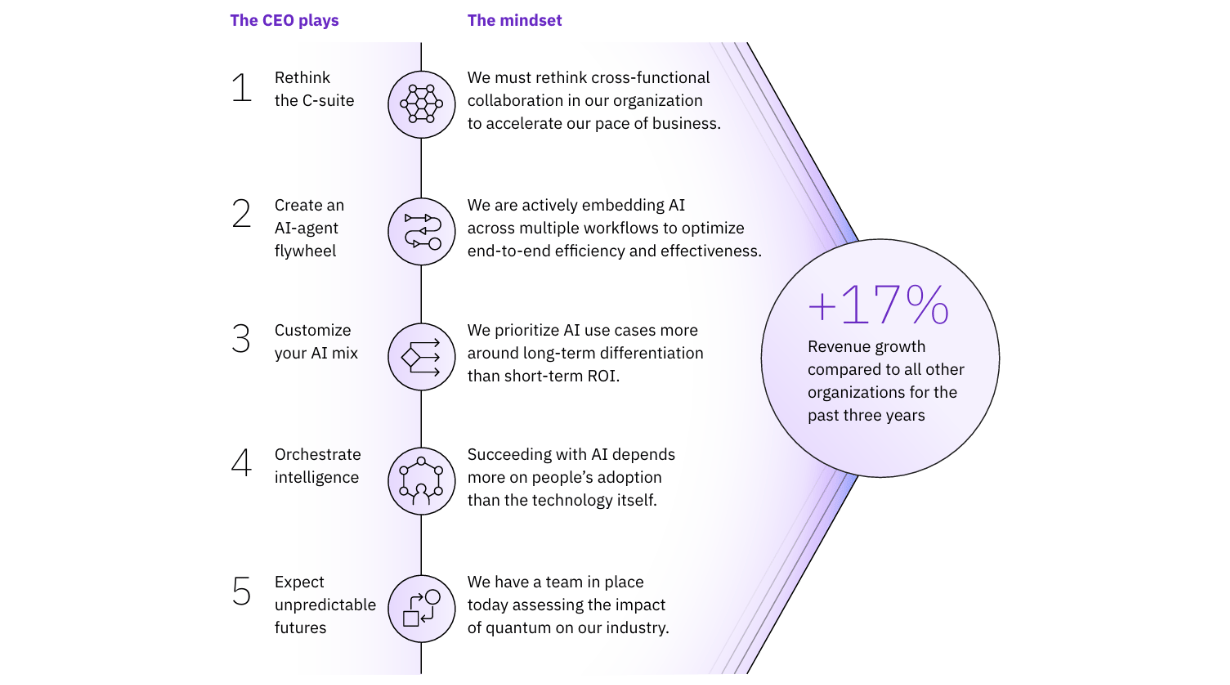
Image source: IBM
Brief: IBM’s annual CEO study of 2,000 leaders found that as AI becomes more pervasive in the enterprise, CEOs face rising pressure to rethink how leadership teams operate, decisions are made, and organizations are structured.
Breakdown:
76% of firms have a CAIO in 2026, up from 26% in 2025, while 64% of CEOs are comfortable making major strategic decisions based on AI.
CEOs who are remaking the C-suite with an AI-first mindset have scaled 10% more AI initiatives enterprise-wide than peers.
83% of CEOs say AI sovereignty is essential to strategy, underscoring the importance of having the right controls.
Despite 86% of CEOs believing employees have the skills to work with AI, only 25% of the workforce is using it regularly.
Why it’s important: The CEO’s role has always involved leading through disruption, but AI increases both the speed and impact of decisions. Winning organizations will operate AI-first, not as a layer of technology, but as a new operating model. Faster decision cycles, fewer silos, and rapid execution.
CEO & BOARD INSIGHT
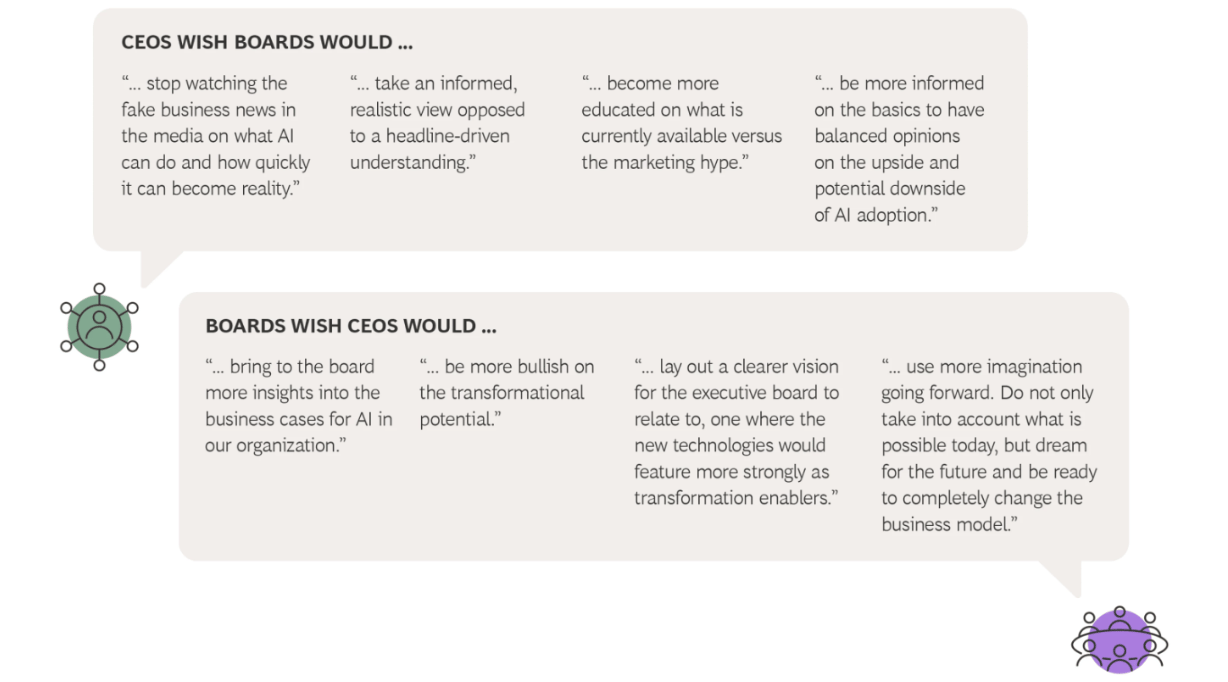
Image source: Boston Consulting Group
Brief: BCG’s inaugural Split Decisions survey of 351 CEOs and 274 board members from companies with over $100M in revenue shows growing misalignment between leadership teams and boards on AI strategy.
Breakdown:
Over half of CEOs say boards need a clearer view of the AI hype-reality gap, with 35% believing boards overestimate what AI can replace.
Boards feel CEOs need to do a better job selling them on their AI strategy, emphasizing the need for more proactive communication.
60% of CEOs believe boards are too impatient with the pace of AI transformation, underestimating complexity.
40% of board members who describe themselves as less AI-savvy than peers worry their organization is not adopting AI fast enough.
Why it’s important: At first glance, CEOs and boards appear to agree on how AI should be governed, implemented, and valued. Look closer, however, and you’ll see critical gaps. At a moment when clear, coordinated leadership is essential, these fault lines could create tension in the boardroom.
MARKET & BEST PRACTICE INSIGHT
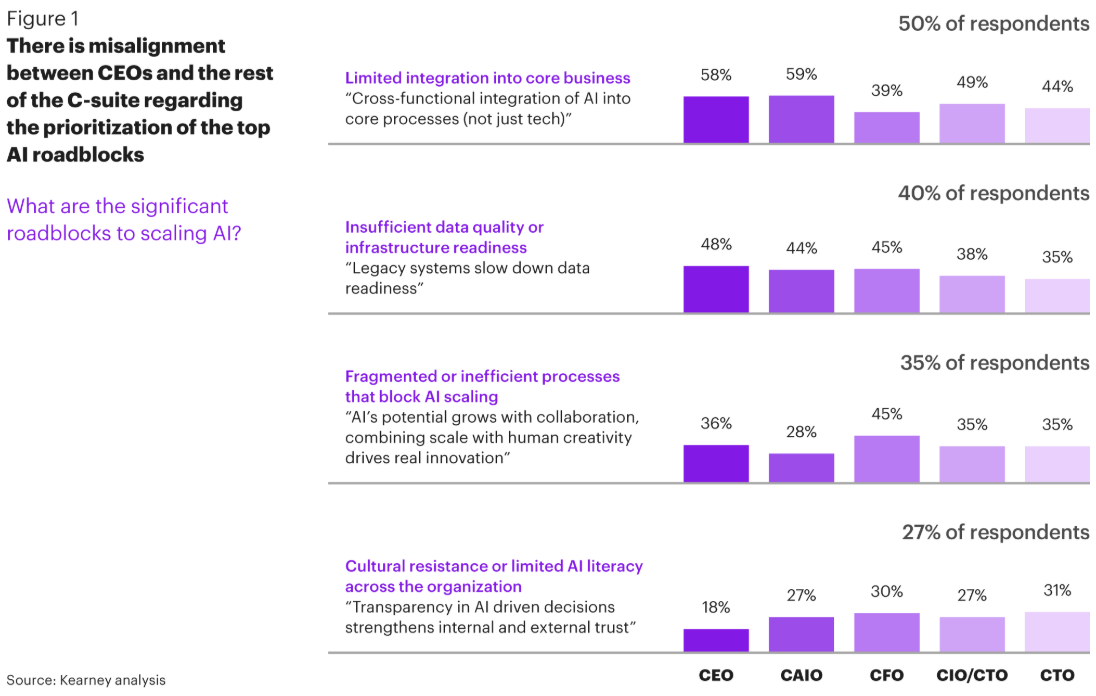
Image source: Kearney
Brief: Kearney surveyed more than 500 C-suite leaders across 16 industries, finding that the challenge of scaling AI and capturing value is less about technology and more about ownership, governance, and business design.
Breakdown:
Eight in ten AI projects fail to deliver, nearly half of POCs never reach production, and abandonment rates have doubled.
The study reveals sharp C-suite divides, with CXOs ranking AI challenges differently, exposing fragmented views (image above).
Executives disagree on ownership and strategy, debating efficiency versus innovation, and culture’s role in AI success.
Misalignment runs deeper, with conflicting views on integration and ROI barriers, leaving firms stuck in pilots without discipline to scale.
Why it’s important: Leading organizations align ownership, invest in data, processes, and governance, and embed AI into workflows. Those treating AI as transformation, not technology, are closing the gap between promise and impact.
BEST PRACTICE INSIGHT

Image source: Huawei
Brief: Huawei published a 129-page guide on integrating AI across industrial sectors, outlining how enterprises can apply emerging AI capabilities to address challenges and accelerate transformation.
Breakdown:
AI is shifting toward agentic and physical AI, with manufacturing adoption accelerating as the innovation-application gap narrows.
The guide assesses processes across seven industrial sectors, identifying key pain points and high-value AI use cases.
Huawei introduces a “Three Layers, Five Stages, Eight Steps” framework covering design, development and delivery, and ongoing operations.
Looking ahead, Huawei outlines “six industrial megatrends” shaping transformation across sectors and global value chains.
Why it’s important: Optimization of production processes, energy use, and innovation are reshaping industrial competitiveness. By shifting from scale-driven growth to efficiency- and innovation-led models, enterprises can position themselves for sustained, high-quality industrial development.
Anthropic released a 21-page deployment guide on Claude for legal, covering its own team's use and an adoption roadmap.
Accenture's 16-page report examines how AI data center growth is intensifying energy network pressures and the broader energy trilemma.
Cognizant released a deep dive explaining multi-agent systems, how they function, and real-world enterprise applications across industries.
MORE MUST-READ BREAKDOWNS
Enterprise AI for CEOs (16 playbooks)
AI for Board Directors (19 playbooks)
Enterprise AI for CXOs (32 playbooks)
AI for Enterprise Leaders (18 playbooks)
Build-Buy-Borrow (14 frameworks)
Agentic AI Case Studies (40 cases)
AI Use Case Prioritization (12 frameworks)
AI Strategy Playbooks (16 playbooks)
AI Agents & Agentic AI Use Cases (2,195)
ENTERPRISE AI EXECUTIVE
Agentic and generative AI are evolving rapidly in the enterprise, driving a new era of AI transformation.
Twice a week, we review hundreds of the latest agentic and generative AI best practices, case studies, market dynamics and innovations to bring you what is driving material value — and why it’s important.
Example editions:
Found this valuable? Share with a colleague.
Received this from someone else? Sign up here.
Connect on LinkedIn.

Lewis Walker, Editor