- Enterprise AI Executive
- Posts
- 18 playbooks for enterprise AI leaders
18 playbooks for enterprise AI leaders
Plus, key takeaways to help you level up fast.

Lewis Walker
March 30, 2026

Welcome executives and professionals. Leaders across tech, finance, sales, marketing, HR, risk, and beyond are racing to capture value from AI agents, agentic AI, and generative AI.
Strategies, operating models, architectures, delivery approaches, and responsible AI practices are evolving rapidly.
To help you stay ahead, I’ve distilled the key takeaways from the top AI leadership playbooks published in the past two months.
EXECUTIVE INSIGHT

Image source: Deloitte
Brief: Deloitte published a role-by-role playbook outlining how each C-suite executive should think about their responsibilities in putting agentic AI to work, including key actions and questions.
Breakdown:
CEOs steer strategy, major technology and organizational decisions, and mobilize the board and stakeholders around the vision.
COOs align tech with strategy while building the workforce, processes, and capabilities to enable and scale AI transformation.
CIOs and CTOs work across business and tech silos to align architecture decisions and tech investments with enterprise-wide priorities.
The report also outlines key questions CHROs, CFOs, and CROs should ask, and the actions they should own to enable adoption.
Why it’s important: Turning agentic AI into sustainable enterprise value requires coordinated leadership across the C-suite. Each executive plays a distinct role in aligning strategy, tech, workforce, and risk management to deploy agents responsibly at scale.
BEST PRACTCIE INSIGHT

Image source: Bain & Company
Brief: Bain & Company explored how AI providers are repositioning AI from a productivity tool to an enterprise operating system. As software indexes fell sharply earlier this year, it highlights areas executives should address now.
Breakdown:
The signal is clear: we are moving from narrow task automation to integrated, function-specific AI agents embedded in human-agent teams.
The insights cover three competitive dynamics helping leaders define how AI will reshape your industry and strategy.
Six stages of the agent factory, outlining how to industrialize the way AI agents are designed, deployed and governed.
Six scaling patterns for enterprise AI, clarifying how to expand AI across the enterprise (see image above).
Why it’s important: The past few months mark the start of the AI enterprise era. Winners will rethink strategy under new AI economics, redesign work around agent-led workflows, industrialize how AI is built and governed, and apply scaling models aligned to their competitive reality.
CXO INSIGHT

Image source: Boston Consulting Group
Brief: BCG outlined what CEOs should expect from an AI-first Chief Transformation Officer (CTrO). In large-scale AI transformation, the right CTrO can determine the difference between success and failure.
Breakdown:
Transformations are far likelier to succeed when one leader owns execution; appointing a CTrO early lifts success odds by 22 points.
Effective CTrOs drive discipline, sustain momentum and align functions, measuring progress by outcomes rather than activity.
The AI-first CTrO must extend beyond deployment of gen AI and agentic AI to fundamentally reshape how work gets done.
They focus on where AI delivers value, have enough tech savvy, and own nothing except being accountable for everything.
Why it’s important: Transformations are difficult under any circumstances, and AI makes them even harder. For CEOs, having a CTrO with the right judgment, temperament, and ability to drive execution may be what ultimately determines whether AI reshapes how work gets done.
BEST PRACTICE INSIGHT & CASE STUDY
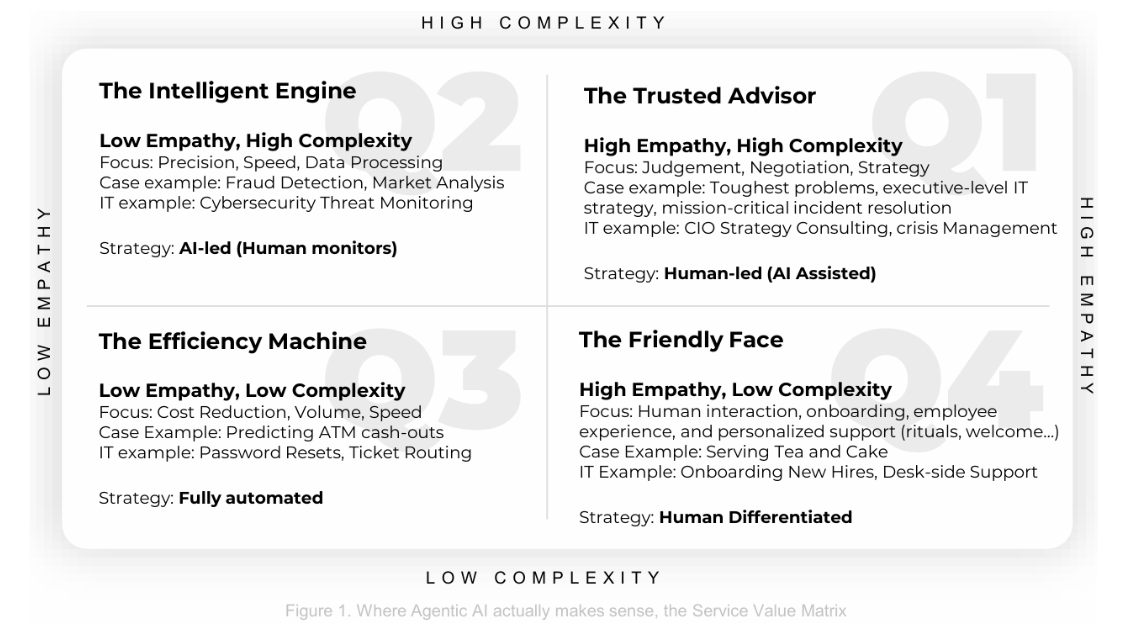
Image source: Atos - Service Value Matrix
Brief: Atos published an 18-page white paper on enterprise-grade agentic AI, as the technology advances rapidly but enterprises still face challenges around defensible value, security, sovereignty, and scaling in production.
Breakdown:
Introduces a “Services as Software” blueprint using Atos’ Sovereign Agentic Studio to turn workflows into software-driven outcomes.
Defines a trust control plane with runtime governance, zero-trust access, behavioral security, kill switches, observability, and audit trails.
Explains sovereignty by design while embedding AgentOps and FinOps from day one with unit economics, and strong data readiness.
Includes do's and dont's for scaling agentic AI and a production case study on incident resolution, showing how autonomy can scale with control.
Why it’s important: Most agentic AI efforts fail when moving from demo to production due to gaps in governance, security, and cost discipline. This framework provides a path to scale autonomy, aligning deployments with enterprise risk, compliance, and economic accountability requirements.
MARKET & BEST PRACTICE INSIGHT

Image source: IBM
Brief: IBM, with Palo Alto Networks, published a 40-page report drawing on a survey of 1,000 C-level executives to examine how enterprises secure AI-driven operations and how AI itself is being deployed to strengthen security.
Breakdown:
Firms are rapidly embedding AI, expanding attack surfaces. 61% report AI models, data, or assets have already been compromised.
AI-powered threats are accelerating faster than defenses. Legacy security models cannot be retrofitted to address new AI-specific risks.
80% of leaders cite the need for stronger integration across hybrid cloud, AI, and security environments to support AI at scale.
A leading 24% are integrating AI across operations and security, supported by mature governance and exposure management.
Why it’s important: Achieving secure AI at scale requires new thinking and action on four fronts: Robust AI asset governance, an integrated AI-first operations and security environment, a mature AI exposure management posture, and a strategically aligned security ecosystem.
BEST PRACTICE INSIGHT
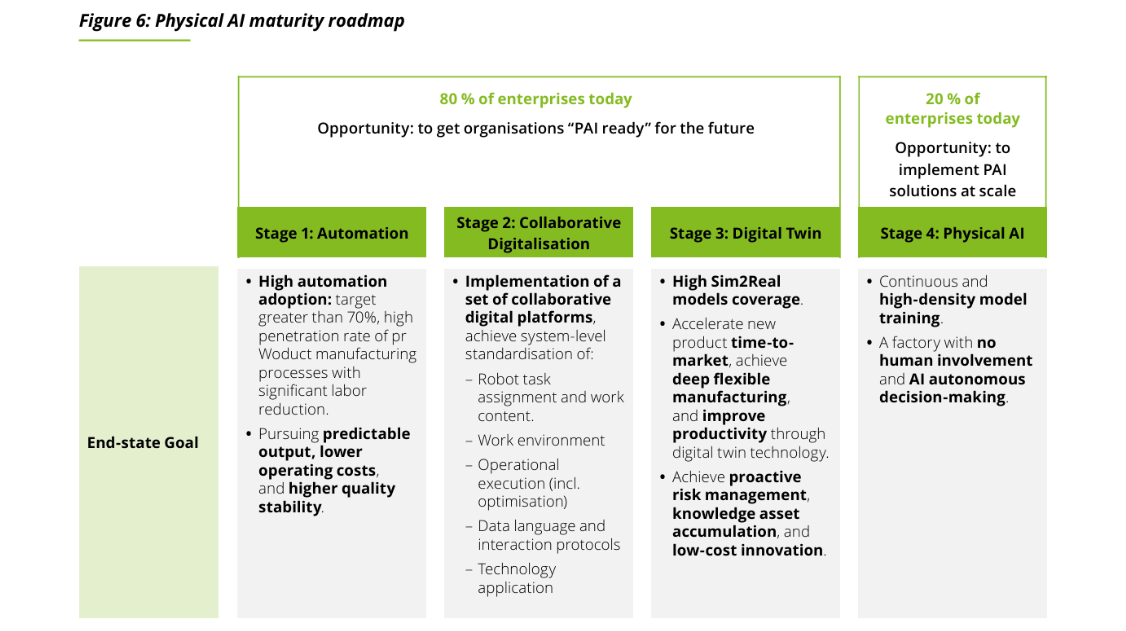
Image source: Deloitte
Brief: Deloitte China published a 13-page paper outlining a practical framework for leaders adopting Physical AI (PAI): where to start, how to sequence investment, and which organisational foundations are required to enable value.
Breakdown:
PAI’s shift to commercial reality is driven by converging advances, including lower multimodal sensor costs and a 60% gain in precision.
BYD’s Xi’an robotic factory runs at ~97% automation, with AI-guided robots and autonomous mobile robots.
The evolution from rigid machinery to truly autonomous, adaptive physical systems follows four maturity stages (image above).
The paper also details the PAI technology stack, a three-layer value model, and questions every leader should be asking now.
Why it’s important: PAI is no longer a question of if or when, but readiness. With 41% of leaders expecting transformational impact within three years and adoption forecast to grow sixfold in two, the window to establish the right operational and technical foundations is rapidly narrowing.
BEST PRACTICE INSIGHT
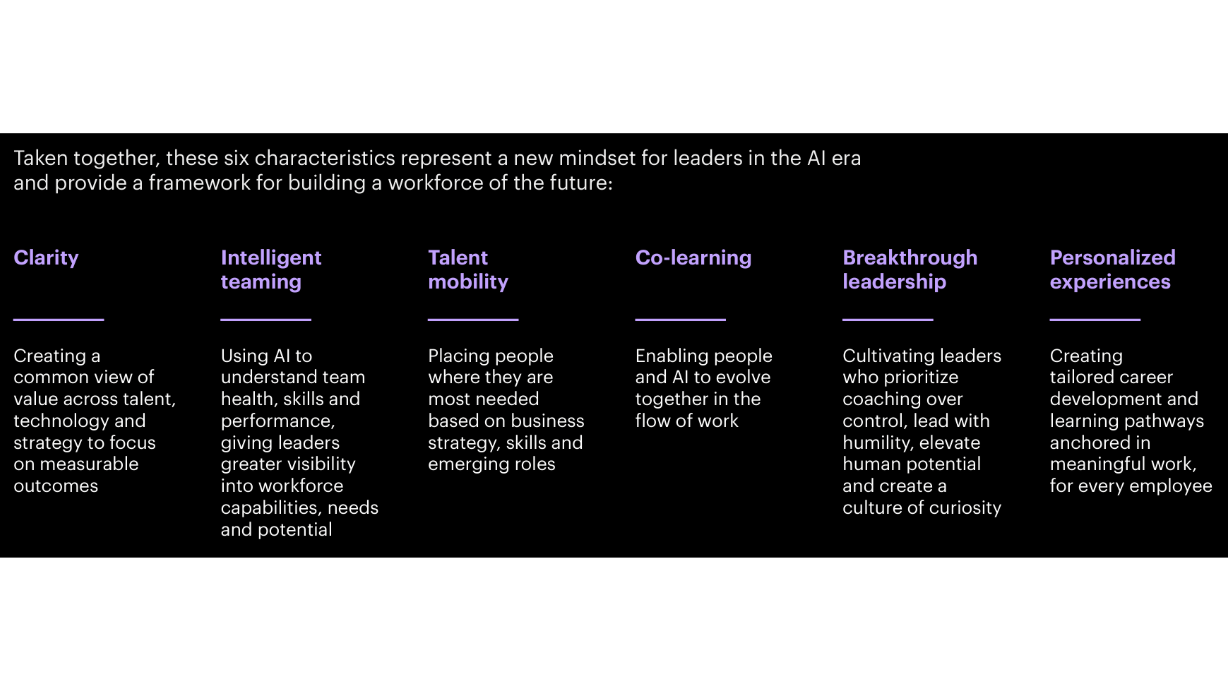
Image source: Accenture
Brief: Accenture published a 54-slide report drawing on surveys of 1,320 C-suite executives and 4,560 employees, identifying an elite 18% of organisations, “Talent Reinventors,” that take a distinct approach to talent.
Breakdown:
Talent Reinventors outperform peers, delivering 1.4% higher profit growth and being 7x more likely to strengthen organisational culture.
The differentiator is an integrated human–AI talent strategy built on six workforce characteristics that shape how talent evolves (image above).
While most firms show strength in select areas, Talent Reinventors stand out by unifying all six characteristics into a cohesive system.
The report highlights real-world success, with case studies from Volkswagen, Microsoft, Caterpillar, Merck, and BASF Group.
Why it’s important: Organizations that find the right balance between humans and AI will attract and retain the best talent and continue to outpace their peers. Firms will tell you it takes effort to reinvent your talent strategy, but the gains are impossible to ignore.
BEST PRACTICE INSIGHT
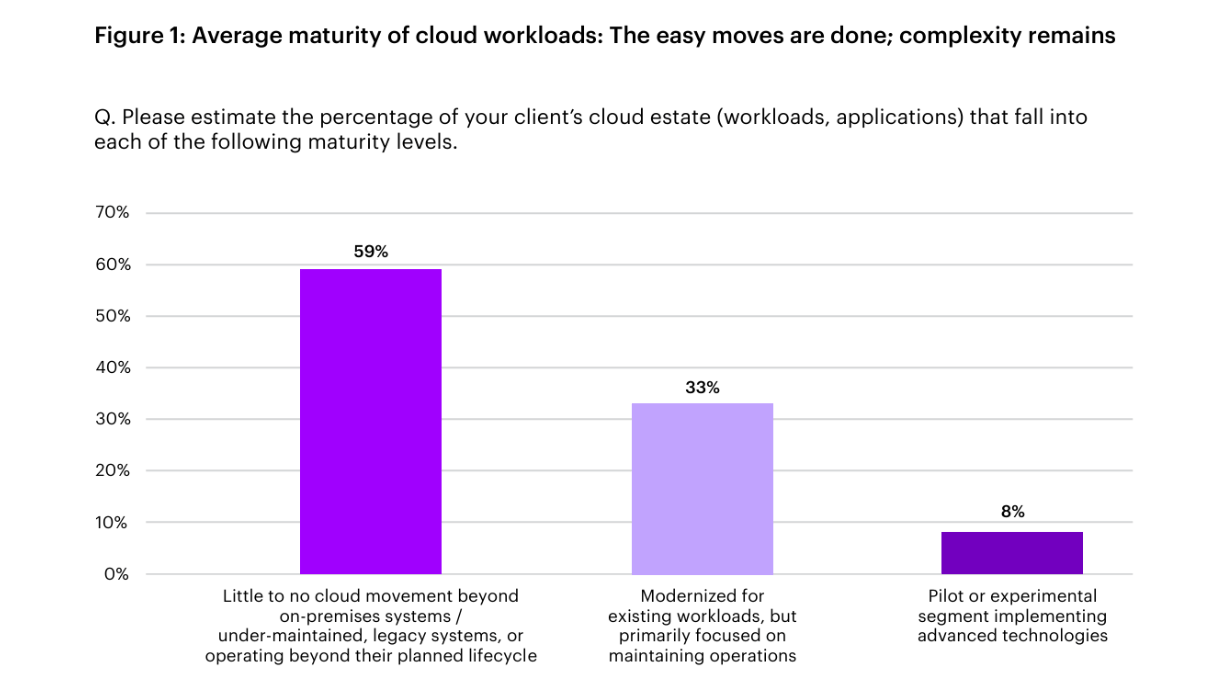
Image source: Accenture
Brief: Accenture published a 34-slide report on how AI is redefining the role of cloud as the foundation for enterprise advantage, outlining “no-regret moves” firms should take now to ensure their cloud environments are AI-ready.
Breakdown:
Many firms treat cloud transformation as complete once scalability, resilience, and uptime targets are met and signed off.
In reality, there is more cloud ahead than behind, as AI accelerates across generative, agentic, and physical domains.
Accenture finds 59% of workloads remain on-premises or in ageing systems, with only 8% dedicated to advanced tech.
The report outlines strategies (stabilizers, optimizers, innovators) to progress toward the level of cloud maturity that allows for AI reinvention.
Why it’s important: Scaling AI requires a resilient, adaptable digital core with cloud at its centre. Rather than a single destination, cloud now spans public, private, hybrid, multi-cloud, sovereign, and edge environments, where workload placement is driven by latency, regulation, risk, and cost.
BEST PRACTICE INSIGHT
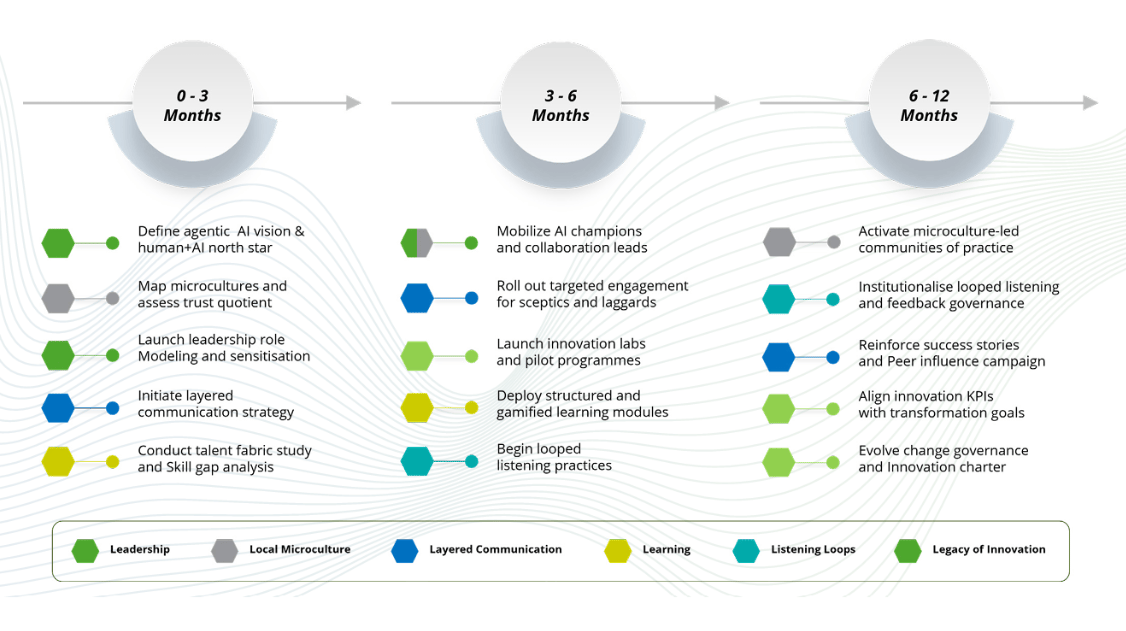
Image source: Deloitte
Brief: Deloitte shared its AgenticAdopt Kompass™ framework, outlining six interconnected pillars that guide firms through the agentic AI journey, ensuring alignment, adaptability and impact at every stage of AI change.
Breakdown:
The framework pillars include leadership for strategic alignment and local microcultures to build trust and adoption.
It highlights layered communication for explainability and learning models focused on role design in agentic workflows.
Listening loops enable human-in-the-loop feedback, while “legacy of innovation” supports simulation environments for testing agentic AI.
These pillars are activated across transformation stages, guiding organisations through adoption and scale-up (image above).
Why it’s important: This framework outlines strategies for CXOs to build trust, embed governance, and lead the agentic AI shift as a human-centred evolution. In this era, success will not be defined by how much AI can do, but by how humans and AI evolve together.
PLATFORM STRATEGY

Image source: Kearney
Brief: Kearney explored the emerging agentic AI software infrastructure market, outlining how the stack is forming, and where investors and enterprises can find value as the ecosystem matures.
Breakdown:
Like the shift from on-premises software to SaaS between the late 1990s and mid-2010s, agentic AI is introducing a new software delivery model.
The emerging agentic AI infrastructure landscape can be broken into functional layers/components forming a new stack (image above).
Agent development reflects a shift combining prompt engineering with conventional software development practices.
The report outlines eight investment theses from agentic AI as a service to operations, governance, and risk management converging.
Why it’s important: An attractive long-term strategy is assembling an integrated agentic stack over time: begin with an orchestration anchor, add governance and registries, layer financial controls, expand through MCP and integrations, and extend into agentic marketplaces as the ecosystem matures.

Image source: McKinsey & Company
Brief: McKinsey outlined how sovereign AI can only be achieved by linking energy, compute, data, models, platforms, and applications across governments, enterprises, investors, and providers.
Breakdown:
Sovereign AI refers to a nation’s or firms ability to control its own AI capabilities, ensuring alignment with domestic values and laws.
Drawing on a survey of enterprises, providers, governments, and investors, McKinsey outlines the roles ecosystem actors should play.
The report highlights partnership models that consistently outperform, and a practical roadmap for building sovereign AI capabilities.
Sovereign AI is best viewed as a spectrum of solutions distributed across different tiers of sovereignty (image above).
Why it’s important: Governments, enterprises, and investors increasingly view control over AI capabilities as central to competitiveness, resilience, and trust. Yet despite this urgency, many sovereign AI initiatives are stalling and failing to deliver their expected results.
BEST PRACTICE INSIGHT
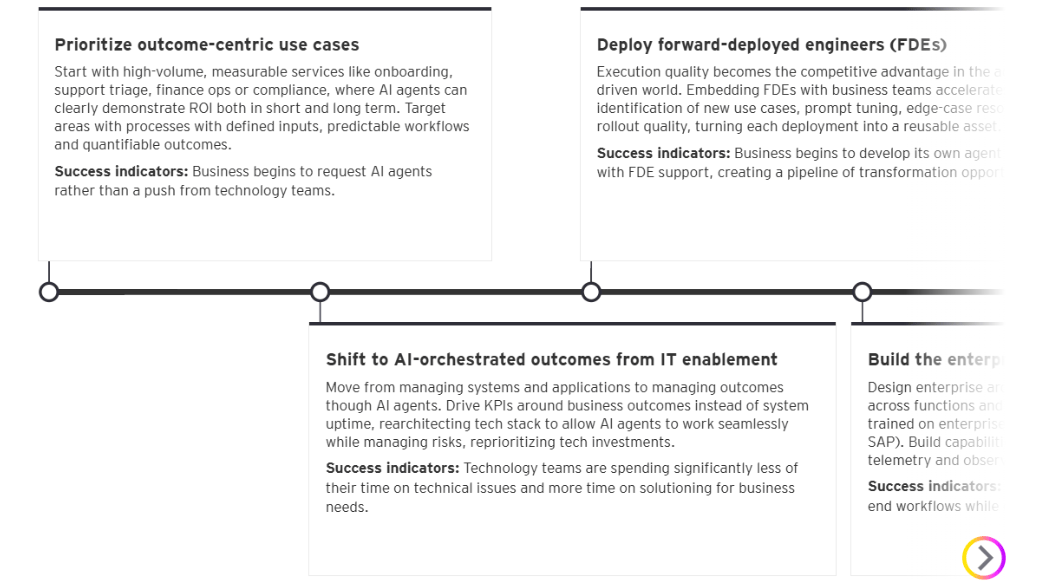
Image source: Ernst & Young
Brief: At a recent EY Center for Executive Leadership gathering of 30 leading technology executives, EY highlighted agentic AI as the next catalyst for CIOs to evaluate as they consider strategy and procurement decisions.
Breakdown:
More firms are deploying agents to analyze large datasets, accelerate insight generation, and deliver natural, conversational outputs.
Enterprise capabilities can sit on a lean agentic AI layer that interfaces directly with core systems, with human oversight guiding decisions.
Bringing agentic workforces to life requires a structured, cross-functional playbook; EY outlines eight stages, each with success indicators.
Leaders should prioritize outcome-centric use cases, deploy forward-deployed engineers, redesign pricing around results, and more.
Why it’s important: Agentic AI is transforming enterprise architecture by transforming static services into dynamic, self-directed software capabilities. Firms should design for autonomy, orchestrate around outcomes, and compete on speed, adaptability, and scalable value realization.
MARKET INSIGHT

Image source: Boston Consulting Group
Brief: BCG drew on two complementary surveys, over 115 enterprise executives and 75+ technology services leaders, to show how autonomy is transforming delivery economics and unlocking new growth pathways.
Breakdown:
Agentic AI presents both disruption and growth for providers, as autonomous systems alter delivery models and business outcomes.
Efficiency gains may compress some traditional services, but BCG estimates up to $200B in net new value pools over five years.
One-third of enterprises are already scaling agentic AI, while two-thirds expect technology services providers to build and run priority use cases.
Providers see rising demand, yet report readiness gaps across enterprise priorities, efficiency commitments, and commercial models.
Why it’s important: Together, these perspectives reveal a market in transition. Providers that act decisively, reshaping portfolios, delivery models, and talent, can capture the next wave of value creation. Those that delay risk losing relevance as enterprises accelerate agentic adoption.
SOFTWARE STRATEGY

Image source: Cathay Capital
Brief: Cathay Capital examined the agentic AI B2B software opportunity, outlining what is being disrupted, why Systems of Record remain foundational to agentic architectures, and where incumbents hold structural advantages.
Breakdown:
SaaS is a subscription business model, not a product category or technical architecture, and that distinction is central to the debate.
The disruption targets UI-first design, seat pricing and feature-led releases, not the recurring revenue model itself.
Agents require structured data, permissions and compliance frameworks housed in core Systems of Record (ERP, CRM etc.)
Cathay outlines a three-layer agentic SaaS architecture: System of Record, Context, and Agentic, to capture value and the user relationship.
Why it’s important: Established B2B SaaS providers that own strong Systems of Record and deep domain expertise are not automatic casualties of the agentic shift. They are positioned to benefit, if they evolve their product architecture, pricing models and culture.
BEST PRACTICE INSIGHT

Image source: Ernst & Young
Brief: EY outlined how AI-first managed services transform critical functions from cost centers into strategic enablers, helping organizations close readiness gaps and apply proven frameworks to scale AI adoption.
Breakdown:
Technological disruption and a multipolar geopolitical landscape are accelerating change beyond what traditional operating models can sustain.
Many organizations struggle to realize AI’s potential in core functions due to readiness gaps in skills, data, and change management.
EY identifies three modernization pathways: in-house execution, full-service outsourcing, or a collaborative hybrid model.
The hybrid model gives organizations the benefit of managed services capabilities without relinquishing control.
EY presents a structured framework guiding AI adoption, from strategy through to scaling and ongoing maintenance (image above).
Why it’s important: The global services economy is being transformed by technological disruption and geopolitical fragmentation. To remain competitive, organizations should reinvent operating models, diversify revenue streams, and strengthen resilience across increasingly complex value chains.
CXO INSIGHT
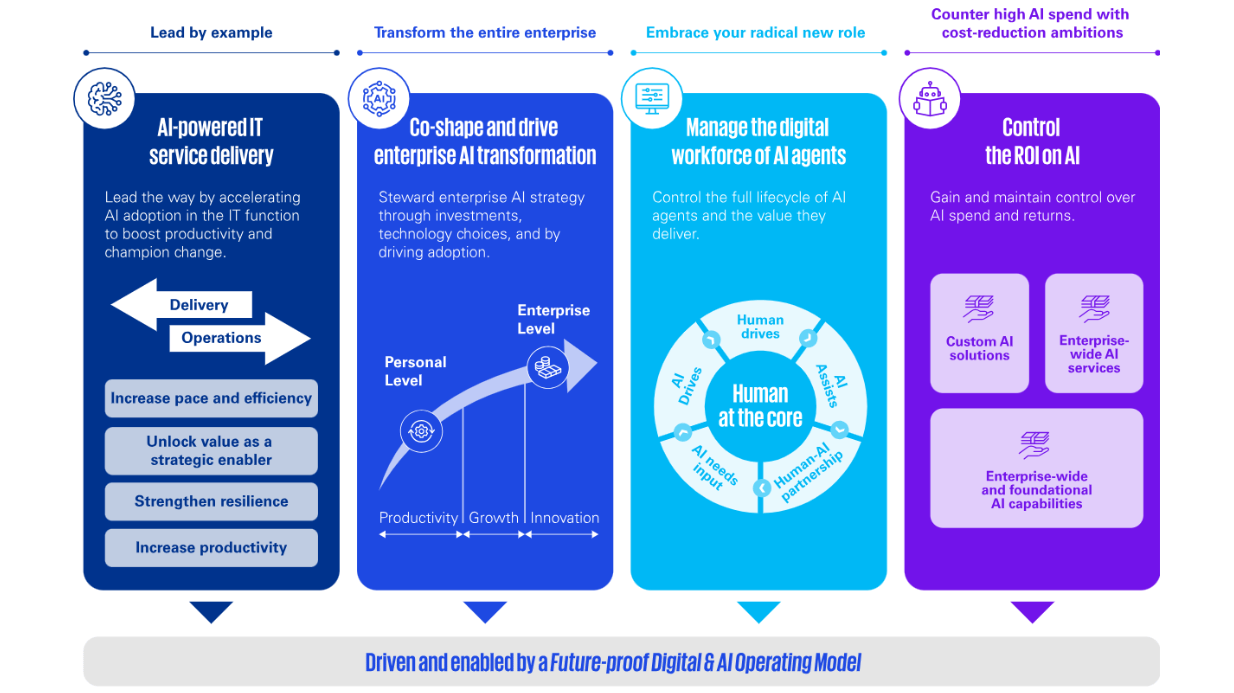
Image source: KPMG
Brief: KPMG outlined how for many enterprises the CIO has become central to translating AI ambition into value, steering human-centered adoption across the entire organization.
Breakdown:
To unlock AI value enterprise-wide, technology leaders should embrace four roles that influence the target operating model.
Enhance IT service delivery with AI-driven productivity use cases to deliver value quickly and build enterprise credibility.
Evolve from platform provider to co-strategist by shaping governance, data foundations, cross-function portfolios, and AI standards.
Establish a digital labor model defining how AI agents are onboarded, governed, trained, monitored, and integrated with human roles.
Act as guardian of AI investment by tracking spend, validating savings, and ensuring productivity gains translate into leverage.
Why it’s important: IT can accelerate enterprise AI adoption by aligning strategy, governance, and human-centered change under a unified operating model. Without coordinated leadership, fragmented initiatives create duplication, increase risk exposure, and undermine long-term value.
BEST PRACTICE INSIGHT

Image source: Bain & Company
Brief: Bain outlined how unlocking AI’s exponential productivity requires modernizing workflow and workforce in tandem. Without both, AI investments risk delivering incremental gains rather than enterprise-wide transformation.
Breakdown:
Despite billions invested in AI, most companies are seeing limited gains, such as faster reporting and narrow productivity lifts.
The missing link is aligning workflow modernization with workforce modernization through process reengineering and targeted tech.
The two are inextricably linked but when people impact is treated as downstream change management, AI stalls at micro-productivity gains.
Firms taking a human-centric approach to productivity deliver 2.3 times higher total shareholder returns.
Why it’s important: AI is more than just another technology cycle; it is a leadership test. Firms that pay down workflow debt, and apply AI with discipline while modernizing talent in parallel will outperform peers. Those that separate technology change from workforce strategy risk unrealized value.
MARKET INSIGHT

Image source: Cloud Security Alliance and Google Cloud
Brief: Google commissioned the Cloud Security Alliance to survey 300 IT and security leaders on AI security and governance as generative and agentic systems increasingly scale in production.
Breakdown:
Firms with formal AI governance are twice as likely to adopt agentic AI and twice as confident in protecting AI systems.
Security teams are early AI adopters, with over 90% testing or planning use cases across threat detection, red teaming, and access control.
Enterprises pursue multi-model strategies, averaging 2.6 models, yet usage is concentrated around Gemini, Claude, GPT, and LLaMA.
Executive enthusiasm remains strong, but 72% report low or neutral confidence in their organization’s ability to secure AI.
Why it’s important: The findings highlight a widening divide: organizations with mature AI governance are accelerating adoption with confidence, while others advance without adequate safeguards. As AI shifts from pilots to production, governance maturity is becoming a key predictor of success.
ENTERPRISE TRANSFORMATION

Image source: The Conference Board
Brief: The Conference Board published a 17-page report outlining how leaders should transform their organizations to maximize AI value, drawing on surveys of 214 enterprise leaders and 704 professionals.
Breakdown:
Sustainable AI transformation requires an AI strategy that aligns leaders with business goals and enables innovation in how work is executed.
Scaling AI successfully demands redesigned organizational structures and processes, agile teams, and seamless information flow.
HR plays a critical role in AI transformation by shaping culture, building skills, and driving people-centered change management.
A strong AI culture depends on transparency, inclusion, and shared purpose to support experimentation and collaborative co-creation.
Navigating AI transformation complexity requires ongoing upskilling, workforce planning, and flexible reward systems.
Why it’s important: The future is uncertain, requiring organizational agility to pivot as new technologies and opportunities emerge. This agility should be mirrored in the enterprise operating model, building flexibility into structures, processes, and governance.
EXECUTIVE COMPENSATION

Image source: Equilar
Brief: Equilar, a leading provider of corporate leadership data, examined corporate disclosures to assess how companies are currently integrating AI metrics into executive compensation programs.
Breakdown:
Most firms adopting AI metrics have embedded them in annual incentive plans, though Qorvo applies them within its long-term incentive plan.
Qorvo disclosed a fiscal 2025 long-term incentive goal tied to exploring and deploying AI tools aimed at improving productivity across the firm.
Juniper Networks included a strategic objective in its annual incentive plan to “win the AI opportunity,” weighted at 10% (image above).
Juniper defined this goal around executing its AI strategy across networking/data centers, linking AI execution to revenue growth.
Ralph Lauren excluded AI metrics from its latest plan but announced plans to introduce AI scorecard metrics into executive incentives.
Why it’s important: Although still early in the AI adoption curve, firms are increasingly embedding AI goals into executive incentives. Objectives now span efficiency, revenue growth, and competitive positioning, signaling that AI performance metrics will become more common in 2026 and beyond.
MARKET INSIGHT
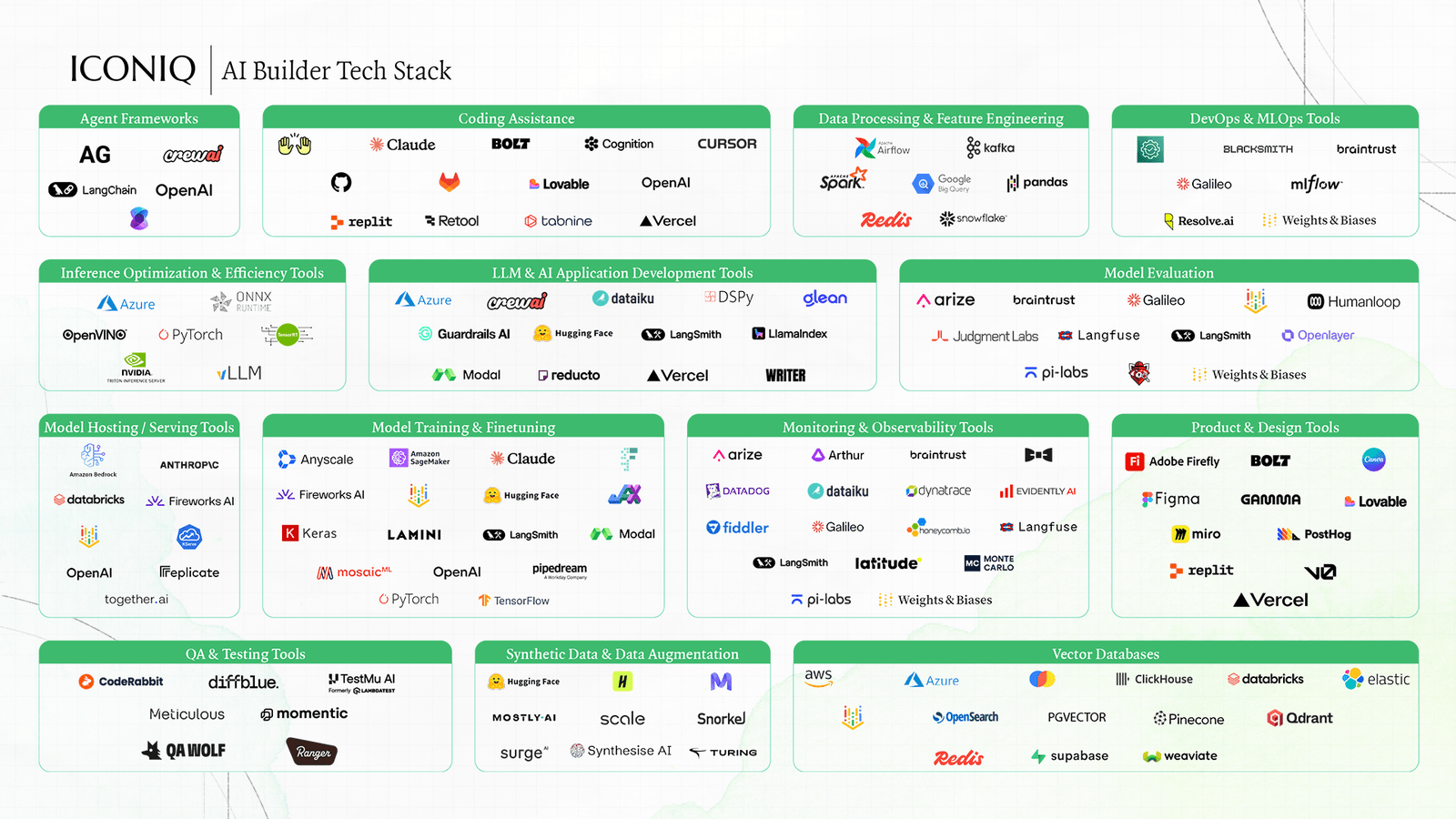
Image source: ICONIQ Capital
Brief: ICONIQ published its bi-annual State of AI report, surveying 300 executives building AI products to understand how teams are approaching model strategy, product differentiation, agentic workflows, and monetization.
Breakdown:
49% of firms report their primary differentiation comes from the application-layer rather than proprietary model development (14%).
Builders now use an average of 3.1 model providers, up from 2.8 six months ago, reflecting cost, latency, and performance considerations.
Subscription pricing remains common at 58%, but consumption-based (35%) and outcome-based (18%) pricing have grown meaningfully.
Use cases such as coding assistance, testing, documentation, and content generation show the highest time savings (30-40%+).
The AI tooling ecosystem is maturing around the most widely adopted tools for AI product development (image above).
Why it’s important: Advantage is accruing to teams that can scale AI reliably in production, control costs, and integrate it deeply into workflows that matter. AI leadership in 2026 will hinge on disciplined execution across product, cost, trust, and go-to-market.
MORE MUST-READ BREAKDOWNS
AI for Board Directors (15 playbooks)
AI for CXOs (32 playbooks)
AI Use Case Prioritization (12 frameworks)
Agentic AI Case Studies (40 cases)
AI Strategy Playbooks (16 playbooks)
AI Agents & Agentic AI Use Cases (2,195)
ENTERPRISE AI EXECUTIVE
Agentic and generative AI are evolving rapidly in the enterprise, driving a new era of AI transformation.
Twice a week, we review hundreds of the latest agentic and generative AI best practices, case studies, market dynamics and innovations to bring you what is driving material value — and why it’s important.
Example editions:
Deloitte's agentic enterprise 2028 blueprint.
OpenAI's best practices from 300 implementations.
What board directors need to know.
The next trillion-dollar opportunity.
Found this valuable? Share with a colleague.
Received this from someone else? Sign up here.
Connect on LinkedIn.

Lewis Walker, Editor