- Enterprise AI Executive
- Posts
- 15 AI playbooks for board directors
15 AI playbooks for board directors
Plus, key takeaways to help you level up fast.

Lewis Walker
January 06, 2026

Welcome executives and professionals. We are at a pivotal moment in the history of human invention, as board members and management teams work to harness the potential of AI.
However, these opportunities carry significant risks and responsibilities, and the decisions leaders make today will shape their firms and society.
To help you stay ahead and save time, I’ve distilled the key takeaways from 15 top AI boardroom playbooks published in the past year.
AUSTRALIAN INSTITUTE OF COMPANY DIRECTORS
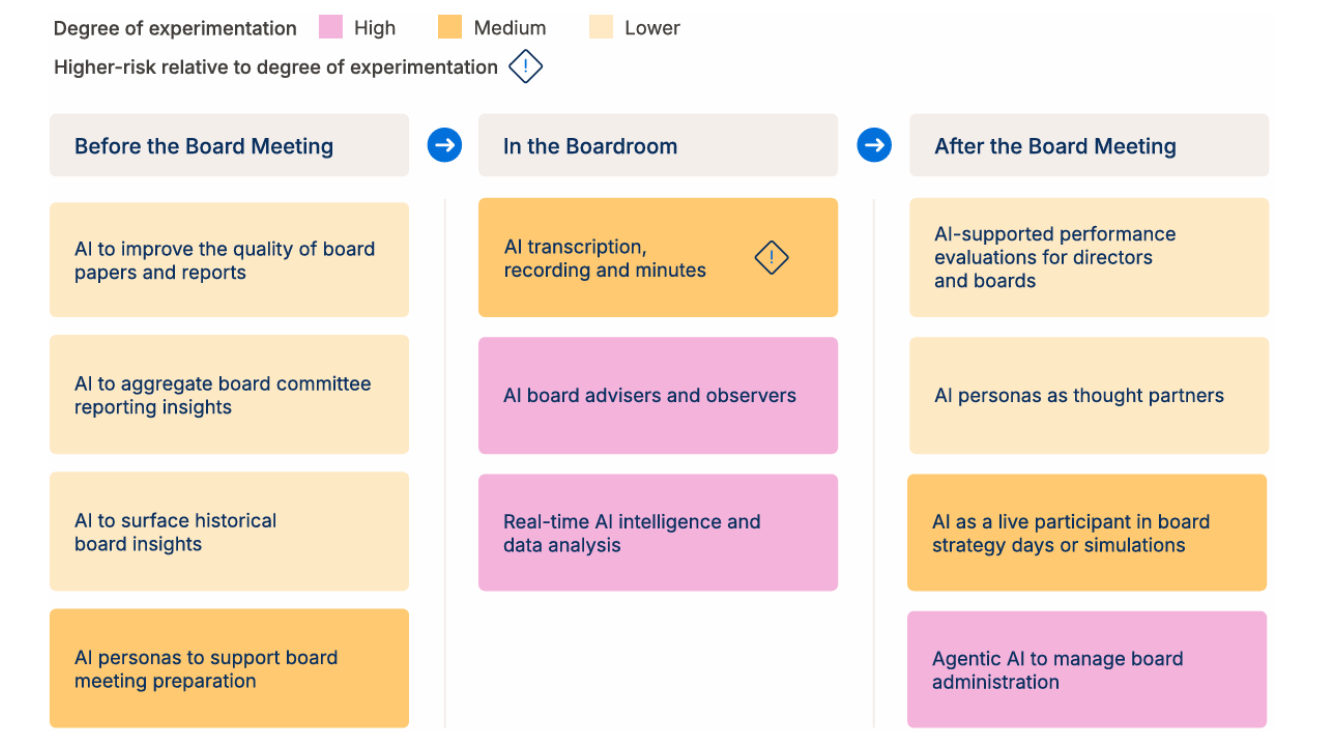
Image source: Australian Institute of Company Directors
Brief: The Australian Institute of Company Directors published a 28-page report outlining how boards and directors can use AI, detailing practical use cases, the potential impacts on board roles as well as wider dynamics.
Breakdown:
Before board meetings, AI can improve reports, aggregate insights, surface historical decisions, and act as a preparatory persona.
In the boardroom, AI can support transcription and minutes, act as an advisor or observer, and offer real-time intelligence and data analysis.
After board meetings, AI can support performance evaluations, aid strategy simulations, and help manage board administration.
The report notes a two-speed dynamic at play, with collective formal board use of AI lagging ‘shadow’ individual director use.
It provides guidance for using AI alongside human judgment, ensuring decisions stay within the limits, purpose and role of the board.
Why it’s important: As organizations embed AI into operations and business strategy, conversations in boardrooms are shifting from ‘how do we govern AI’ to ‘how can AI help us govern?’ This report aims to prompt directors to assess where AI can enhance the practice of directorship, today and in the future.
INFOSYS

Image source: Infosys Knowledge Institute
Brief: Infosys Knowledge Institute surveyed 300 board members from North American firms generating over $1 billion in revenue, examining how boards define and oversee enterprise AI strategy and implementation.
Breakdown:
72% of boards now receive AI updates regularly, while 14% review AI progress and risks at every meeting, signaling growing oversight.
Many directors now feel better informed on AI and emerging tech than on geopolitical, economic, or regulatory developments.
Despite threats (graph above), only 14% of boards express high concern about reputational damage from failures like AI errors.
While 29% have approved enterprise-wide AI plans, most boards (55%) rely on department-level initiatives without unified KPIs.
46% of boards oversee explainable AI decisions directly, while half delegate this responsibility to management teams.
Why it’s important: AI complicates the role of corporate board members by introducing new layers of complexity to already high-stakes decisions. Unlike financial cycles, competitive threats, or regulatory shifts, each with long histories, AI is advancing at a frenetic, less predictable pace.
STANFORD

Image source: Stanford Hoover Institution
Brief: Stanford's Hoover Institution released a 5-page brief detailing how AI will reduce information asymmetry between management and directors, and alter the process by which boards fulfil their governance obligations.
Breakdown:
AI will enhance scenario planning, risk analysis, and investment prioritization in-house, reducing reliance on consultants and cutting costs.
Improve compensation committee pay benchmarking, predict proxy advisor recommendations, and assess tax/legal impacts faster.
Enhance audit committee fraud surveillance, internal controls, reasonableness checks, and balance automation vs. human oversight.
Identify workforce skill gaps and forecast capacity needs. Monitor legal and regulatory changes, including lawsuits and enforcement actions.
Track and assess board effectiveness in time allocation, focus, and balancing reactive vs. proactive decision-making.
Why it’s important: While boards recognize the vast potential of AI, it's important to consider how it can reshape board operations and practices itself, with the prospect of substantially improving corporate governance quality in how boards function, process information and interact with management.
DELOITTE

Image source: Deloitte
Brief: Deloitte published its AI Governance Roadmap, a 16-slide guide, to help boards understand their role in AI governance. It explores key questions and resources for overseeing AI, regardless of the organization's AI maturity.
Breakdown:
Evaluate AI approach within corporate strategy, oversee execution, and help management adapt strategy to AI risks and opportunities as needed.
Oversee AI risks (strategic, functional, and external) to the company’s overall strategy, integrating them into the enterprise risk program.
Define oversight ownership at the board level (e.g. the full board, sub-committee etc.). Consider an AI advisory council or adding an AI-expert.
Monitor performance against AI-specific strategic, financial, and operational goals. Establish a consistent evaluation process.
Assess if management has the skills to execute the AI strategy and cultivate trustworthy AI with appropriate disclosures/comms.
Why it’s important: Although AI is not new, the increasingly proliferation of gen AI in enterprises brings governance topics to the forefront. The decisions leaders make today in balancing opportunity and risk will shape their enterprises and society at large for years to come.
DELOITTE

Image source: Deloitte
Brief: AI transformation is still early for many, but a Deloitte survey of 695 board members (84%) and C-suite executives (16%) in 56 countries reveals a growing impetus for action compared to six months ago.
Breakdown:
AI isn't always on the board agenda, but progress is being made: 31% say it's not on the agenda, down from 45% in the previous survey six months ago.
More boards are getting up to speed: 66% say their boards have "limited to no knowledge or experience" with AI, lower than 79% in the last survey.
Time on AI is improving: 33% are “not satisfied” or “concerned” with how much time boards spend on AI, down 13 points from the previous survey.
AI is influencing board composition: 40% say AI made them rethink board makeup, a 4-point increase from the last survey.
The report also highlights key questions for board members and their management teams to help embrace their oversight responsibility.
Why it’s important: Boards are recognizing the need to accelerate AI, embedding it into their agendas and C-suite dialogue. Deloitte’s previously released Strategic AI Governance Roadmap can help boards oversee risks, support ethical use, and navigate the evolving AI landscape.
BOSTON CONSULTING GROUP

Image source: Boston Consulting Group
Brief: BCG explores how intensifying AI competition is accelerating global tech fragmentation. Boards must ask the right questions to help management anticipate threats, prepare for risks, and pivot fast when disruptions hit.
Breakdown:
Tech regulation once focused on consumers and competition. With gen AI, national security and sovereignty are increasingly important.
Even strategies like friendshoring may not insure against disruption with uncertainty around tariffs and limits on allied nations.
Anticipate: Are key inputs/processes exposed to geopolitical risks? What regulatory shifts matter, and how could they disrupt partnerships?
Prepare: Are there adequate prospective technology partners in key regions? What are the tradeoffs between efficiency and tech resilience?
Pivot: What internal processes and mechanisms have been set up to rapidly pivot and execute defensive strategies?
Why it’s important: Geopolitical concerns are top priorities for executives and boards. Boards must recognize their unique role in steering management to prepare for the increasing likelihood of disruption to hardware, software, and data. It all begins with asking the right questions.
IBM
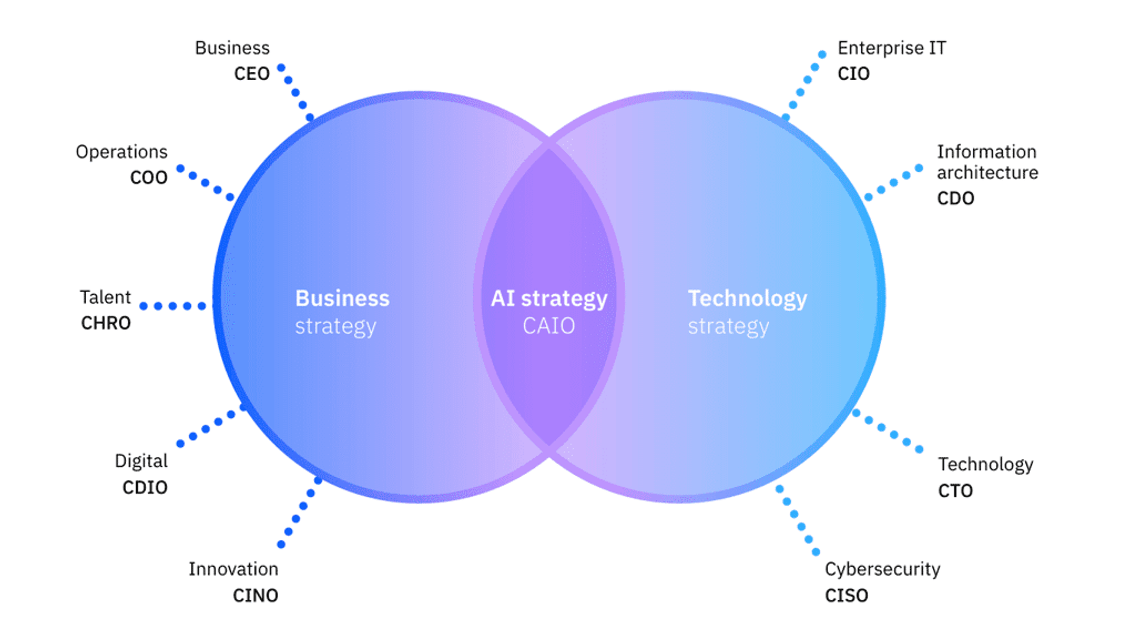
Image source: IBM
Brief: IBM released a 32-page report on how Chief AI Officers navigate complexity, collaborate across the C-suite, and drive transformation to deliver stronger, measurable ROI throughout the enterprise.
Breakdown:
Organizations with a distinct CAIO role, rather than assigning duties to other execs like the CDO, see 10% higher ROI on AI investments.
26% of companies have a CAIO today, up from 11% in 2023. Of these, 57% report directly to the CEO or Board of Directors.
57% of CAIOs were appointed internally, and two-thirds believe most organizations will formalize the role within two years.
CAIOs typically lead AI strategy, manage budgets, and drive enterprise-wide adoption, channeling focus and effort toward AI value.
C-suite collaboration is critical. The report outlines how CEOs, COOs, CHROs, and tech leaders can align efforts to improve AI ROI.
Why it’s important: While C-suite compositions vary by organizational context, IBM research shows that firms with a distinct CAIO role typically achieve stronger AI ROI. As AI becomes more central to competitive advantage, more firms are expected to formalize the role and strengthen C-suite synergies.
The Institute of Directors shared essential AI questions for your next board meeting, covering goals, accountability, regulation, and more.
BCG emphasized the role of boards in driving corporate transformation, articulating that vision, not technology, must drive the mission.
UC Berkeley shared an AI Governance Maturity Matrix to assess and benchmark board-level AI adoption across five core dimensions for boards.
The Institute of Directors published AI boardroom governance guidance, from auditing AI in use to empowering an independent review committee.
KPMG’s Board Leadership Center outlined AI’s pace, direction, and where boards should focus to harness value creation opportunities.
Bain Capital Ventures surveyed its CFO Advisory Board, a community of 50 CFOs, revealing that 79% plan to increase AI budgets in 2025.
EY explored how boards can become more future-focused, elevating efficiency, enhancing effectiveness, engineering simplicity, applying AI, and more.
PwC urged boards to match AI’s velocity, pursue proactive governance, and not forget the human aspect of AI.
MORE MUST-READ BREAKDOWNS
AI for Enterprise Leaders (18 playbooks)
Agentic AI Case Studies (40 cases)
AI Use Case Prioritization (12 frameworks)
AI Strategy Playbooks (16 playbooks)
AI Agents & Agentic AI Use Cases (2,195)
ENTERPRISE AI EXECUTIVE
Agentic and generative AI are evolving rapidly in the enterprise, driving a new era of AI transformation.
Twice a week, we review hundreds of the latest agentic and generative AI best practices, case studies, market dynamics and innovations to bring you what is driving material value — and why it’s important.
Example editions:
Deloitte's agentic enterprise 2028 blueprint.
OpenAI's best practices from 300 implementations.
What board directors need to know.
The next trillion-dollar opportunity.
Found this valuable? Share with a colleague.
Received this from someone else? Sign up here.
Connect on LinkedIn.

Lewis Walker, Editor