- Enterprise AI Executive
- Posts
- Claude Mythos attacks: Executives’ 11-point defense plan
Claude Mythos attacks: Executives’ 11-point defense plan
Plus, Stanford's AI Index, board AI principles, and more.

Lewis Walker
April 15, 2026

Edition in partnership with

Welcome executives and professionals. With the latest frontier AI models, the cost, effort, and level of expertise required to find and exploit software vulnerabilities have all dropped dramatically.
Since the previous edition, we have reviewed hundreds of the latest insights in agentic and generative AI, spanning best practices, case studies, market dynamics, and innovations.
This briefing outlines what is driving material value — and why it’s important.
In today’s briefing:
How to defend against Claude Mythos.
Stanford's 2026 AI Index report.
BCG's five-level physical AI framework.
AI governance principles for boards.
Transformation and technology in the news.
Insights for Executive+ members.
Career opportunities & events.
Read time: 4 minutes.

BEST PRACTICE INSIGHT
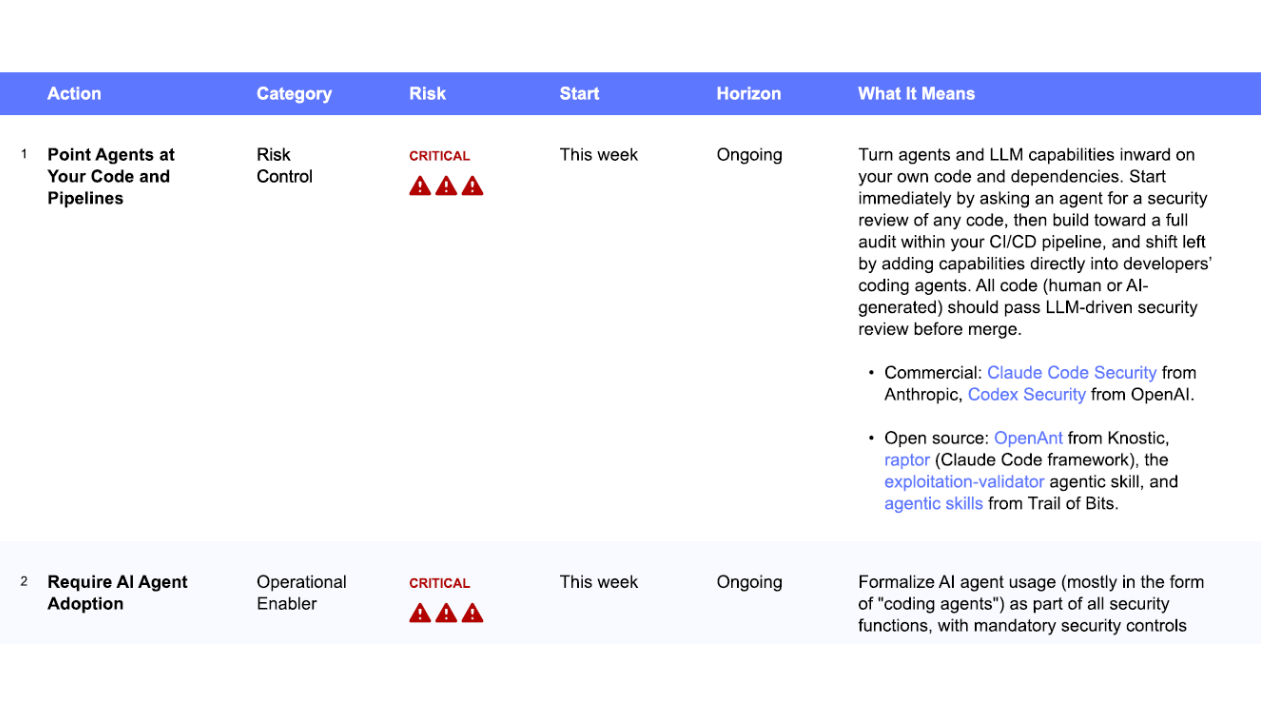
Image source: Cloud Security Alliance
Brief: The Cloud Security Alliance, led by 19 information security executives, released a 29-page expedited briefing on Claude “Mythos-ready” security to defend against complex, automated attacks at scale.
Breakdown:
Anthropic testing showed Mythos generated 181 Firefox exploits, while Claude Opus 4.6 succeeded only twice, a sharp rise in capability.
Security teams are likely to be overwhelmed by rising volumes of AI-discovered vulnerabilities, exploits, and automated attacks.
Organizations should strengthen core defenses, including segmentation, egress controls, multifactor authentication, and layered security.
The report outlines 13 key risks and an 11-point action plan (extract in image above) to help CISOs build more resilient defenses.
Why it’s important: The storm of vulnerability disclosures from Anthropic’s Project Glasswing is the first of many large waves of AI-discovered vulnerabilities. The capabilities seen in Mythos will quickly become more widely available, dramatically increasing the scale and complexity of attacks.
IN PARTNERSHIP WITH ELEVENLABS
Brief: Customer support is broken. And most ‘AI solutions’ make it worse. Rigid chatbots. IVR menus. Customers repeating themselves on every call. ElevenAgents by ElevenLabs takes a different approach.
Deploy an agent in minutes that:
Answers naturally using your own knowledge and SOPs
Creates tickets and transfers to a human with full context
Works in over 70 languages, twenty-four hours a day
MARKET INSIGHT
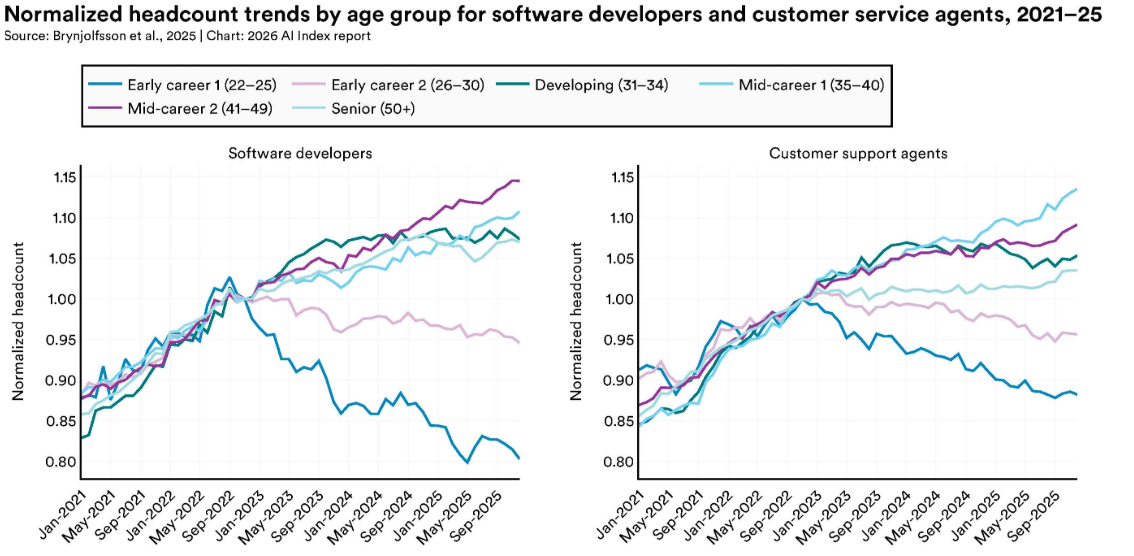
Image source: Stanford University
Brief: Stanford University released its 423-page AI Index, offering arguably the most comprehensive view of AI’s trajectory across the economy, labor markets, infrastructure, responsible development, and beyond.
Breakdown:
AI is driving 14-26% productivity gains in software, while U.S. developers aged 22-25 saw employment fall 20% since 2024.
The US hosts over 10x more data centers than any other country, while global chip supply remains heavily dependent on TSMC.
Robots achieve high success in controlled settings but succeed in just 12% of household tasks, highlighting gaps in real-world performance.
The US leads in AI investment (23x China), but its ability to attract AI researchers and developers has dropped sharply over the past year.
Why it’s important: As AI capabilities accelerate, the systems needed to govern, evaluate, and integrate them are struggling to keep pace. Gaps in policy, infrastructure, and talent readiness risk widening as adoption grows. Closing this gap will be key to ensuring AI delivers sustainable value.
BEST PRACTICE INSIGHT
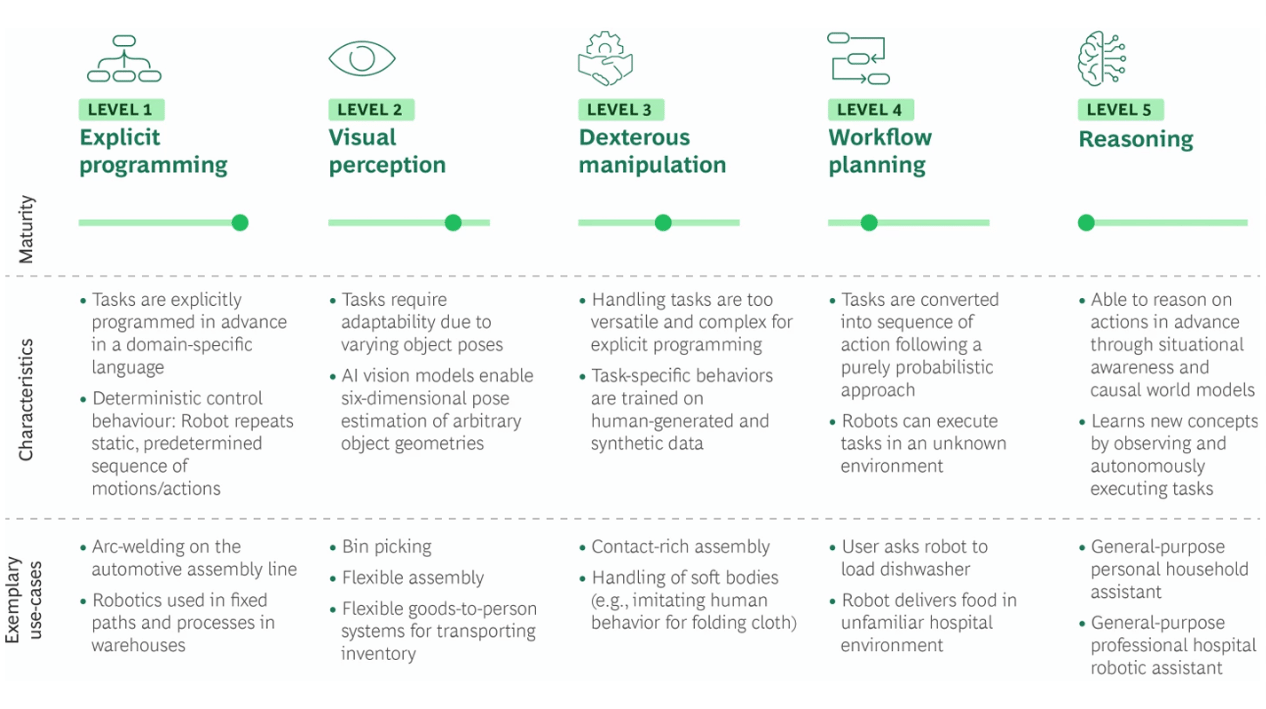
Image source: Boston Consulting Group
Brief: BCG published a 15-page report on how physical AI is reshaping robotics, outlining a framework that helps leaders distinguish proven capabilities from emerging bets and sequence investments with discipline.
Breakdown:
Analyst forecasts for the humanoid robotics market by 2030 range widely, from under 1 million to more than 6 million annual units.
BCG proposes a five-level physical AI framework clarifying what robotic systems can do today, near-term readiness, and long-term bets.
Near-term value is concentrated in Level 2 and 3, where perception and dexterous manipulation are improving automation economics.
General-purpose autonomy in Level 5 depends on causal reasoning advances that remain unresolved and are not yet industrially viable.
Why it’s important: For boards and executives, this is fundamentally a capital allocation challenge. The key risk is misjudging capability maturity, either by overinvesting in immature technologies or underinvesting in already viable ones. Getting this sequencing right will determine who captures value.
IN PARTNERSHIP WITH WONDERFUL

Brief: While 79% of organizations are experimenting with gen AI, fewer than 10% have scaled AI agents. The gap isn’t ambition; it’s execution. The McKinsey-Wonderful alliance aims to help clients close this divide.
The integrated offering:
Leverages McKinsey’s transformation expertise and QuantumBlack AI
Wonderful’s enterprise agent platform and forward-deployed engineers
Transitioning experiments to production-grade deployment
BEST PRACTICE INSIGHT
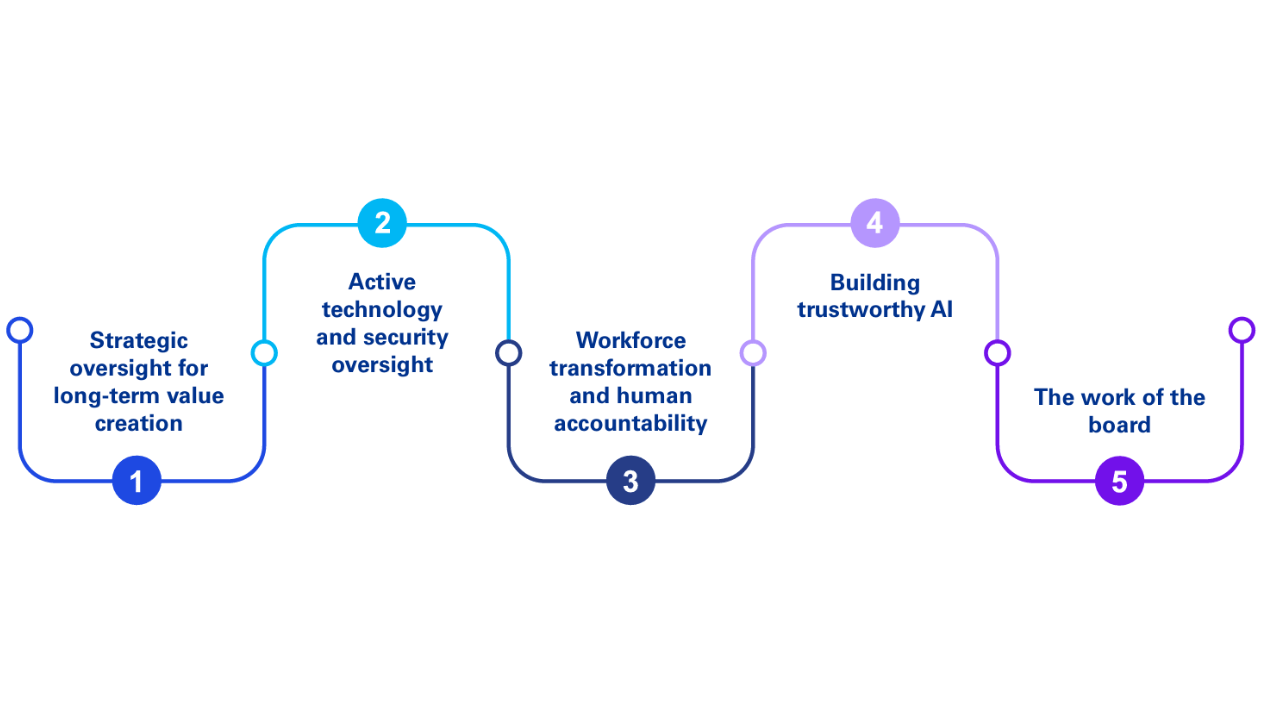
Image source: KPMG
Brief: KPMG published a framework outlining five core principles to guide board-level AI oversight, helping organizations align strategy, governance, and risk management in a fast-moving and increasingly uncertain environment.
Breakdown:
The board oversees development and execution of AI strategy, ensuring alignment with sustainable long-term value creation.
The board oversees AI technology choices, ensuring trade-offs across speed, cost, sovereignty, privacy, safety, and security are evaluated.
The board expects clear AI principles from management, addressing human versus AI roles, and capability building across the firm.
The board ensures trustworthy AI standards and evolves governance, adapting oversight, risk management, and accountability frameworks.
Why it’s important: Co-developed with the INSEAD Corporate Governance Centre and informed by the perspectives of experienced board members globally, the practical principles are designed to help boards ask the right questions, balance opportunity and risk, and strengthen oversight.

HfS outlined how Anthropic is devouring IT services, mapping its enterprise ecosystem as the Claude services land grab accelerates.
BCG explored the rise of autonomous agents, with OpenClaw downloads surging to nearly half a million times a day, pressuring CIO responses.
a16z outlined how companies can navigate AI price wars, highlighting enterprise sales friction and pricing strategy risks.
Bain outlined a phased approach to building agentic architecture, and why trust and data quality become the foundation for agentic AI at scale.
BCG published a paper on turning ESG regulatory complexity into advantage using AI to improve efficiency, reduce costs, and strengthen reporting.
C3 AI announced C3 Code, automating the full application lifecycle by turning enterprise data into governed AI applications fast.

OpenAI introduced GPT-5.4-Cyber, a more permissive model for defensive security, expanding access to thousands of verified defenders.
Nvidia released Ising, an open-source AI model family built for quantum computers, tackling challenges like calibration and error decoding.
Anthropic redesigned Claude Code’s desktop app for multi-session workflows, adding a sidebar, drag-and-drop panes, and an integrated editor.
Microsoft is adding OpenClaw-style features to 365 Copilot, including 24/7 agents across Office apps, with a preview likely at Build in June.
OpenAI CRO Denise Dresser called Anthropic’s $30B run rate inflated, framing it as a single-product firm in a broader platform war.
US Treasury Secretary Bessent and Fed Chair Powell convened CEOs to address cyber risks linked to Anthropic’s Mythos model.

Unlock Executive AI Index: The top 225 AI playbooks, by industry and function, with direct links to each. Updated weekly.
Get the extended version of Enterprise AI Executive, delivered twice weekly.

CAREER OPPORTUNITIES
EY-Parthenon - AI Director
BlackRock - Applied AI Vice President
BNY - AI Vice President
EVENTS
OpenAI ChatGPT for Work - April 22, 2026
Google Cloud Next - April 22-24, 2026
Gartner Data & Analytics Summit - May 11-13, 2026

Reach enterprise AI decision-makers:
66% of readers are C-level executives or VP and Director-level leaders.
63.2% of the audience is based in the U.S., EU, UK, ANZ, and Singapore.
Read by leaders at Microsoft, Deloitte, the Fortune 500, and more.
Guaranteed impression and custom sponsorship packages available, with post-send performance reporting.

Conceived as a practical communication for executives Lewis Walker has worked with, this briefing has become a trusted resource for thousands of senior decision-makers shaping the future of enterprise AI.
We welcome your feedback.

Lewis, Ashley, Mark