- Enterprise AI Executive
- Posts
- Where the money's flowing in enterprise AI
Where the money's flowing in enterprise AI
Plus, long-running agents, API governance, and more.

Lewis Walker
April 12, 2026

Edition in partnership with

Welcome executives and professionals. Most AI adoption insights rely on self-reported usage or surveys capturing sentiment, not hard revenue data showing where enterprise AI spend is actually flowing.
Since the previous edition, we have reviewed hundreds of the latest insights in agentic and generative AI, spanning best practices, case studies, market dynamics, and innovations.
This briefing outlines what is driving material value — and why it’s important.
In today’s briefing:
Where enterprises are actually adopting AI.
Episodic agents to long-running agents.
API governance for agentic AI.
The next frontier in B2B pricing.
Transformation and technology in the news.
Insights for Executive+ members.
Career opportunities & events.
Read time: 4 minutes.

MARKET INSIGHT

Image source: Andreessen Horowitz
Brief: Andreessen Horowitz has been tracking where AI is seeing the most adoption, compiling hard revenue data from leading startups to identify what’s actually working across enterprise AI use cases and industries.
Breakdown:
29% of the Fortune 500 and ~19% of the Global 2000 are leading AI startup customers with signed top-down contracts and live deployments.
Enterprise AI adoption, based on aggregate startup revenue, is dominated by a clear set of use cases and industries.
Coding, customer support, and search dominate enterprise AI use cases, with coding standing out as an order-of-magnitude leader.
Technology, legal, and healthcare sectors are leading AI adoption, demonstrating the highest levels of enterprise spending.
Why it’s important: There has been significant speculation about the extent to which AI has made inroads into large enterprises, but most existing information consists solely of self-reported AI usage or surveys that capture qualitative buyer sentiment rather than hard revenue data.
IN PARTNERSHIP WITH TELEPORT
Brief: Autonomous agents can’t rely on API keys or long-lived credentials anymore. Teleport’s Agentic Identity Framework replaces static secrets with verifiable, cryptographic identity for machine actors at scale.
With Teleport, you get:
Zero standing privileges for autonomous agents
Ephemeral, certified machine identities
Policy-based access control
Reliable, auditable workflow orchestration
Give every agent a verifiable identity. Explore the framework.
BEST PRACTICE INSIGHT

Image source: Bain & Company
Brief: Bain & Company examined AI’s next operating model, charting the shift from episodic agents toward persistent, long-running agents that retain context and operate across workflows.
Breakdown:
Most AI agents operate episodically, completing bounded tasks on demand but losing context between sessions, limiting productivity.
Long-running agents maintain goals, preserve decisions, and accumulate domain knowledge across extended workflows.
Persistence shifts economics: value comes from context retained, rework reduced, and knowledge built, making AI a compounding asset.
Persistence raises the governance stakes: Organizations must address memory hygiene, permissioning, and knowledge portability.
Why it’s important: Most firms should not treat long-running agents as ready for broad deployment yet, but they should begin learning now. Start with workflows that fail when context is lost over time, such as customer escalations, sourcing events, clinical coordination, claims processing, and legal matters.
BEST PRACTICE INSIGHT
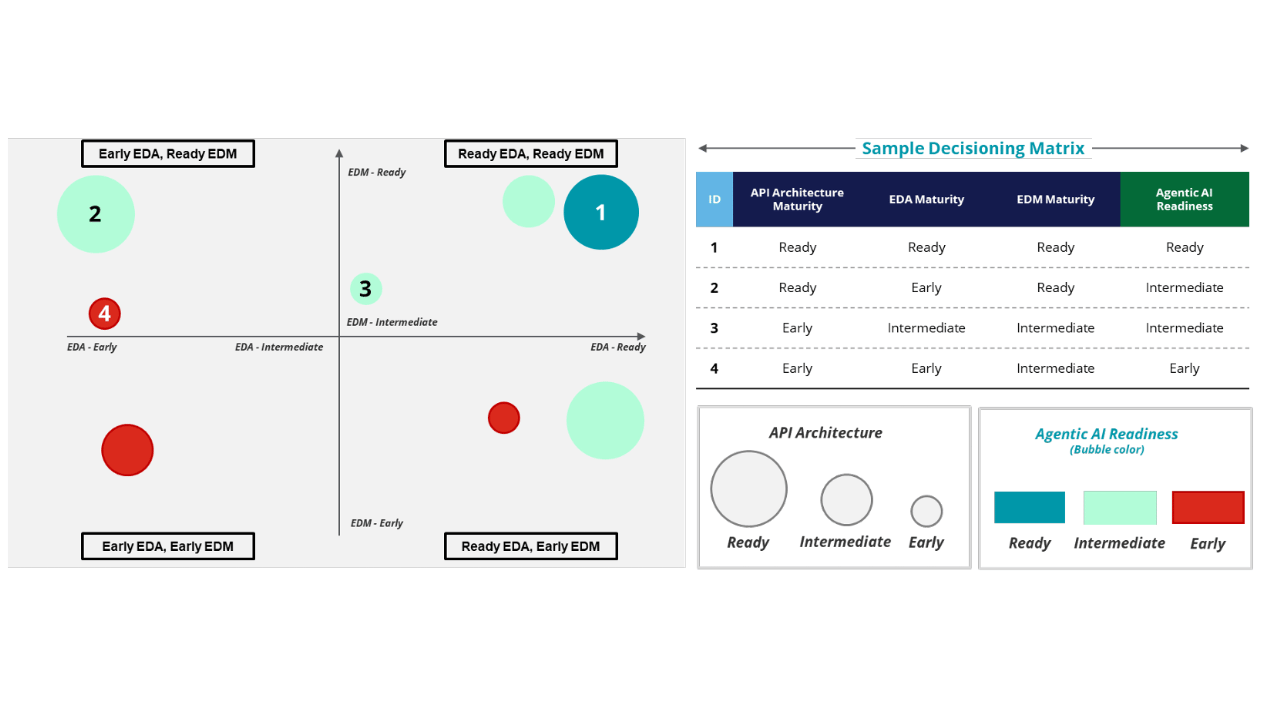
Image source: Deloitte
Brief: Deloitte published a 12-page report on why API implementation maturity matters for agentic AI adoption. APIs serve as the control layer, connecting AI to enterprise data, applications, and workflows.
Breakdown:
An agentic AI enterprise embeds agents into core business processes and decision-making, driving autonomy.
Mature APIs give agents reliable, governed access to data and services, enabling execution of complex tasks with greater speed and consistency.
An enterprise data model (EDM) unifies core entities and relationships, reducing silos and enabling consistent integration.
Event-driven architecture (EDA) allows AI systems to respond to business events in real time, dynamically triggering actions as conditions change.
Why it’s important: Agentic AI is scaling fast and brittle integrations won’t keep up. A clear enterprise application program interface (API) strategy standardizes how APIs are designed, published and reused, so AI integration can move from pilots to production.
MARKET & BEST PRACTICE INSIGHT

Image source: McKinsey & Company
Brief: McKinsey explored how agentic AI promises a fundamental shift in how B2B pricing is set, managed, and optimized to drive a step change in both efficiency and effectiveness.
Breakdown:
Pricing is shifting from human-led processes supported by analytics to AI-orchestrated insights at greater scale and consistency.
One $15 billion B2B distributor built agentic capabilities onto its analytical AI foundations that included a price adviser and discount manager.
The program delivered 50+ basis points of margin uplift, while compressing value realization from years to weeks.
A survey of 400+ B2B pricing leaders found 65-85% expect to deploy gen or agentic AI within three years, up from 10-30% today.
Why it’s important: If executed effectively, this shift could enable smarter, more precise pricing at a scale and speed that would be difficult to achieve with humans alone. The impact is material: a 1% price increase can drive an 8.7% uplift in operating profit, assuming stable volume.

Kearney published insights on the AI factory, outlining how enterprises can build infrastructure that scales, and compounds value over time.
Bain examined how quantum computing will reshape a few critical problems and how marketers should adapt customer discovery strategies for an AI.
Menlo Ventures explored the shift from vertical SaaS to vertical AI, where software moves from assisting users to reasoning and executing tasks.
Bain explored how industrial automation is undergoing a structural shift, and how AI is bringing both headwinds and tailwinds to the Rule of 40.
OpenAI CRO Denise Dresser discussed the next phase of enterprise AI, reflecting on insights from hundreds of enterprise customers.
BCG published a 32-page playbook for economic affairs government leaders outlining where AI creates value and what is required to build the future.

Meta’s Superintelligence Labs unveiled Muse Spark, a multimodal reasoning model marking the debut of Alexandr Wang’s AI division.
Anthropic launched a public beta for Claude Managed Agents, enabling developers to quickly build agent products without complex backend setup.
Amazon CEO Andy Jassy shared AI revenue figures, defended $200B capex plans, and suggested potentially offering Trainium chips to outside buyers.
OpenAI developed a cybersecurity-focused model akin to Anthropic’s Mythos and plans a limited release to select partners.
Perplexity reached $450M in estimated ARR after rapid growth, driven by its Computer agent and a usage-based pricing model.
Canva acquired Simtheory and Ortto, expanding its platform with agentic workflows and marketing automation for end-to-end campaign execution.

Unlock Executive AI Index: The top 225 AI playbooks, by industry and function, with direct links to each. Updated weekly.
Get the extended version of Enterprise AI Executive, delivered twice weekly.

CAREER OPPORTUNITIES
OpenAI - Head of People Science & Operations
Anthropic - Head of Partner Success
Johnson & Johnson - AI & Automation VP
EVENTS
Deloitte - AI in B2B Commerce - April 29, 2026
Salesforce - Agentic AI in Manufacturing - May 5, 2026
The AI Conference - Sept 29-Oct 1, 2026

Reach enterprise AI decision-makers:
66% of readers are C-level executives or VP and Director-level leaders.
63.2% of the audience is based in the U.S., EU, UK, ANZ, and Singapore.
Read by leaders at Microsoft, Deloitte, the Fortune 500, and more.
Guaranteed impression and custom sponsorship packages available, with post-send performance reporting.

Conceived as a practical communication for executives Lewis Walker has worked with, this briefing has become a trusted resource for thousands of senior decision-makers shaping the future of enterprise AI.
We welcome your feedback.

Lewis, Ashley, Mark