- Enterprise AI Executive
- Posts
- OpenAI shares agentic enterprise lessons
OpenAI shares agentic enterprise lessons
Plus, 2030 scenarios, IBM agentic commerce, and more.

Lewis Walker
January 11, 2026

Welcome executives and professionals. Enterprises expect AI agents to handle complex workflows reliably, honor policies, operate at scale under load, and explain decisions clearly.
Since the previous edition, we have reviewed hundreds of the latest insights in agentic and generative AI, spanning best practices, case studies, market dynamics, and innovations.
This briefing outlines what is driving material value — and why it’s important.
Last call for Executive+ launch memberships (ends today).
Join senior leaders from JPMorgan, Deloitte, and NVIDIA already inside.
In today’s briefing:
OpenAI: Netomi’s agentic enterprise lessons.
WEF: Four scenarios for AI and talent in 2030.
IBM on owning agentic commerce.
TCS Digital Twindex Automotive 2026.
Transformation and technology in the news.
Insights for Executive+ members.
Career opportunities & events.
Read time: 4 minutes.

CASE STUDY & BEST PRACTICE INSIGHT
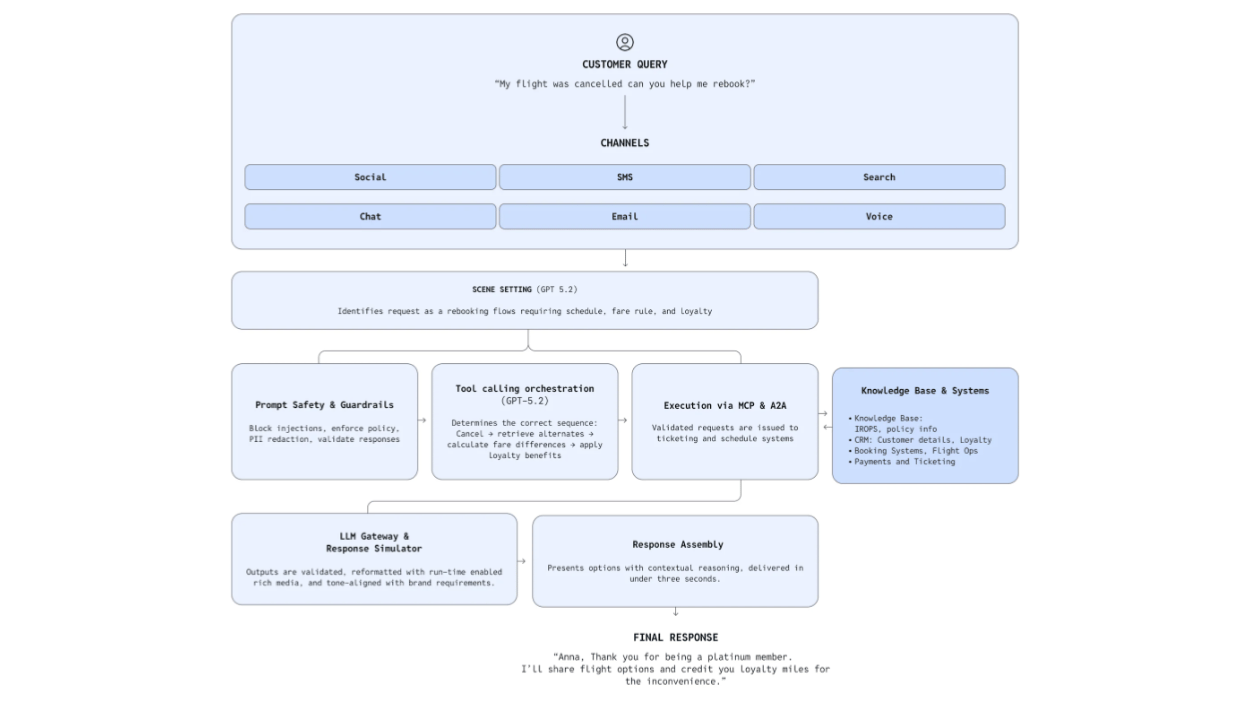
Image source: OpenAI
Brief: OpenAI shared how Netomi built enterprise AI agents using GPT-4.1 and GPT-5.2, creating a blueprint for scaling safe, predictable agentic systems where reliability, governance, and performance are critical.
Breakdown:
Enterprises expect AI agents to handle complex workflows reliably, honor policies, operate at scale under load, and explain decisions clearly.
Netomi designs agents for real-world complexity, using GPT-4.1 for fast tool-calling and GPT-5.2 for deeper reasoning in multi-step planning.
To drive predictability across tasks, Netomi applies OpenAI-recommended prompting patterns including persistent reminders.
AI often fails via sequential tasks. Netomi parallelizes them, using GPT-4.1’s low-latency streaming and stable tool-calling for faster speed.
Governance is embedded directly into runtime, with schema validation, observability, and deterministic fallback built in by default.
Why it’s important: Netomi shows how AI earns enterprise trust engineering for complexity, optimizing for latency, and embedding governance. OpenAI models provide the reasoning, while Netomi’s systems engineering ensures AI remains safe, auditable, and ready for Fortune 500 environments.
WORKFORCE EVOLUTION
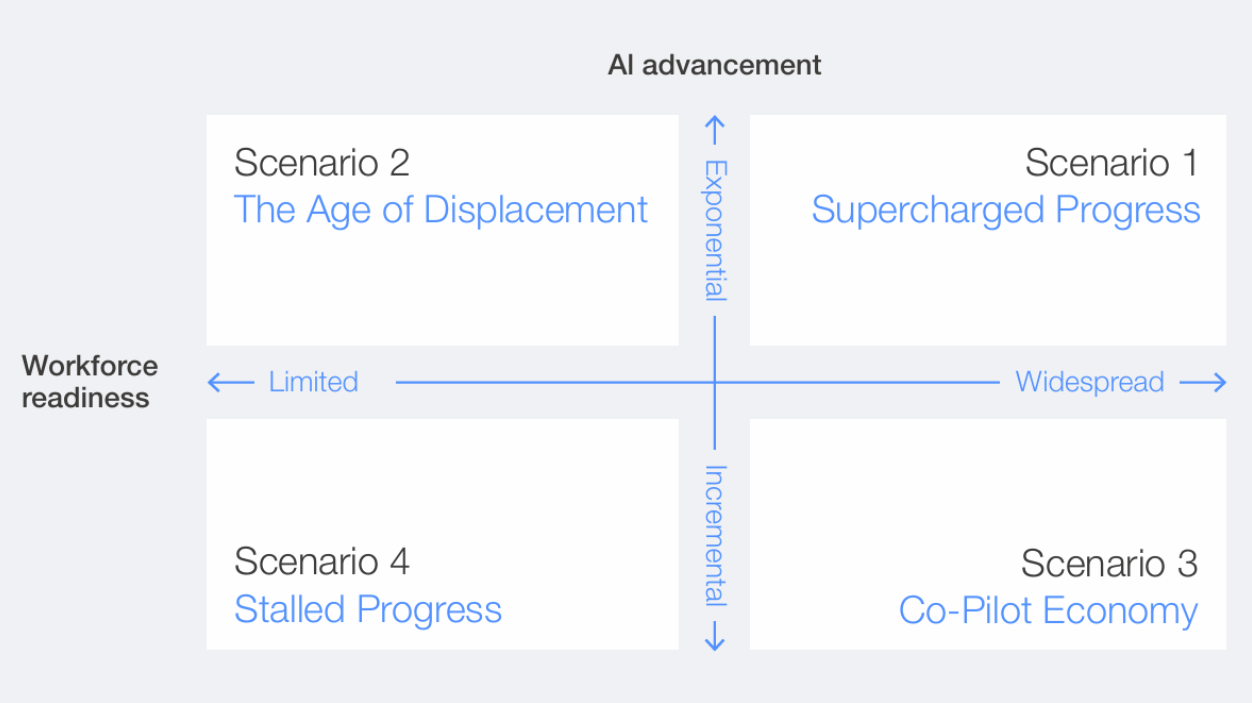
Image source: World Economic Forum
Brief: The World Economic Forum (WEF) outlined four scenarios for the future of jobs, exploring how AI advancement and workforce readiness could shape labor markets and societal outcomes globally by the year 2030.
Breakdown:
Executives are split on AI’s impact, with 54.3% expecting job displacement, 24% job creation, and 45% forecasting higher margins.
Scenario 1: Rapid AI breakthroughs and strong workforce readiness create an AI-centric economy, shifting roles to oversight as social safety nets lag.
Scenario 2: AI advances faster than workforce adaptation, driving widespread automation, job displacement, and rising economic volatility.
Scenario 3: Gradual AI progress with workforce readiness positions AI as an augmenting force, with human–AI teams reshaping value chains.
Scenario 4: Steady AI progress meets a workforce lacking critical skills, resulting in brittle deployments, stalled productivity, and fading optimism.
Why it’s important: These scenarios provide a lens through which leaders can address uncertainties, and shape strategies to navigate and harness trends in AI and talent. WEF also outlines a set of “no-regret” executive strategies that can help businesses prepare for each scenario.
MARKET & BEST PRACTICE INSIGHT
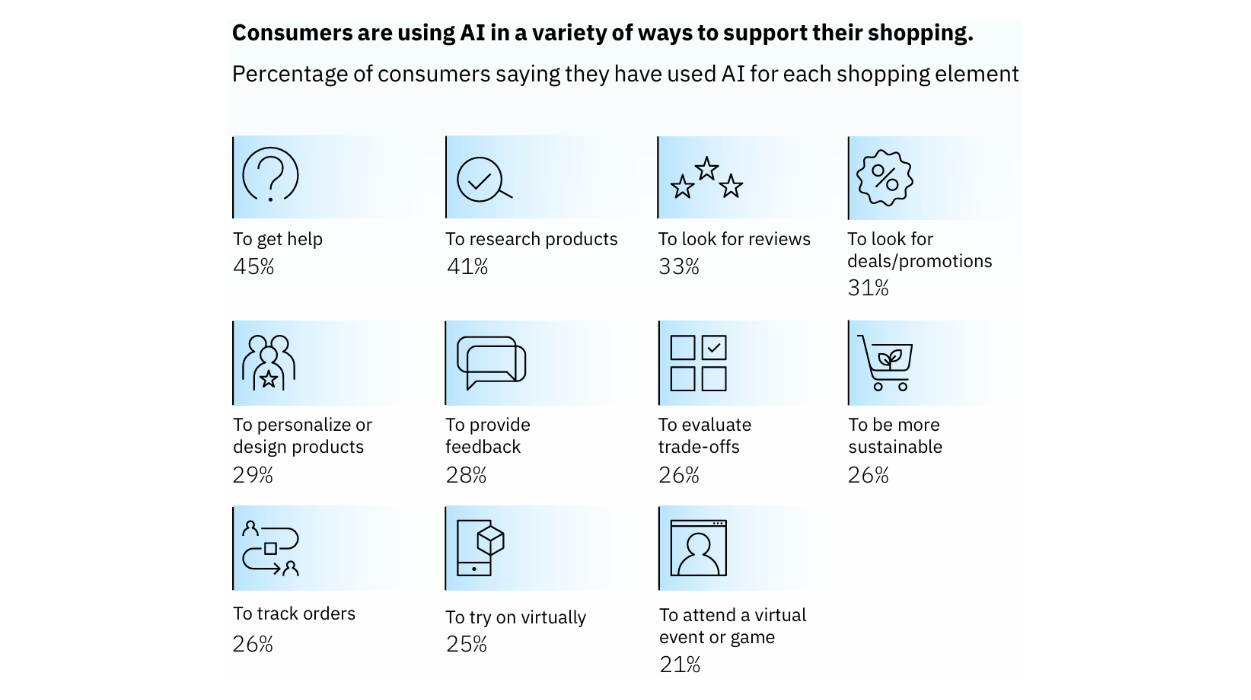
Image source: IBM
Brief: IBM published a report on owning the agentic commerce experience, drawing on insights from over 18,000 consumers and 200 executives to show that consumers are ready for the next phase of shopping.
Breakdown:
Commerce is shifting from people-led browsing to AI-assisted discovery and ultimately to agents making purchases on shoppers’ behalf.
Use of AI for shopping surged 62% in two years, rising to 82% for Gen X and 92% for Boomers, signaling broad demographic adoption.
41% of consumers use AI assistants to research products, 33% to look for reviews, and 31% to search for deals (see image above).
Brands and retailers should orchestrate experiences and ensure visibility and relevance across digital, physical, and AI-enabled touchpoints.
Organizations should fortify data practices to build trust with consumers today and credibility with AI agents that will purchase tomorrow.
Why it’s important: As agentic commerce emerges, winners will engineer omnichannel experiences for both people and machines. Success depends on AI discoverability, transparent data practices, and strong governance. See the full report for more specific actions to prepare.
INDUSTRY INSIGHT

Image source: Tata Consultancy Services
Brief: TCS’ Digital Twindex Automotive brings together leaders from Tata Motors, AWS, Oracle, and ServiceNow who are actively building the future of transport across vehicles, factories, supply chains, and digital platforms.
Breakdown:
The biggest change isn’t what drivers see, it’s the intelligence embedded in engineering systems, factories, workflows, and compliance platforms.
Centralized and edge compute, decoupled software/hardware, and digital twins turn vehicles into living products that improve over time.
Intelligence matured in factories through software-defined operations, robotics, and feedback loops, making flexibility/adaptation operational.
Advantage is shifting from isolated features to fleet-wide learning, where shared data drives safety, sustainability, and customer experience.
AI and connected systems turn intelligence into trust, showing up not as novelty but in safer, more reliable everyday journeys.
Why it’s important: Cars were once simple tools for transport, designed to move us from place to place. Today, intelligent vehicles support safer roads, cleaner cities, and experiences deeply integrated into how we live and work, an extension of our living room, workplace, and personal space.

BCG shared how AI agents and technology will transform healthcare in 2026, alongside an executive playbook for mining and metals firms.
McKinsey explored how AI investment is coming at the expense of ERP foundations, and why human skills will matter more than ever in the age of AI.
Microsoft shared a guide to AEO and GEO, explaining how products rank in conversational search and how competition shifts from SEO to influence.
Deloitte discussed how it is using agentic AI to redefine workplace roles and shift the automotive experience into high gear.
OpenAI shared how Tolan used GPT-5.1 to build a low-latency voice app with accurate context and stable personalities as conversations evolve.
Accenture agreed to acquire Faculty for reinvention and invested in Profitmind to expand its agentic AI capabilities across retail.

Nvidia unveiled the Rubin platform, delivering 5x Blackwell’s training compute, alongside Alpamayo OS models for autonomous driving.
Amazon launched Alexa.com, a browser-based interface bringing its Alexa+ AI assistant to the web, competing with ChatGPT, Gemini, and Claude.
xAI completed a $20B Series E round, valuing the company above $200B, with backing from Nvidia, Qatar’s sovereign wealth fund, and others.
OpenAI introduced ChatGPT Health, an experience that lets users connect medical records and fitness data for more contextual health conversations.
Microsoft launched Copilot Checkout, allowing U.S. shoppers to complete purchases directly inside the AI assistant, with major retailers integrated.
Google introduced Gemini AI upgrades to Gmail, enabling natural language inbox queries, automatic summaries, and more proactive actions.

Last call for Executive+ launch memberships (ends today). Join senior leaders from JPMorgan, Deloitte and NVIDIA already inside.
Executive+ members receive the extended edition of Enterprise AI Executive each week: Further AI transformation and technology coverage, plus executive insights beyond AI.
Your membership also supports the Enterprise AI Executive mission, helping to sustain research quality and consistency.
$90 USD/year (equivalent to $7.50/month) — a 33% launch week discount, exclusively for Enterprise AI Executive subscribers.
This rate is available until Sunday, January 11, at 8:00 p.m. EST. After that, pricing will increase to $135 USD/year. Your launch rate remains locked in for as long as you stay a member.

CAREER OPPORTUNITIES
BCG - AI Factory Executive Director
Siemens - Agentic AI Senior Director
CVS Health - AI Executive Director
EVENTS
Google - Gemini Enterprise - January 21, 2026
Stanford - AI @ Work - March 3, 2026
MIT - Enterprise AI Forum - April 15, 2026

Originally conceived as a practical communication for executives the editor, Lewis Walker, has worked with, this briefing now serves as a trusted resource for thousands of senior decision-makers shaping the future of enterprise AI.
If your AI product or service adds value to this audience, contact us for information on a limited number of sponsorship opportunities.
We also welcome feedback as we continue to refine the briefing.

Lewis Walker, Editor