- Enterprise AI Executive
- Posts
- Deloitte's new AI agent observability playbook
Deloitte's new AI agent observability playbook
Plus, 10 enterprise AI predictions, a16z agent evolution, and more.

Lewis Walker
January 04, 2026

Welcome executives and professionals. The transition from human-powered to human-led, agent-enabled operations demands a thoughtful approach to architecture, metrics, and oversight.
Since the previous edition, we have reviewed hundreds of the latest insights in agentic and generative AI, spanning best practices, case studies, market dynamics, and innovations.
This briefing outlines what is driving material value — and why it’s important.
Introducing Executive+
You can now access an extended version of Enterprise AI Executive each week by becoming an Executive+ member.
In today’s briefing:
Deloitte on AI agent observability.
Enterprise AI predictions for 2026.
How gen AI is reshaping purchasing.
Andreessen Horowitz “Big Ideas 2026”
Transformation and technology in the news.
Insights for Executive+ members.
Career opportunities & events.
Read time: 4 minutes.

BEST PRACTICE INSIGHT
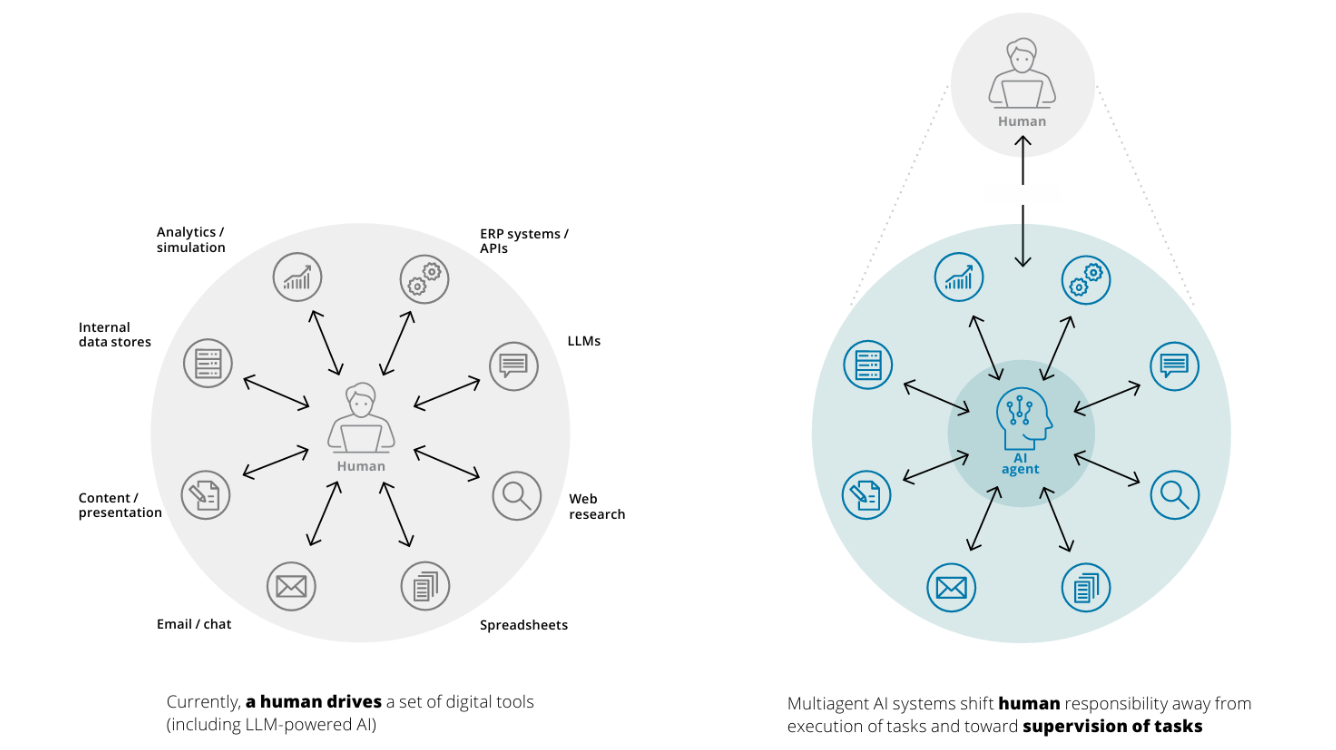
Image source: Deloitte
Brief: Deloitte published a report on AI agent observability, detailing approaches, metrics, and operating models to govern, monitor, and continuously improve agent performance in line with business objectives.
Breakdown:
AI agents enable enterprises to shift human roles from execution to supervision, unlocking gains in productivity and operational effectiveness.
AI agent observability blends technology with human oversight to understand, manage, and optimize agent performance against objectives.
The report defines a KPI framework spanning cost, speed, productivity, quality, and trust to assess and manage AI agent performance.
Business process decomposition helps pinpoint where agents add value and define the KPIs needed to optimize performance.
Deloitte outlines a scalable agent ops architecture using hot and warm observability paths, illustrated through an enterprise case study.
Why it’s important: Deloitte’s guidance helps organizations progress faster from human-powered to human-led, agent-enabled operations, while reducing risk. It extends Deloitte’s agent series, complementing prior work on the agentic enterprise, multi-agent systems, among other topics.
MARKET OUTLOOK
Image source: Information Services Group
Brief: ISG leaders, analysts, and its Chief AI Officer shared 10 predictions for 2026, focused on AI at the core of enterprise transformation and how organizations will balance cost optimization with business reinvention.
Breakdown:
Across the Global 2000, legacy systems and technical debt are becoming strategic risks, pushing technology modernization to the board agenda.
Fragmented data, inconsistent semantics, and weak governance limit AI impact, slowing adoption and enterprise-scale outcomes.
Over 30% of top-funded AI use cases are now in production, but scaling benefits remains difficult despite strong early business results.
The convergence of generative AI and future quantum computing is driving new cybersecurity risks, increasing investment urgency today.
Broader trends address AI expanding cloud workloads, digital sovereignty challenges, growth in global capability centers, and more.
Why it’s important: After aggressive cost optimization in 2025, enterprises are reinvesting savings into AI pilots and platforms. In 2026, success will depend on transforming operating models to scale AI into measurable results, reshaping processes, governance, and every layer of the technology stack.
MARKET INSIGHT
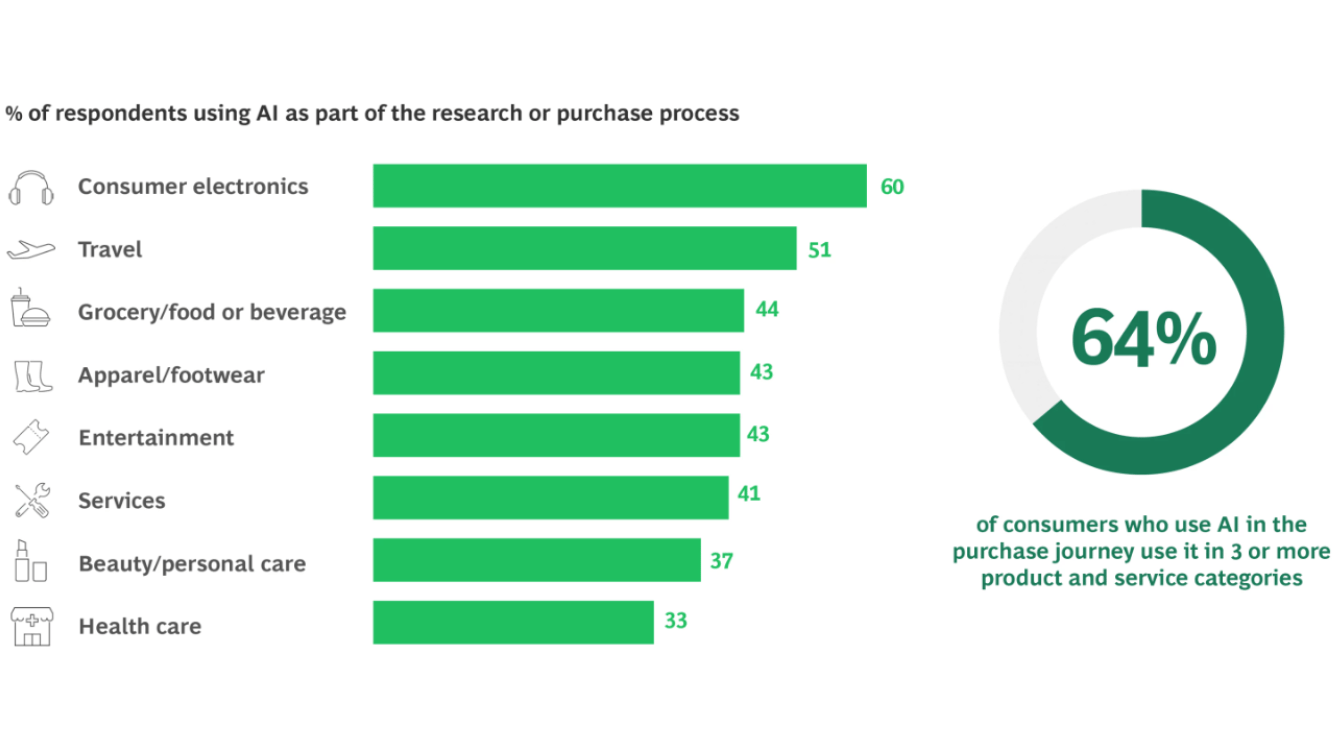
Image source: Boston Consulting Group
Brief: BCG surveyed over 9,000 consumers across markets representing roughly 48% of the global population (including the US, UK, China, and India) to understand how generative AI is impacting purchase pathways.
Breakdown:
Shopping-related gen AI usage rose 35% (Feb–Nov 2025) as consumers increasingly use it to research, evaluate, and purchase products.
Gen AI is used across categories, supporting both high-consideration purchases like electronics and everyday decisions such as groceries.
Shoppers value gen AI for being direct, more objective, transparent, and personalized, helping them decide even when initially uncertain.
Brands increasingly recognize AI as a meaningful standalone touchpoint and as an integrated part of a broader, multi-touchpoint purchase journey.
For example, Walmart partnered with ChatGPT for instant checkout, enabling users to discover and purchase without leaving the chat.
Why it’s important: This shift raises the stakes. Product narratives, facts, and value propositions should be clearly differentiated, consistent, and optimized for AI-driven environments. Leading firms will secure visibility and preference in moments when gen AI shapes demand, consideration, and final choice.
VENTURE INSIGHT
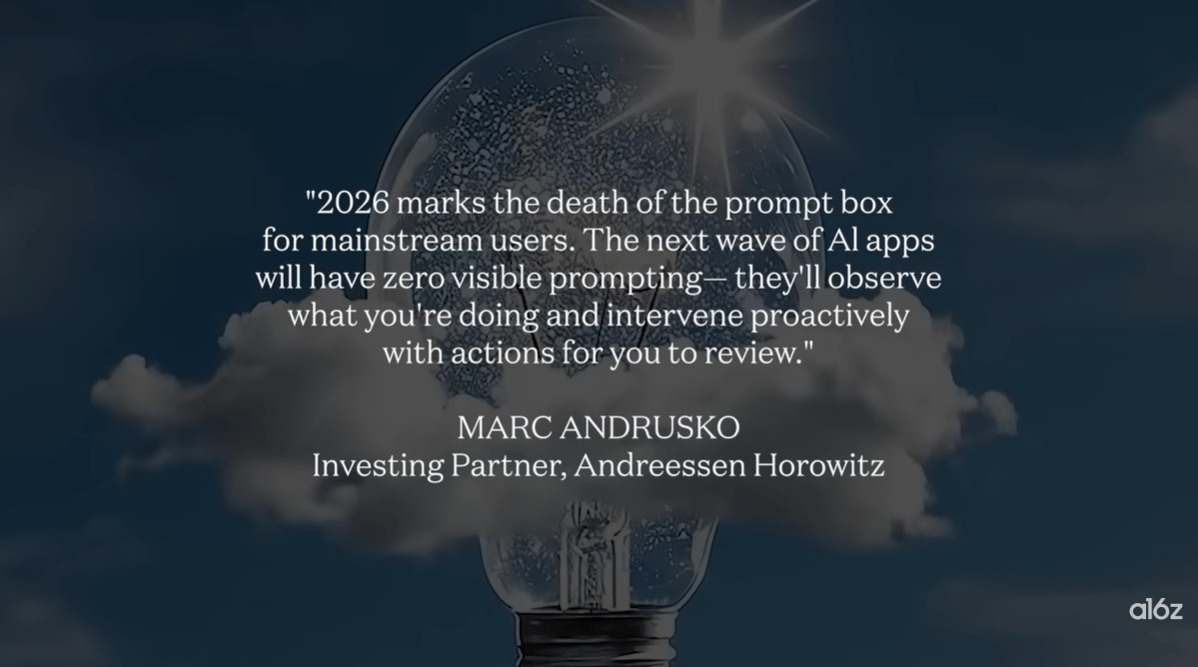
Image source: Andreessen Horowitz
Brief: Andreessen Horowitz released its three-part “Big Ideas 2026” video series, examining how AI agents will evolve, what disruptions to expect, and key AI predictions, with insights from the firm’s Investing Partners.
Breakdown:
Episode one outlines three shifts shaping AI’s future, arguing the change is not simply better models but software itself taking on a new form.
Partners discuss the move from prompting to execution, machine-legible software, and why voice agents are maturing in enterprises.
Together, these shifts move interfaces from chat to action, design from human-first to agent-readable, and work toward agentic execution.
Episode two explains how advantage shifts from fragmented plumbing to AI-native platforms and from static records to agent-driven execution.
Episode three explores why the most durable AI companies are those where AI reinforces the core business model, not added as a feature.
Why it’s important: a16z’s “Big Ideas 2026” positions AI as an economic reset, not a product cycle. As agentic execution replaces human effort, value creation moves beyond the $400B software market toward the $13T global labor pool, reshaping how competitive advantage and scale are created.

BCG published an executive playbook on the future of biopharma, detailing end-to-end AI transformation with practical steps to scale impact.
IBM highlighted the trends expected to shape AI and technology strategies in 2026, as well as charting the evolution of AI agents.
Anthropic expanded its Claude vending machine test in the WSJ newsroom, where staff manipulated the AI into giving away items, including a PS5.
TCS CEO K. Krithivasan outlined how the company intends to be the world’s largest AI-led services firm by shifting from digital to AI enterprise.
Coforge, the IT services provider, announced the $2.35B acquisition of AI firm Encora to strengthen in-house AI capabilities and expand across the U.S.
JPMorgan published this year’s “Smothering Heights,” analyzing gen AI’s extraordinary impact on global markets, returns, and investing trends.

Meta announced the acquisition of Manus for over $2B, adding a top-performing agentic system and proven revenue product to its AI expansion.
Nvidia struck a $20B licensing deal with AI chip startup Groq, with Groq’s CEO and president joining Nvidia to scale the inference tech.
OpenAI founding member Andrej Karpathy said he’s “never felt this much behind" as programming is "being dramatically refactored."
Microsoft CEO Satya Nadella shared his 2026 outlook, arguing AI is shifting from "spectacle" to "substance," with success measured by outcomes.
LMArena released 2025 rankings, with Google’s Gemini 3 Pro leading text, vision, and search, while Veo 3.1 topped video models.
Accenture invested in Ryght AI to transform clinical research with agentic AI and expanded its global partnership with Palantir to drive AI reinvention.

Become an Executive+ member to access the extended edition of Enterprise AI Executive each week: Further AI transformation and technology coverage, plus executive insights beyond AI.
Your membership also supports the Enterprise AI Executive mission, helping to sustain the research, quality, and consistency of both the complimentary and Executive+ insights.
$90 USD/year (equivalent to $7.50/month) — a 33% launch week discount, exclusively for Enterprise AI Executive subscribers.
This rate is available until Sunday, January 11, at 8:00 p.m. EST. After that, pricing will increase to $135 USD/year. Your launch rate remains locked in for as long as you stay a member.

CAREER OPPORTUNITIES
JPMorgan - AI Executive Director
SAP - Head of AI Product & Partner Management
BDO USA - Gen AI Lead
EVENTS
CES 2026 - January 6-9, 2026
Anthropic - AI in healthcare - January 12, 2026
AAAI 2026 - January 20-27, 2026

Originally conceived as a practical communication for executives the editor, Lewis Walker, has worked with, this briefing now serves as a trusted resource for thousands of senior decision-makers shaping the future of enterprise AI.
If your AI product or service adds value to this audience, contact us for information on a limited number of sponsorship opportunities.
We also welcome feedback as we continue to refine the briefing.

Lewis Walker, Editor