- Enterprise AI Executive
- Posts
- Deloitte: 3,235 leaders on the state of AI
Deloitte: 3,235 leaders on the state of AI
Plus, Palantirization, the AI attention stack, and more.

Lewis Walker
January 25, 2026

Welcome executives and professionals. A widening performance divide separates companies that embed AI at the core of strategy and those that treat it as a cost-reduction tool.
Since the previous edition, we have reviewed hundreds of the latest insights in agentic and generative AI, spanning best practices, case studies, market dynamics, and innovations.
This briefing outlines what is driving material value — and why it’s important.
Executive+
Get the extended edition of Enterprise AI Executive.
This week: Davos takeaways, CEO insights on growth, executive tabletop exercise best practices, and more.
In today’s briefing:
Deloitte: State of Enterprise AI 2026.
The Palantirization of everything.
How AI’s reshaping advertising.
Enterprise AI infrastructure ROI.
Transformation and technology in the news.
Insights for Executive+ members.
Career opportunities & events.
Read time: 4 minutes.

MARKET INSIGHT
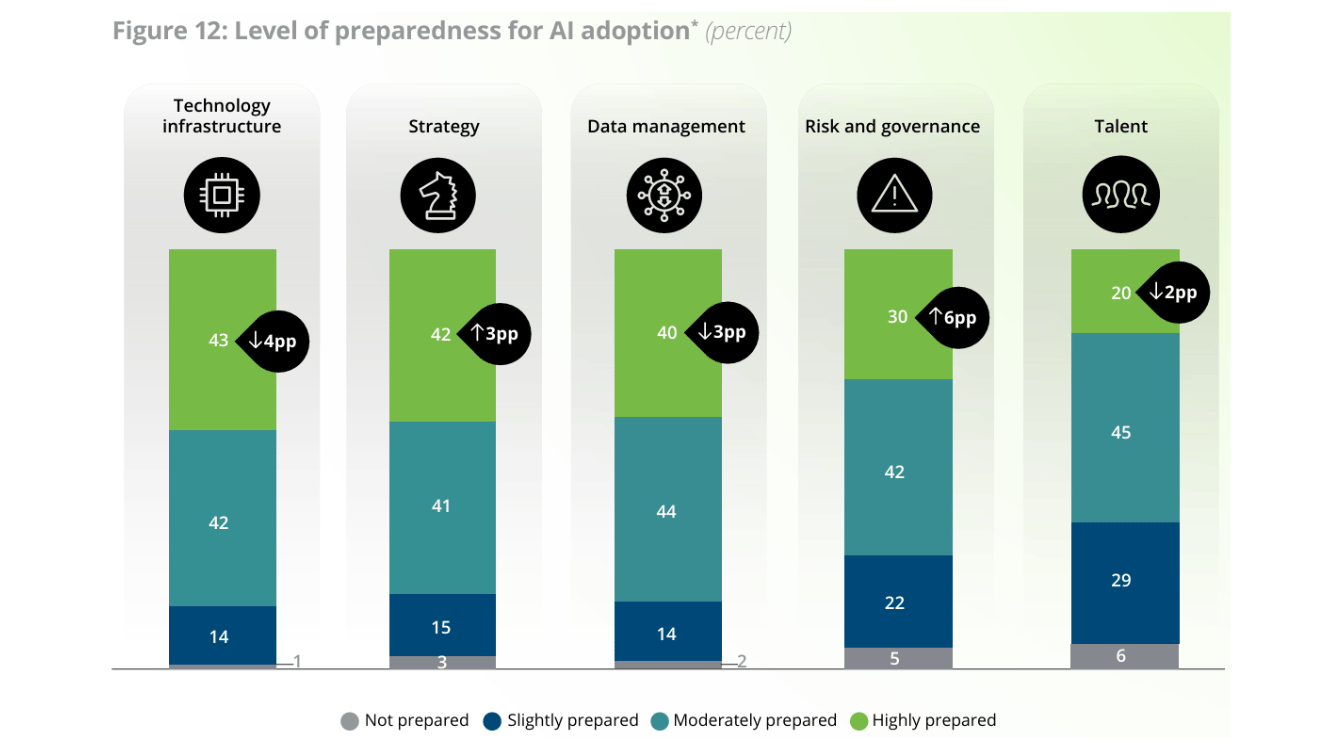
Image source: Deloitte
Brief: Deloitte’s 41-slide 2026 State of AI in the Enterprise report surveyed 3,235 director- to C-suite leaders across 24 countries (Aug–Sep 2025), showing that many stand at the untapped edge of AI’s potential.
Breakdown:
Worker access to AI rose 50% in 2025; firms with ≥40% of AI projects in production are expected to grow from 25% to 54% within six months.
77% say AI development location is key when choosing new tech, signaling that AI sovereignty now rivals innovation as a strategic priority.
Agentic AI usage is projected to rise from 23% to 74% within two years, yet only 20% of firms report having mature governance for autonomy.
58% of organizations report at least limited use of physical AI today, expected to reach 80% in two years, with Asia Pacific leading adoption.
While 42% of companies say their AI strategy is highly prepared, many feel less prepared in terms of infra, data, and talent (image above).
Why it’s important: With developments in agentic, physical, and sovereign AI rapidly expanding the boundaries of what’s possible, companies are at the edge of tapping into AI’s full potential. The challenge is activation: moving beyond experimentation to operationalizing enterprise AI at scale.
DELIVERY MODEL

Image source: Andreessen Horowitz
Brief: Andreessen Horowitz explored how tech (and consulting) firms are embedding outcome-driven forward-deployed engineers (FDEs) with customers, following the Palantir model pioneered in the early 2010s.
Breakdown:
Palantir is “a category of one,” and most companies copying its approach risk becoming costly services businesses as FDE job postings surge.
Palantir operates platform-first, building on reusable primitives such as data models/workflow engines rather than fully bespoke client systems.
The firm is opinionated on how work should happen, pushing clients into new ways of working, a rare vendor courage enabling reuse.
Becoming Palantir-like required years of negative sentiment, political controversy, and unclear near-term monetization while it matured.
Palantir spent over a decade building elite generalist engineers able to code, navigate bureaucracy, and work with CIOs and regulators.
Why it’s important: Palantir’s success comes from a rare mix of software, consulting, political complexity, and patient capital. The Palantir model isn’t easy to replicate; companies should determine when the “Palantirization” strategy makes sense (see full insights for gating questions).
BEST PRACTICE INSIGHT

Image source: Boston Consulting Group
Brief: BCG outlined how AI is reshaping advertising for the first time in a decade, detailing the emerging “AI attention stack” and explaining the implications of shifting consumer behavior inside AI interfaces.
Breakdown:
Consumers are spending less time in traditional web funnels, feeds, and category pages as predictable browsing patterns continue to decline.
More consumer journeys now start and finish inside AI interfaces that combine exploration, evaluation, and recommendation in one experience.
This shift creates an “AI attention stack” (image above) where time, intent, and influence converge, unlocking advertising opportunities.
BCG highlights implications for marketing leaders, including model-mediated discovery, rising complexity, and trust as a differentiator.
The next 18 months are pivotal; BCG urges marketers to build AI-native media systems, governance frameworks, and data safeguards.
Why it’s important: What comes next will depend on how platforms balance monetization with credibility, brands adapt to being interpreted by AI models, and consumers respond as conversations become commercial. Advertising will be defined not by placement but by how AI shapes decisions.
COST OPTIMIZATION

Brief: IDC, with Supermicro and AMD, outlined key factors driving AI infrastructure costs and recommendations to improve ROI, noting that over 60% of businesses cite “specialized AI hardware” as their top expense.
Breakdown:
Fewer than one-third of organizations involve IT at all during the conceptual stage of an AI initiative, leading to unpredictable infra costs.
Firms should not assume LLMs are always required; alternative AI approaches can deliver needed capabilities at lower infrastructure cost.
Companies should balance model uniqueness with infrastructure demands to drive customization within use case budget constraints.
77% of organizations fine-tune existing models, while 40% of firms develop AI models in-house from scratch (image above).
IDC outlines seven factors driving AI infrastructure ROI including model type, parameter count, training data volume, model accuracy, and more.
Why it’s important: Rising costs, competition for budget, and challenges proving ROI continue to slow enterprise AI scaling. IDC believes that despite this concern, enterprises can build a strong ROI for their AI initiatives, especially if they deploy the right infrastructure.

BCG shared how companies deploying AI agents should redesign end-to-end processes to achieve the promised step changes in value creation.
OpenAI published 17 pages on how closing the “capability overhang” between AI potential and typical use is key to unlocking value.
Bain Capital Ventures spoke with CTO Advisory Board members, including Ford’s CDAIO Franziska Bell, on enterprise AI adoption and impact.
WEF, in collaboration with Accenture, released a 29-page report on where AI is delivering real-world results, with impact, scale and trust.
OpenAI revealed how Cisco by deploying Codex broadly made AI-native development a core part of how enterprise software gets built.
Deutsche Bank outlined why 2026 is likely to be a challenging year for AI as three themes converge: disillusionment, dislocation, and distrust.

Anthropic's Claude Code is having a “ChatGPT moment,” fueling a selloff in traditional software stocks and investors fearing a new era of AI-built 'selfware.'
OpenAI launched Stargate Community, pledging to fund energy infrastructure needs so AI expansion doesn’t raise local electricity prices.
Davos featured Jensen Huang, Dario Amodei, Satya Nadella, Elon Musk, and other CEOs outlining their latest perspectives on AI.
IBM launched Enterprise Advantage, a new consulting service delivering a secured platform, shared standards, and reusable AI assets.
ServiceNow and OpenAI announced a multi-year deal expanding customer access to frontier models powering 80+ billion workflows yearly.
Google DeepMind hired Hume AI’s CEO and engineers in an acqui-hire deal to integrate Hume's emotionally intelligence voice tech into Gemini.

Get the extended edition of Enterprise AI Executive.
This week: Davos takeaways, CEO insights on growth, executive tabletop exercise best practices, and more.

CAREER OPPORTUNITIES
OpenAI - Accenture Partner Director
GE HealthCare - AI Transformation Leader
Macy’s - Enterprise AI Senior Director
EVENTS
OpenAI - ChatGPT at Work - January 28, 2026
Norton Rose Fulbright - Securing AI Agents - February 11, 2026
Anthropic - Enterprise Agents - February 24, 2026

Originally conceived as a practical communication for executives the editor, Lewis Walker, has worked with, this briefing now serves as a trusted resource for thousands of senior decision-makers shaping the future of enterprise AI.
If your AI product or service adds value to this audience, contact us for information on a limited number of sponsorship opportunities.
We also welcome feedback as we continue to refine the briefing.

Lewis Walker, Editor