- Enterprise AI Executive
- Posts
- Anthropic’s 2M Claude conversations
Anthropic’s 2M Claude conversations
Plus, McKinsey's state of AI trust, the sovereignty illusion, and more.

Lewis Walker
March 29, 2026

Edition in partnership with

Welcome executives and professionals. Anthropic’s Claude continues to gain traction across enterprise and consumer markets. A new analysis of 2M AI conversations shows how it is used in professional work.
Since the previous edition, we have reviewed hundreds of the latest insights in agentic and generative AI, spanning best practices, case studies, market dynamics, and innovations.
This briefing outlines what is driving material value — and why it’s important.
In today’s briefing:
Anthropic’s analysis of 2M AI conversations.
McKinsey’s state of AI trust in 2026.
BCG: AI sovereignty is an illusion.
Structuring website content for LLMs.
Transformation and technology in the news.
Insights for Executive+ members.
Career opportunities & events.
Read time: 4 minutes.

MARKET INSIGHT
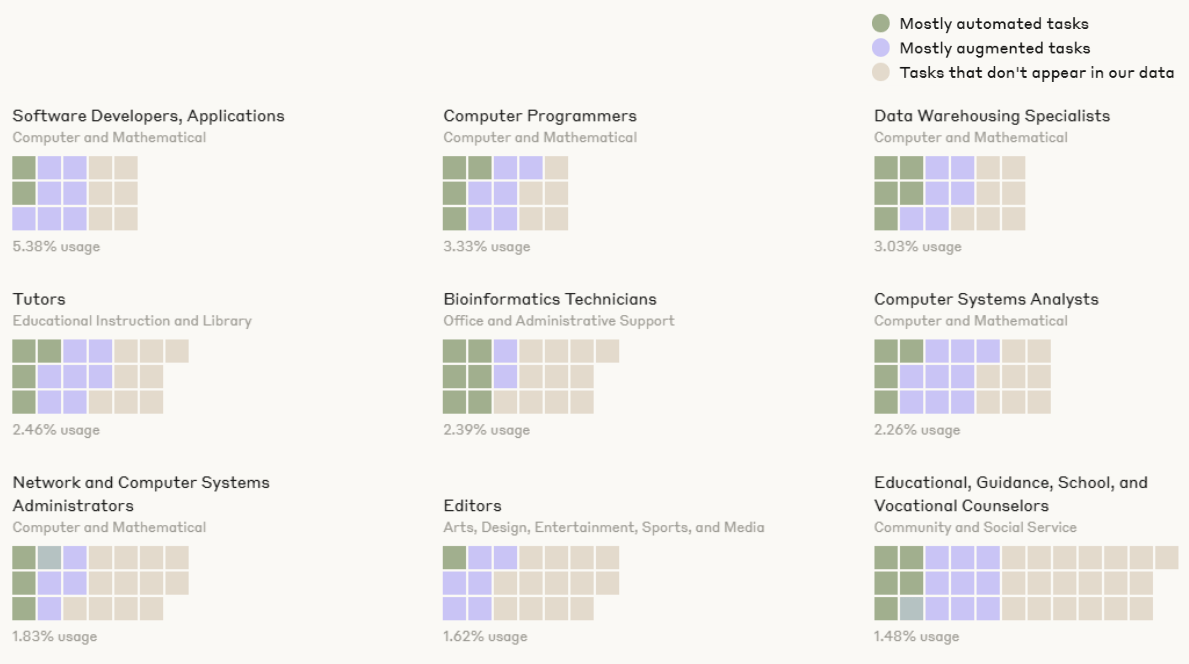
Image source: Anthropic
Brief: Anthropic’s Economic Index tracks how Claude is used across work and the wider economy. Its latest report analyses activity from Feb 5-12, drawing on two million conversations across Claude’s app and API.
Breakdown:
Coding tasks continue shifting from augmentative use within the Claude app toward more automated, first-party API traffic.
Claude app usage is becoming less concentrated, with the top 10 tasks accounting for 19% of traffic in February, down from 24% in November.
Around 49% of jobs have seen at least a quarter of their tasks performed using Claude (see 'Job explorer' visualization).
As use cases diversify, the average value of work on Claude has declined slightly, reflecting more lower-value queries like home maintenance.
Why it’s important: Overall, Claude is used for high-value, complex work that is not broadly representative of the US economy. As adoption grows, lower-paid tasks now make up a larger share of usage. Average task value has declined on the Claude app, while rising among API users.
IN PARTNERSHIP WITH DEX

Brief: Dex doesn’t just assist IT; it investigates, plans, and executes tasks with controlled autonomy. Dex reasons through IT issues across your environment. Built by a team behind technology trusted by 3,000+ organizations and millions of users worldwide.
The Dex advantage:
Specialized AI agent built for complex, end-to-end IT tasks.
Resolve issues through plain-language conversations.
Maintain control: Approve all actions before execution.
Resolve 90% of IT issues before they become tickets.
See the first public demonstration of Dex on March 31.
MARKET INSIGHT
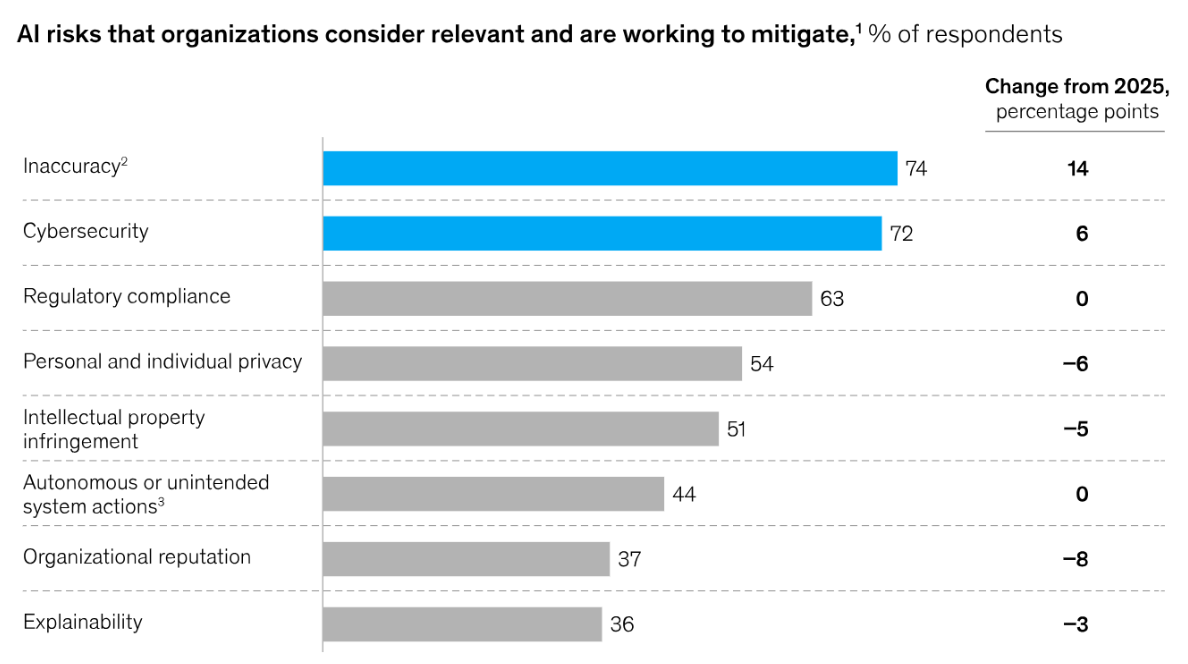
Image source: McKinsey & Company
Brief: McKinsey’s 2026 AI Trust Maturity Survey, conducted Dec 2025-Jan 2026 across ~500 organizations, examines AI trust across maturity levels, emerging risks, and how leading firms are closing gaps to scale AI responsibly.
Breakdown:
Average RAI maturity (scale 0-4) rose to 2.3 in 2026 from 2.0 in 2025, yet only one-third of organizations report scores of three or higher.
Firms investing $25M+ in RAI report higher maturity and are far more likely to achieve material AI benefits, including EBIT gains.
As AI adoption grows, 74% of firms identify inaccuracy and 72% cite cybersecurity as highly relevant risks (image above).
Nearly 60% cite knowledge and training gaps as the primary barrier to implementing RAI practices, up from 51% last year.
Why it’s important: As AI becomes more autonomous and embedded in critical workflows, gaps in governance and risk management will become increasingly costly. Without clear accountability, robust controls, and effective monitoring, firms risk slower adoption and declining stakeholder trust.
BEST PRACTICE INSIGHT
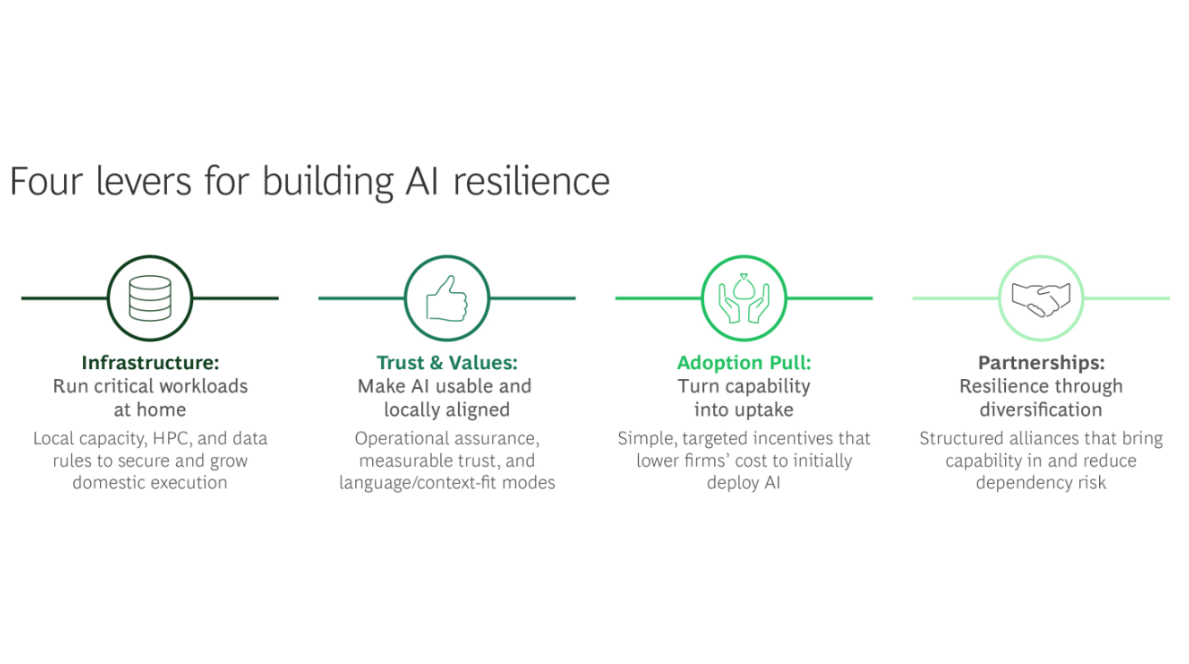
Image source: Boston Consulting Group
Brief: BCG Henderson Institute studied AI policy actions across 30+ countries to assess how nations can support domestic AI use and governance, identifying pathways spanning infrastructure, trust, adoption, and partnerships.
Breakdown:
Countries should secure infra capacity to expand domestic workload execution and shape standards that reflect local languages/social norms.
Deploy targeted incentives that reduce initial AI adoption costs, alongside alliances that reduce long-term dependency risks.
With these foundations in place, countries can increase AI diffusion rates and capture productivity gains that underpin sustained economic growth.
The analysis examples examples from Europe, India, Singapore, South Africa, Brazil, and South Korea navigating trade-offs to build AI resilience.
Why it’s important: AI sovereignty is often framed around control, but for most countries, the priority is enabling reliable domestic use under local rules. That is what resilience delivers. It is not a retreat from sovereignty, but a more practical path when full control across the AI stack is not achievable.
IN PARTNERSHIP WITH RESOLVE
Brief: ITSM platforms struggle to support modern, cross-domain orchestration. As tickets and approvals slow resolution, IT teams hit scale limits. Resolve introduces agentic AI to bridge the gap through real-time, autonomous incident resolution.
Join Resolve on April 1 for a breakdown of:
Why traditional ITSM orchestration fails to support modern operations.
How agentic AI enable autonomous resolution.
The future of resolution beyond ticket-driven workflows.
Register now to save your spot.
BEST PRACTICE INSIGHT
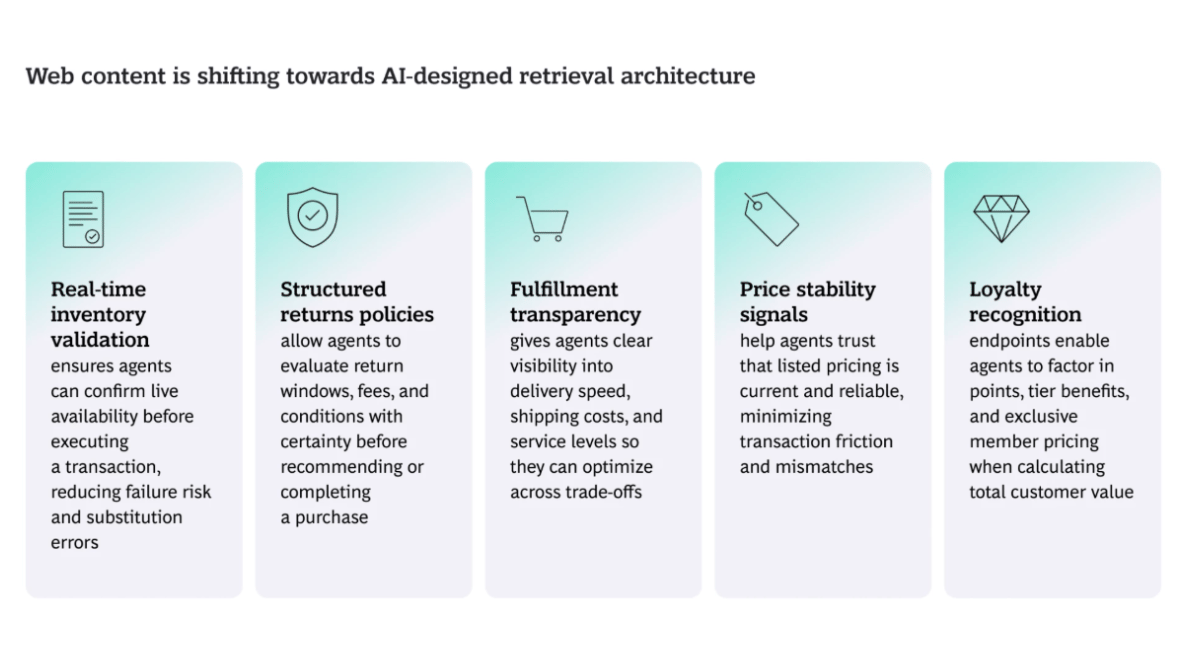
Image source: Boston Consulting Group
Brief: BCG explored how to structure website content for LLM discovery, outlining how organizations can move beyond search visibility to ensure content is accessible, understandable, and selected by AI.
Breakdown:
For two decades, digital strategy focused on search visibility. The next decade will focus on selection within AI-generated answers.
Visibility alone is not enough. Advantage comes from structuring content so AI can easily access, interpret, and select it.
If content is blocked, inconsistent, structurally ambiguous, or hard to parse, it is not evaluated by AI, it is bypassed entirely.
Winning brands will prioritise clear entities, stable schemas, trusted feeds, machine-readable content, and agentic transactions (image above).
Why it’s important: In a world where AI systems mediate discovery, the question is no longer “Can we rank?” but “Can we be accessed, understood, retrieved, recommended, and acted upon?” Organizations that redesign now won’t just appear in answers, they will shape the decisions those answers drive.

Everest Group published a 21-page workplace transformation playbook, including the 4C vision: cognitive, composable, connected, and curated.
NTT Data surveyed 2,300 leaders across 33 countries, revealing a gap between enterprise AI ambition and underlying cloud readiness.
Omdia reported AWS as the world’s largest cloud provider in Q4 2025 with 32% share, followed by Microsoft Azure at 22% and Google Cloud at 12%.
BCG published a 30-page playbook on AI-first power and utilities, outlining how leading firms are transforming operations and strategy.
DBResearch explored investment in energy infrastructure for the AI era, as rising demand creates a widening global energy supply gap.
The U.S.-China Economic and Security Review Commission published 30 pages on how China’s open AI strategy reinforces industrial dominance.

Google rolled out Gemini 3.1 Flash Live, a faster, more capable voice AI designed to power conversations across Search, Gemini Live, and its API.
OpenAI is raising another $10B, pushing its total funding beyond $120B, with backing from Microsoft, a16z, and T. Rowe Price.
Mistral released Voxtral TTS, a lightweight model that clones voices from a 3-second clip and generates natural speech across nine languages.
Cohere released Transcribe, a free open-source speech model that ranks first on HuggingFace’s accuracy leaderboard across 14 languages.
Meta open-sourced TRIBE v2, trained on brain scans from 700+ people, simulating neural activity and outperforming real fMRI recordings.
Apple plans to open its Siri revamp to third-party models from iOS 27, ending ChatGPT exclusivity and enabling increased user choice.

Unlock Executive AI Index: The top 215 AI playbooks, by industry and function, with direct links to each. Updated weekly.
Get the extended version of Enterprise AI Executive, delivered twice weekly.

CAREER OPPORTUNITIES
PwC - Responsible AI Director
Shield AI - VP, AI and Digital Workplace
Cognizant - Head of AI Sales
EVENTS
OpenAI - ChatGPT for Work - April 8, 2026
Leaders In AI Summit - April 21-22, 2026
Google Cloud Next - April 22-24, 2026

Reach enterprise AI decision-makers:
66% of readers are C-level executives or VP and Director-level leaders.
63.2% of the audience is based in the U.S., EU, UK, ANZ, and Singapore.
Read by leaders at Microsoft, Deloitte, the Fortune 500, and more.
Guaranteed impression and custom sponsorship packages available, with post-send performance reporting.

Conceived as a practical communication for executives Lewis Walker has worked with, this briefing has become a trusted resource for thousands of senior decision-makers shaping the future of enterprise AI.
We welcome your feedback.

Lewis, Ashley, Mark