- Enterprise AI Executive
- Posts
- 300 executives on AI execution
300 executives on AI execution
Plus, OpenAI's in-house agent, Anthropic on agentic coding, and more.

Lewis Walker
February 01, 2026

Welcome executives and professionals. The AI market has entered a new phase of maturity, increasingly shifting from experimentation to scaling durable, economically viable products.
Since the previous edition, we have reviewed hundreds of the latest insights in agentic and generative AI, spanning best practices, case studies, market dynamics, and innovations.
This briefing outlines what is driving material value — and why it’s important.
Inside Executive+
Join executives from IBM, AWS and Morgan Stanley getting ahead with the extended edition of Enterprise AI Executive.
In today’s briefing:
ICONIQ: The execution era of AI.
OpenAI’s in-house data agent.
Anthropic’s agentic coding trends.
Every model has a point of view.
Transformation and technology in the news.
Insights for Executive+ members.
Career opportunities & events.
Read time: 4 minutes.

MARKET INSIGHT
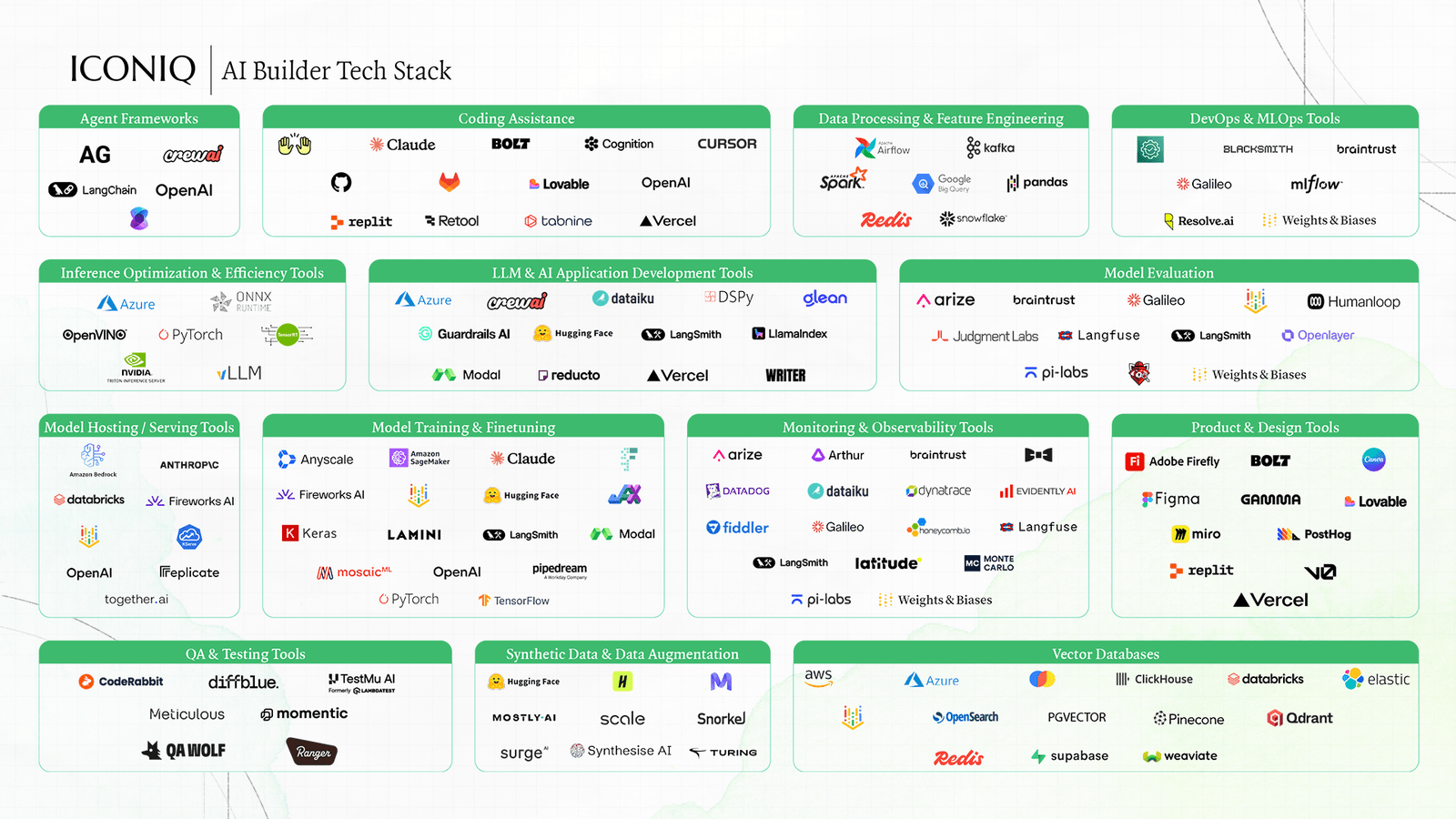
Image source: ICONIQ Capital
Brief: ICONIQ published its bi-annual State of AI report, surveying 300 executives building AI products to understand how teams are approaching model strategy, product differentiation, agentic workflows, and monetization.
Breakdown:
49% of firms report their primary differentiation comes from the application-layer rather than proprietary model development (14%).
Builders now use an average of 3.1 model providers, up from 2.8 six months ago, reflecting cost, latency, and performance considerations.
Subscription pricing remains common at 58%, but consumption-based (35%) and outcome-based (18%) pricing have grown meaningfully.
Use cases such as coding assistance, testing, documentation, and content generation show the highest time savings (30-40%+).
The AI tooling ecosystem is maturing around the most widely adopted tools for AI product development (image above).
Why it’s important: Advantage is accruing to teams that can scale AI reliably in production, control costs, and integrate it deeply into workflows that matter. AI leadership in 2026 will hinge on disciplined execution across product, cost, trust, and go-to-market.
CASE STUDY

Image source: OpenAI
Brief: OpenAI outlined how it built its bespoke in-house AI data agent, covering the motivation, context, evaluation, security design, and key lessons learned during deployment across the firm.
Breakdown:
OpenAI’s data platform supports over 3.5k internal users and 600PB of data, making discovery a major bottleneck for analysis.
The agent leverages GPT-5.2 and is embedded across Slack, web, IDEs, in the Codex CLI, and internal ChatGPT via an MCP connector.
Answer quality is improved through layered context that grounds reasoning in OpenAI’s data and institutional knowledge.
Designed as a collaborative teammate you can reason with, the agent supports both quick answers and iterative exploration.
Evals are built on curated question-answer sets that target metrics and analytical patterns OpenAI prioritizes for accuracy.
Why it’s important: This custom, internal-only agent built around OpenAI’s data, permissions, and workflows, offers insights into building impactful enterprise agents. The same tools used, GPT-5, Codex, the Evals API, and the Embeddings API, are available across enterprises.
MARKET & BEST PRACTICE INSIGHT

Image source: Anthropic
Brief: Anthropic, drawing on its experience with customers, released an 18-page report outlining trends it expects will define agentic coding in 2026. The trends span three categories: foundation, capability, and impact.
Breakdown:
AI is a constant collaborator, but using it effectively requires active supervision and validation, especially in high-stakes work.
Routine coding tasks can increasingly be delegated to AI, but humans remain responsible for validating and approving outputs.
Foundation trends describe how agentic systems are fundamentally reshaping the software development lifecycle (image above).
Capability trends focus on expanding agent scope, from single agents to coordinated agent teams and long-running agents.
Impact trends examine how productivity gains are reshaping software economics, and expanding AI use beyond technical roles.
Why it’s important: Taken together, these trends signal a shift from software development as an activity centered on writing code to an activity grounded in orchestrating agents that write code, while maintaining the human judgment, oversight, and collaboration that ensures quality outcomes.
BEST PRACTICE INSIGHT

Image source: Boston Consulting Group
Brief: BCG explored how selecting generative AI models is a strategic, not purely technical, decision, as each model embeds distinct perspectives that can shape analysis, judgment, and downstream business decisions.
Breakdown:
Gen AI models interpret information through embedded perspectives shaped by training data and design choices.
These perspectives affect how models frame risks, trade-offs, and priorities, even when outputs remain factually accurate.
Benchmarks alone are insufficient; companies should evaluate if model perspectives align with business goals (image above).
Leaders should ask whether a model broadens thinking, reinforces existing views, or productively challenges organizational assumptions.
Leveraging a small, intentional mix of models can reduce risk, surface blind spots, and better support critical decision making.
Why it’s important: Ignoring the perspectives embedded in models can increase risk, weaken trust, and distort decision making. Organizations should apply AI that leverages diverse perspectives to inform judgment and strengthen business integrity.

Bain examined how leadership teams evolve across five core dimensions to thrive with AI and how AI is reshaping the future of work inside the firm.
McKinsey released an end-to-end guide to evaluation across the delivery lifecycle and analyzed the automation curve in agentic commerce.
Intuition Labs shared insights on the evolution of enterprise AI agents, covering architectures, case studies, and Anthropic’s approach.
ServiceNow published 27 pages on AI’s impact on enterprise risk and security, warning failures arise when accountability is unclear.
Anthropic released a 20-page enterprise AI transformation guide for retail, highlighting lessons from retailers already achieving ROI.
OpenAI released a 16-page report on AI’s next chapter in the EU, plus how TRUSTBANK built personalized recommendations.

AWS shared an executive-level overview of generative AI, explaining neural networks, self-supervised learning, and applications like ChatGPT.
Google announced major Gemini upgrades in Chrome, including agentic browsing; while adding Agentic Vision to Gemini 3 Flash.
Anthropic CEO Dario Amodei published a new essay laying out where he sees AI risks; Claude added in-chat integration for apps like Slack and Canva.
Microsoft debuted Maia 200, its latest in-house AI inference chip, claiming strong benchmark gains while reducing reliance on Nvidia.
Clawdbot went viral for its agentic capabilities, briefly rebranded as Moltbot, and as of Jan 30 is OpenClaw. It’s open-source and powerful.
Moonshot AI, the Chinese startup, open-sourced Kimi K2.5, a 1T-parameter model rivaling GPT-5.2 and Claude Opus.

Executive+ members receive the extended edition of Enterprise AI Executive each week: Further AI transformation and technology coverage, plus executive insights beyond AI.
Your membership also supports the Enterprise AI Executive mission, helping to sustain research quality and consistency.

CAREER OPPORTUNITIES
OpenAI - Account Director, Enterprise
Databricks - AI GTM Leader
U.S. Bank - AI Senior Vice President
EVENTS
Google - Agentic AI Leaders Exchange - February 3, 2026
C-Vision - AI Engineering Exec Dinner - February 4, 2026
Microsoft - AI Power Days - February 17-19, 2026

Originally conceived as a practical communication for executives the editor, Lewis Walker, has worked with, this briefing now serves as a trusted resource for thousands of senior decision-makers shaping the future of enterprise AI.
If your AI product or service adds value to this audience, contact us for information on a limited number of sponsorship opportunities.
We also welcome feedback as we continue to refine the briefing.

Lewis Walker, Editor