- Enterprise AI Executive
- Posts
- Stanford's lessons from 51 deployments
Stanford's lessons from 51 deployments
Plus, Apple on-device AI, agentic AI architecture, and more.

Lewis Walker
April 05, 2026

Edition in partnership with

Welcome executives and professionals. The most valuable insights about AI adoption are not in hypotheticals or predictions. They are in the patterns of those who have already walked the path.
Since the previous edition, we have reviewed hundreds of the latest insights in agentic and generative AI, spanning best practices, case studies, market dynamics, and innovations.
This briefing outlines what is driving material value — and why it’s important.
In today’s briefing:
Stanford’s lessons from 51 deployments.
The layers of an agentic AI platform.
AI will reshape more jobs than it replaces.
Rethinking critical AI infrastructure.
Transformation and technology in the news.
Insights for Executive+ members.
Career opportunities & events.
Read time: 4 minutes.

BEST PRACTICE INSIGHT & CASE STUDIES

Image source: Stanford Digital Economy Lab
Brief: Stanford Digital Economy Lab examined 51 enterprise AI case studies across 41 firms, drawing on interviews with executives and project leaders to understand what drives successful enterprise AI deployments.
Breakdown:
Similar AI use cases delivered results in weeks at some firms and years at others, driven by differences in exec sponsorship and readiness.
Effective sponsors remove blockers, align teams, and tie AI initiatives to OKRs while fostering a culture that supports experimentation.
Headcount reduction was the main outcome in 45% of deployments, while 55% saw redeployment, hiring avoidance, or no change.
In 42% of cases, model choice was interchangeable, with advantage coming from orchestration rather than the underlying model.
Why it’s important: Every week brings new AI forecasts and debates about which jobs will disappear, which industries will transform, which companies will dominate. But executives are more concerned with the practical realities of what is happening right now, not what might happen in five years.
IN PARTNERSHIP WITH TELEPORT
Brief: AI agents are entering production, but legacy IAM can’t secure autonomous actors at scale. Teleport’s Agentic Identity Framework provides a standards-driven architecture with built-in identity, access, and governance.
What’s new:
Short-lived, delegated agent identity
Fine-grained access with MCP & LLM controls
Detection of shadow agents & context poisoning
Secure SDK integrations for infra & dev workflows
BEST PRACTICE INSIGHT
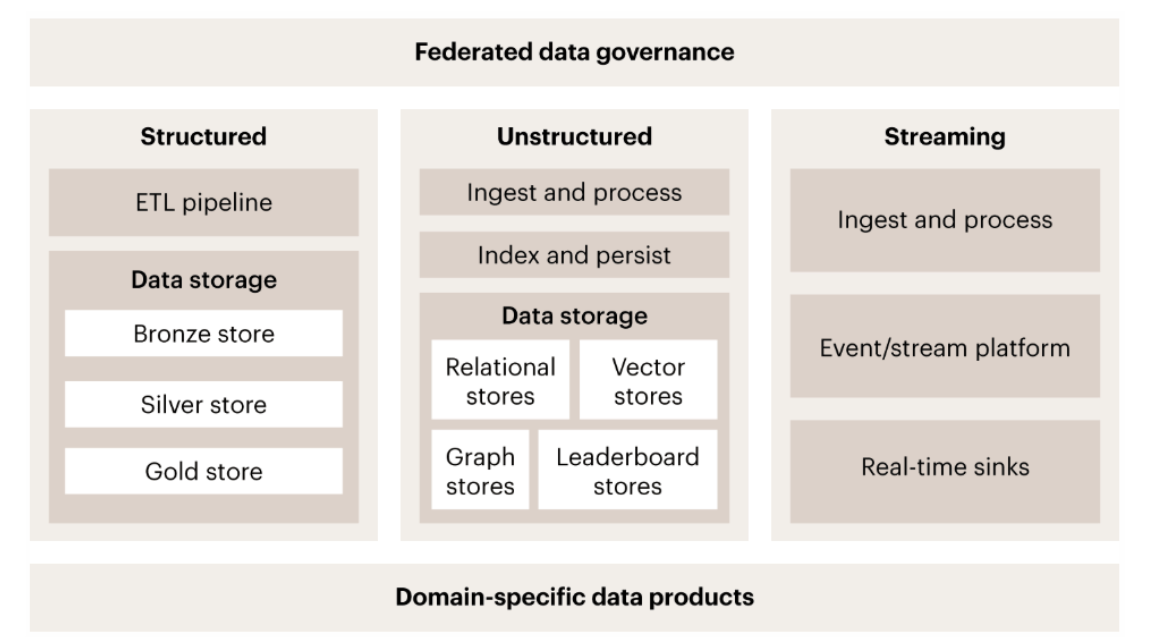
Image source: Bain & Company
Brief: Bain released part two of a four-part series on architecting for agentic AI, outlining how firms should move from isolated models to connected, nondeterministic systems and what this new architecture looks like in practice.
Breakdown:
Modern agentic AI demands a three-layer architecture centered on orchestration, observability, and governed data access.
The application and orchestration layer acts as the control centre, coordinating workflows, managing execution logic and parallel tasks.
The analytics and insight layer (image above) delivers real-time visibility to monitor performance across agents, workflows, and infrastructure.
The data and knowledge layer provides the foundation, integrating data through standardised interfaces for consistent access.
Why it’s important: Together, these layers transform AI architecture from a collection of independent components into a shared enterprise capability. Security and governance are embedded across layers rather than applied after deployment.
MARKET & BEST PRACTICE INSIGHT

Image source: BCG Henderson Institute
Brief: BCG Henderson Institute published a 21-page analysis exploring how AI is set to reshape the workforce, concluding that it will reshape more jobs than it ultimately replaces.
Breakdown:
Over the next two to three years, 50% to 55% of jobs in the US are expected to be reshaped by AI, altering how work is performed.
This shift is already underway and will accelerate, with microeconomic modeling highlighting a large portion of roles where AI will augment tasks.
As productivity gains drive end product demand, firms will require more workers and, in some cases, entirely new roles.
Augmentation and job creation will scale quickly, but full substitution will lag (only 10-15% of US jobs at risk of elimination 5 years from now).
Why it’s important: For employees, this signals continuity in role titles but significant change in expectations, workflows, and outputs. For leaders, it demands a clear transformation strategy, combining structured upskilling, reskilling, and a restructuring of career ladders.
MARKET INSIGHT

Brief: Apple commissioned an Omdia study of 1,500+ enterprise technology leaders, outlining how on-device infrastructure is emerging as a platform for enterprise AI development and deployment.
Breakdown:
The report offers an architectural solution to enterprise challenges across security, economic, and workload alignment.
Three-quarters cite data leakage risks in the cloud, while on-device AI reduces exposure by keeping sensitive data local.
On-device infrastructure offers near-zero marginal cost after setup, replacing variable cloud spend with fixed hardware.
57% of enterprise models are under 10 billion parameters, well within the capabilities of modern devices like the MacBook Air.
Why it’s important: Enterprises have relied on cloud and on-premise infrastructure, often combining both in hybrid models. However, many have yet to fully assess where on-device AI delivers benefits, particularly across security, cost control, and aligning infrastructure with workload demands.

Deloitte examined how firms should rethink operating models for human-agent collaboration as AI systems and multi-agent use cases evolve.
McKinsey detailed how tech leaders can “agentify” workflows, modernise data, and evolve operating models to capture AI value.
Microsoft released the Agent Governance Toolkit, an open-source MIT-licensed project addressing all 10 OWASP risks for AI agents.
KPMG’s Q1 AI Pulse shows capital continues to flow into AI, with firms projecting average spending of $207M over the next year.
Sequoia explored that most firms focus on AI for productivity gains, while few explore its potential to reshape collaboration.
The Digital Regulation Cooperation Forum published a 41-page report on agentic AI, covering opportunities, risks, and regulation.

Google DeepMind released Gemma 4, a family of open models for devices from phones to PCs under the Apache 2.0 license.
Cursor launched Cursor 3, a redesigned interface enabling developers to run fleets of local and cloud coding agents in parallel.
OpenAI acquired TBPN, a daily live tech show popular with Silicon Valley CEOs, in a deal worth hundreds of millions, marking its first move into media.
Alibaba introduced Qwen3.6-Plus, a reasoning model rivaling top coding benchmarks while supporting 1M-token context and multimodal inputs.
SpaceX filed for a potential IPO targeting a $1.75T valuation and $75B raise, positioning it among the most valuable companies globally.
Matthew Gallagher scaled Medvi from a $20K AI experiment to $1.8B in projected revenue, an example of a solo billion-dollar AI company.

Unlock Executive AI Index: The top 221 AI playbooks, by industry and function, with direct links to each. Updated weekly.
Get the extended version of Enterprise AI Executive, delivered twice weekly.

CAREER OPPORTUNITIES
BNY - Applied AI Senior Vice President
SAP - Agentic Experiences Vice President
Morgan Stanley - AI Executive Director
EVENTS
Wharton - AI Future of Work - May 20-21, 2026
Microsoft Build - June 2-3, 2026
ServiceNow Knowledge - May 5-7, 2026

Reach enterprise AI decision-makers:
66% of readers are C-level executives or VP and Director-level leaders.
63.2% of the audience is based in the U.S., EU, UK, ANZ, and Singapore.
Read by leaders at Microsoft, Deloitte, the Fortune 500, and more.
Guaranteed impression and custom sponsorship packages available, with post-send performance reporting.

Conceived as a practical communication for executives Lewis Walker has worked with, this briefing has become a trusted resource for thousands of senior decision-makers shaping the future of enterprise AI.
We welcome your feedback.

Lewis, Ashley, Mark