- Enterprise AI Executive
- Posts
- McKinsey: 6 board actions to govern AI
McKinsey: 6 board actions to govern AI
Plus, how boards use AI, Anthropic AI engineering, and more.

Lewis Walker
December 07, 2025

Welcome executives and professionals. With trillions of dollars potentially at play and implications that could be existential to companies, AI is a reckoning, not a trend. And that’s why it’s a board-level priority.
Since the previous edition, we have reviewed hundreds of the latest insights in agentic and generative AI, spanning best practices, case studies, market dynamics, and innovations.
This briefing outlines what is driving material value — and why it’s important.
In today’s briefing:
McKinsey: How board directors govern AI.
AICD: How board directors use AI.
AI’s impact on engineering at Anthropic.
AWS re:Invent 2025 highlights.
Transformation and technology in the news.
Career opportunities & events.
Read time: 4 minutes.

BEST PRACTICE INSIGHT
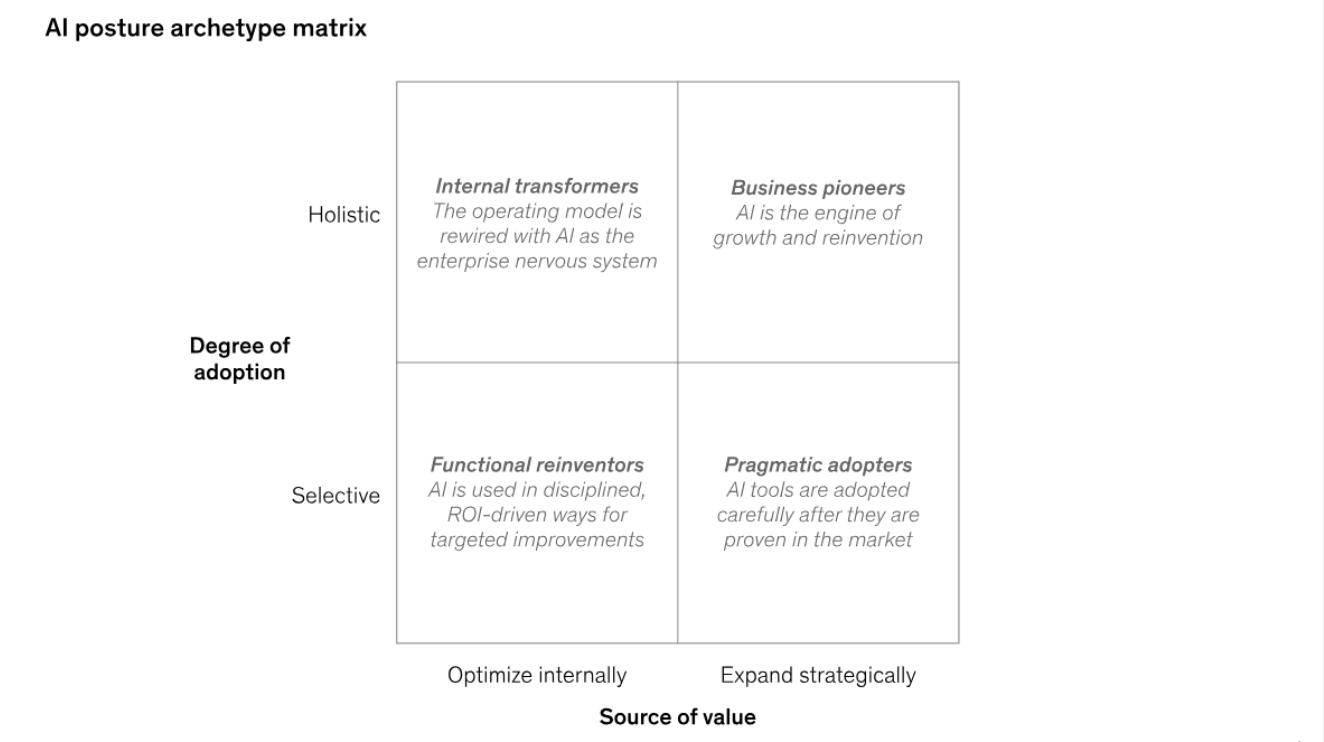
Image source: McKinsey & Company
Brief: McKinsey outlined how boards can define the company’s posture toward AI adoption and align the governance model to that posture, along with six governance actions that every board should consider.
Breakdown:
Boards should align on the company’s AI posture (image above), since clarity is foundational to other governance actions (1).
Oversight requires ownership across the board and management, with clear topics set for review in board meetings (2).
Boards should formalize an AI governance policy, moving beyond principles toward escalation triggers and standards for scaling (3).
Directors should frequently engage executives embedding AI into business operations to stay current on operational progress (4).
Boards should push management to quantify AI’s risks and opportunities (5) and build AI fluency to understand how AI shapes value (6).
Why it’s important: The rules, risks, and expectations related to AI are evolving rapidly. Boards need to evolve to match the pace and scope of change that AI promises while maintaining their traditional focus of providing strategic direction and oversight to senior management.
BEST PRACTICE INSIGHT
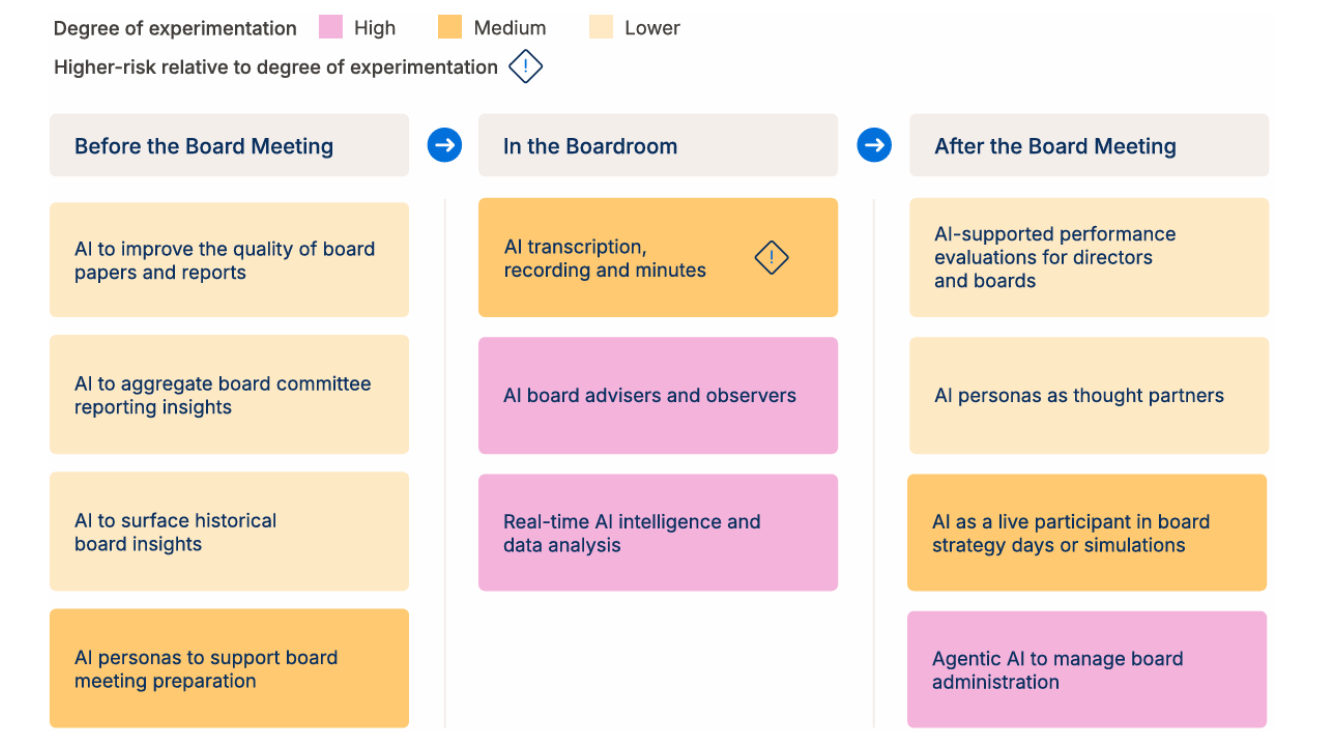
Image source: Australian Institute of Company Directors
Brief: The Australian Institute of Company Directors published a 28-page report outlining how boards and directors can use AI, detailing practical use cases, the potential impacts on board roles as well as wider dynamics.
Breakdown:
Before board meetings, AI can improve reports, aggregate insights, surface historical decisions, and act as a preparatory persona.
In the boardroom, AI can support transcription and minutes, act as an advisor or observer, and offer real-time intelligence and data analysis.
After board meetings, AI can support performance evaluations, aid strategy simulations, and help manage board administration.
The report notes a two-speed dynamic at play, with collective formal board use of AI lagging ‘shadow’ individual director use.
It provides guidance for using AI alongside human judgment, ensuring decisions stay within the limits, purpose and role of the board.
Why it’s important: As organizations embed AI into operations and business strategy, conversations in boardrooms are shifting from ‘how do we govern AI’ to ‘how can AI help us govern?’ This report aims to prompt directors to assess where AI can enhance the practice of directorship, today and in the future.
MARKET INSIGHT
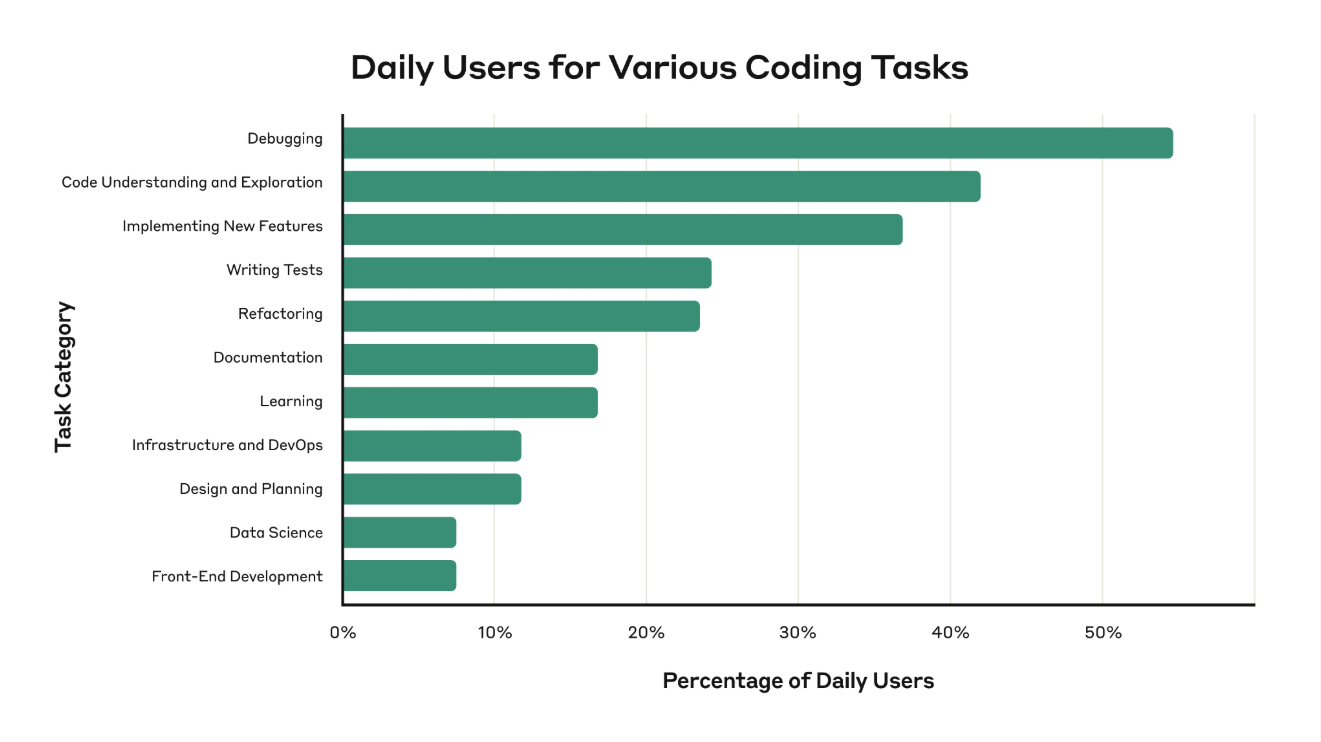
Image source: Anthropic
Brief: Anthropic surveyed 132 of its own engineers and researchers, conducted 53 in-depth qualitative interviews, and studied internal Claude Code usage data to find out how AI use is changing work across the company.
Breakdown:
Anthropic uses Claude most often to fix code errors and learn about code, making debugging and code understanding the most common uses.
Employees report using Claude in about 60% of their work and achieving a 50% productivity lift, marking a two-to-three-fold jump from last year.
27% of Claude-assisted work consists of newly viable work, including scaling projects and making nice-to-have dashboards.
Claude Code now chains together ~20 actions before needing human input, up from 10 six months ago, letting engineers offload more work.
Despite the gains, several interviewees voiced unease, with one saying it "feels like I'm coming to work every day to put myself out of a job."
Why it’s important: Observing how a frontier lab applies its own AI technology offers valuable insight into AI engineering impact, yet employees’ mixed sentiments highlight the genuine uncertainty around AI’s long-term effects on software engineering roles.
ENTERPRISE INNOVATION
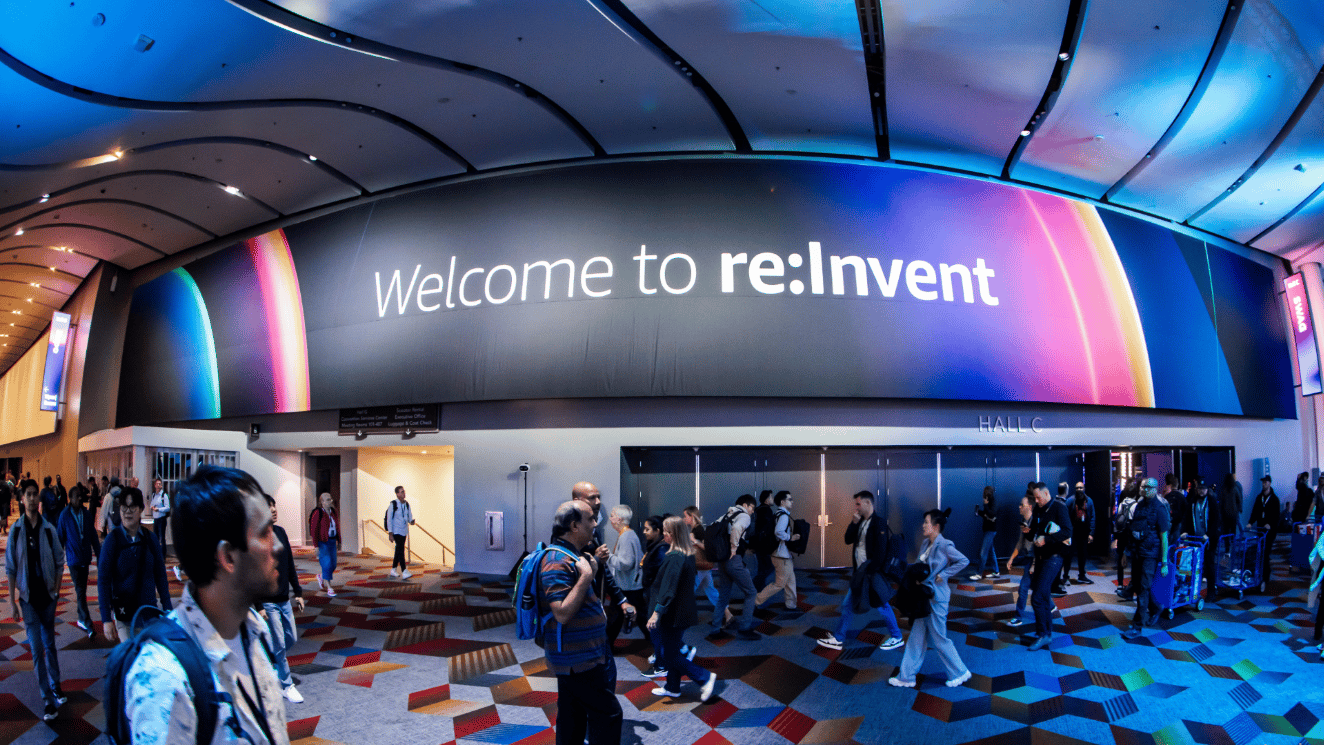
Image source: Amazon Web Services
Brief: AWS’s annual re:Invent conference in Las Vegas delivered a wave of AI announcements, including new Nova foundation models, a model training service, expanded agentic capabilities, and the Trainium3 chip.
Breakdown:
The Nova 2 lineup spans Lite, Pro, Sonic for voice, and Omni for multimodal tasks, offering cost-effective, competitive performance.
Nova Forge lets companies combine their data with Amazon's training data, creating custom "Novella" variants tuned to their business.
Nova Act launches for building and managing AI agents for web-based tasks, alongside improvements to the company’s AgentCore platform.
AWS introduced three "frontier agents," Kiro for coding, plus Security and DevOps agents, designed for long-running autonomous operation.
New Bedrock and SageMaker features simplify advanced AI model customization, allowing for easier model fine-tuning.
Why it’s important: The re:Invent releases show AWS's continued push to compete on the full enterprise AI stack, combining chips, models, and agents. As competition intensifies, AWS is bolstering it AI capabilities and position in the cloud infrastructure market, holding a 30% share as of Q2 2025.

McKinsey outlined how the real AI advantage comes from domain owners who bridge business problems with the possibilities of technology.
BCG published 28 slides on AI-first luxury and fashion firms; plus insights on agentic AI in customer service and rethinking vendor strategy.
TCS’s 24-page Future-Ready Manufacturing Study detailed the current state of AI, future of autonomous operations, and strategic recommendations.
Futurum evaluated whether 2025 actually delivered agentic AI progress or just hype, and how agents have become enterprise battlegrounds.
Deutsche Bank reviewed risks facing OpenAI as Sam Altman signals “code red,” citing slowing subscriptions, emerging substitutes, and cost pressures.
Deloitte shared how Toyota reshaped operations with agentic AI, emphasizing that agents alone won’t drive advantage; process redesign and people will.
Andreessen Horowitz and OpenRouter shared a 100-trillion-token study showing how people use AI today and what it reveals about the future.
Sequoia foresees 2026 as a “Year of Delays” for data centers and AGI, while accelerated end-user adoption pushes AI deeper into enterprise workflows.

Anthropic is reportedly preparing for a 2026 IPO, with Claude Code hitting a $1B annual revenue run rate in just six months.
Google deepened its Replit partnership for enterprise AI coding and introduced Workspace Studio for natural-language agent building.
OpenAI CEO Sam Altman told staff the firm is aiming to fast-track a model codenamed “Garlic” amid the “code red” surge to improve ChatGPT.
Mistral released Mistral 3, a family of 10 open-weight models, from its flagship Large 3 to smaller versions designed to run on laptops, drones, and robots.
Snowflake and Anthropic announced a $200M multi-year partnership to deploy Claude-powered AI agents to Snowflake’s 12,600+ enterprise customers.
Harvey, the AI legal startup, raised $160M at an $8B valuation, while reporting that roughly half of the Am Law 100 firms now use the AI platform.
DeepSeek launched V3.2 and V3.2-Speciale, reasoning models matching GPT-5 and Gemini 3 Pro while remaining cost-efficient and open-source.
MIT and Hugging Face studied 2.2B downloads, revealing a “fundamental rebalancing” in open-weight AI as the U.S. loses share to Chinese firms.

CAREER OPPORTUNITIES
Anthropic - Head of Partner Success
Microsoft - AI Strategy Senior Director
U.S. Bank - Head of AI Strategy
EVENTS
The AI Summit - December 10-11, 2025
OpenAI - Prompting Best Practices - December 18, 2025
CES 2026 - January 6–9, 2026

Originally conceived as a practical communication for executives the editor, Lewis Walker, has worked with, this briefing now serves as a trusted resource for thousands of senior decision-makers shaping the future of enterprise AI.
If your AI product or service adds value to this audience, contact us for information on a limited number of sponsorship opportunities.
We also welcome feedback as we continue to refine the briefing.

Lewis Walker, Editor