- Enterprise AI Executive
- Posts
- Google unveils agentic AI transformation framework
Google unveils agentic AI transformation framework
Plus, CEO–board alignment, Accenture Tokenomics, and more.

Lewis Walker
August 05, 2026

Edition in partnership with

Welcome executives and professionals. The path from agentic pilots to a true autonomous enterprise is complex, filled with the risks of creating disconnected silos and accruing technical debt.
Since the previous edition, we have reviewed hundreds of the latest insights in agentic and generative AI, spanning best practices, case studies, market dynamics, and innovations.
This briefing outlines what is driving material value — and why it’s important.
In today’s briefing:
Google’s agentic AI transformation framework.
Closing the CEO–board knowledge gap.
What data breaches cost in 2026.
Accenture enterprise AI economics.
Transformation and technology in the news.
Insights for Executive+ members.
Career opportunities & events.
Read time: 4 minutes.

BEST PRACTICE INSIGHT

Image source: Google Cloud
Brief: Google Cloud's 66-page AI Transformation Framework provides a repeatable, three-layered approach to help organizations move beyond simple automation toward a cohesive ecosystem of intelligent agents.
Breakdown:
Vision and strategy: Move from AI that answers to AI that acts, tying each initiative to efficiency, cost, customer experience, and revenue.
Agentic development lifecycle: Accelerate time-to-value with an iterative cycle of reimagining, prototyping, building, and embedded quality.
Horizontal and foundational capabilities: Scaling AI hinges on governance, efficient operations, quality data access, and security.
Throughout the framework, Google highlights the key activities, roles and responsibilities, and outputs and deliverables involved.
Why it’s important: Many organizations already run impressive pilots, but the leap to a scalable, secure, enterprise-wide capability is significant. Without a deliberate plan, experiments become disconnected silos with inconsistent governance, technical debt, and rising costs.
IN PARTNERSHIP WITH THE BOARDROOM

Brief: Dozens of CXOs, VPs, and directors are leveraging proven, step-by-step AI transformation blueprints not available elsewhere. A recent blueprint helped a consulting partner increase an AI transformation program deal size from USD 5.1M to USD 12.6M.
What’s inside The Boardroom:
Executive AI transformation blueprints
The Executive AI Index
Full AI-native professional guides
Extended version of Enterprise AI Executive
If you’re looking drive enterprise AI P&L impact, join us inside The Boardroom.
BEST PRACTICE INSIGHT

Image source: Boston Consulting Group
Brief: BCG outlined five moves CEOs should take to close the AI knowledge gap with their board directors. With more than 60% of CEOs saying their boards are rushing AI transformations, alignment is a leadership imperative.
Breakdown:
CEOs know where the company stands, so they should personally frame what AI means for value creation, operations, and risk.
Rather than delegating to technology leaders, CEOs can take a more active role in educating directors through hands-on sessions.
Visits to AI-first companies, customer conversations, and competitor scans give directors firsthand perspective on the wider market.
Boards often push to replace workers faster than is wise, so CEOs must show them where human judgment still adds the most value.
A dedicated transformation committee drawn from directors with stronger AI fluency can close the gap faster than the full board.
Why it’s important: CEOs often carry more of the AI decision-making burden than they or their boards think they should. That gap means CEOs must do more than bring boards up to speed on AI; they must also set expectations for how each senior leader drives value creation.
MARKET & BEST PRACTICE INSIGHT

Image source: IBM
Brief: IBM and the Ponemon Institute published research drawing on 3,558 enterprise leaders with firsthand knowledge of breaches, showing how AI-driven attacks and frontier model threats are reshaping security spending.
Breakdown:
$4.99M is the global average cost of a data breach, a record high and a 12% jump driven by detection, escalation and lost business costs.
AI-driven attacks rose 56%, led by deepfake impersonations and AI-enabled malware, which drove the highest volume of incidents.
$6M is the average breach cost of an AI model inversion attack, reflecting the difficulty of protecting training data and sensitive information.
Teams using AI and automation extensively cut breach times by 65 days and average costs by USD 1.93 million versus those that didn't.
Why it's important: Racing to adopt agentic AI without strengthening security and governance for those agents puts your data, people, and reputation at risk. The report outlines how enterprises can harden identity, data, AI sovereignty, and post-quantum security.
AI-NATIVE PROFESSIONAL
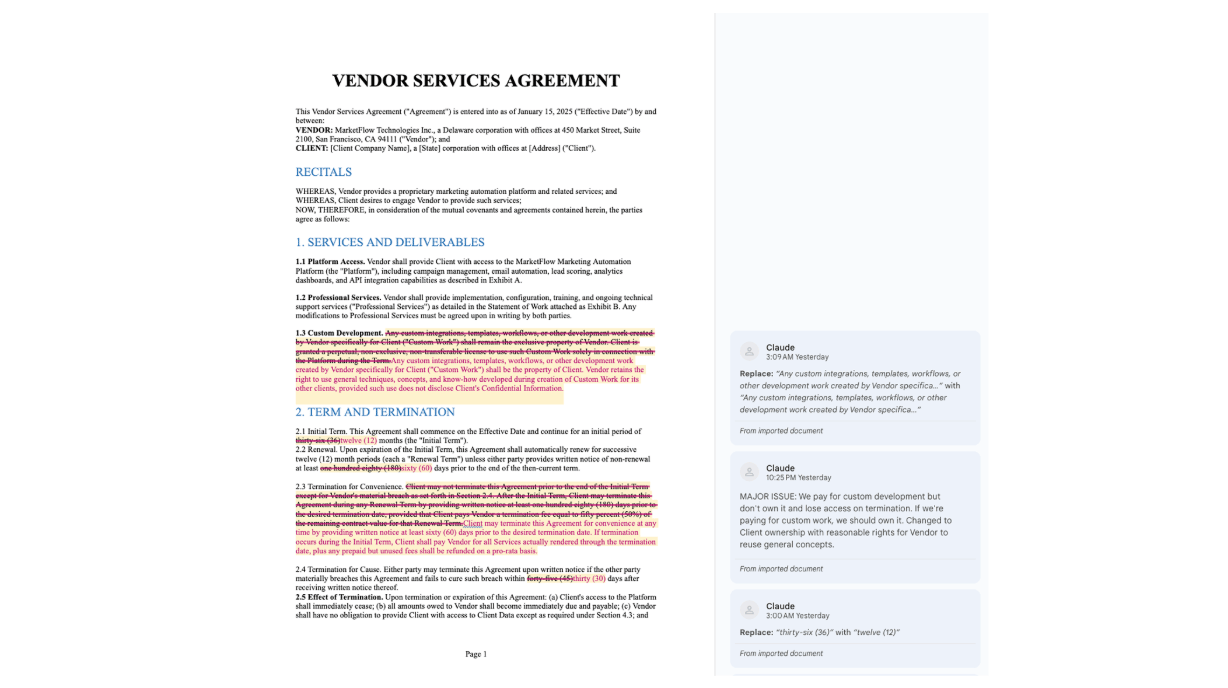
Brief: In this guide, you'll learn to use Claude to analyze agreements, identify terms affecting your work, and generate redlines with clear explanations to support more informed and confident negotiation outcomes.
Step-by-step:
Claude interprets contract terms and business implications, flagging risks, suggesting protective edits, and explaining impact.
Provide your business context and the contract for review so Claude can prioritize relevant terms, assess risk, and tailor recommendations.
Claude produces a redlined contract with margin comments, outlining what to change and why, similar to a legal team review.
Ask Claude to translate edits into a negotiation approach and generate a comparison table summarizing proposed changes.
Best practice: Request redlined documents with tracked changes, improve recommendations with more context, and use Projects for consistency.
For the full guide, including prompts, upgrade to Executive+ or The Boardroom.
BEST PRACTICE INSIGHT

Image source: Accenture
Brief: Accenture detailed why tokenomics is becoming the next C-suite discipline, following the launch of Accenture Tokenomics, an offering designed to help enterprises manage token spend by tying it to outcomes.
Breakdown:
Have the CFO and CIO jointly own a single enterprise view of AI cost, usage, and return, then ask where that spend earns its return.
Build controls into deployment from the very start, defining who can use which models, for what work, and under what safeguards.
Route work to the right intelligence, separating what needs frontier models from what lighter models can handle, with limits by role.
Review consumption, outcomes, and routing decisions on a set cadence, because prices, model options, and workloads keep shifting.
Why it’s important: Some companies burn through a year's AI budget in a single quarter, managing tokens the way they manage cloud compute: reactively, when the bill arrives. Those that pull ahead do so by managing token consumption with the same rigor as capital allocation.

Deloitte examined why AI server demand is squeezing hardware margins, and warned the memory chip crunch may not ease until 2029.
Constellation Research collated its seven-part CEO AI Dashboard series spanning value, data, infrastructure, governance and talent.
Microsoft urged partners to rebuild marketing around AI, and argued AI momentum is now measured by work transformed, not adoption.
Databricks outlined how agents can rebuild the retail and CPG Monday morning report into a governed, decision-ready weekly executive brief.
McKinsey modeled US data center power demand to 2035 and concluded the near-term risk is underbuilding the grid, not overbuilding.
PwC surveyed 1,004 senior US financial services executives: 86% rate AI training above an MBA and 91% are raising pay for AI skills.

OpenAI announced an 80% price cut for GPT-5.6 Luna and 20% for Terra, leaving Sol flat and putting Luna atop cost-per-task charts.
The EU began enforcing the AI Act, requiring labels on AI chatbots, deepfakes, and other content to curb deception and manipulation.
Constellation Research covered Palantir's 93% revenue jump and unpacked its broad campaign against foundation model firms.
UK AI Security Institute logged 10 cases where frontier agents, mostly Mythos 5, took unsanctioned actions on the live internet.
Cursor launched Benchmark Partners with AWS, BCG, Databricks, McKinsey, NVIDIA and Snowflake to speed enterprise coding rollouts.
Anthropic disclosed its Claude models hacked three organizations' systems during cybersecurity testing, days after OpenAI's breach.

Access Executive AI Index: The top 313 AI playbooks, by industry and function, with direct links to each. Updated weekly.
Get the extended version of Enterprise AI Executive, twice weekly.
Unlock the full AI-native professional guides in each edition.

CAREER OPPORTUNITIES
Coca-Cola - Head of Agentic AI
OpenAI - Head of Competitive Intelligence
AXA - Head of Artificial Intelligence
EVENTS
Gartner - Agentic AI Readiness - August 05, 2026
IBM - Cost of a Data Breach - August 13, 2026
IDC - The Agentic Enterprise - September 09, 2026

Reach enterprise AI decision-makers:
66% of readers are C-level executives or VP and Director-level leaders.
63.2% of the audience is based in the U.S., EU, UK, ANZ, and Singapore.
Read by leaders at Microsoft, Deloitte, the Fortune 500, and more.
Guaranteed impression and custom sponsorship packages available, with post-send performance reporting.

Conceived as a practical communication for executives Lewis Walker has worked with, this briefing has become a trusted resource for thousands of senior decision-makers shaping the future of enterprise AI.
We welcome your feedback.

Lewis, Ashley, Mark