- Enterprise AI Executive
- Posts
- Goldman Sachs: AI’s next operating system
Goldman Sachs: AI’s next operating system
Plus, OpenAI GPT-5.5, AI-first SaaS, and more.

Lewis Walker
April 26, 2026

Edition in partnership with

Welcome executives and professionals. For much of its recent history, we’ve treated artificial intelligence as a system that produces answers. World models suggest something more ambitious.
Since the previous edition, we have reviewed hundreds of the latest insights in agentic and generative AI, spanning best practices, case studies, market dynamics, and innovations.
This briefing outlines what is driving material value — and why it’s important.
In today’s briefing:
The operating system for decision-making.
The AI-first SaaS company.
OpenAI introduces GPT-5.5.
The five-layer AI framework.
Transformation and technology in the news.
Insights for Executive+ members.
Career opportunities & events.
Read time: 4 minutes.

ENTERPRISE INTELLIGENCE

Brief: Goldman Sachs examined how, after a decade of systems that recognize patterns and predict text, AI is shifting toward models that understand how the world works and could become the operating system for enterprise decisions.
Breakdown:
A world model acts as an internal simulator, repeatedly asking: if I do this, what happens next? Humans rely on this instinct daily.
World models are powerful because they can approximate how groups behave, not only in aggregate but in interaction.
Enterprises already spend heavily predicting how others will respond: competitor moves, market reactions, and board behavior under pressure.
Today these judgements rely on experience, static analysis, and intuition. Multi-agent simulations offer a closer model of human systems.
Why it’s important: By populating digital environments with agents reflecting different incentives, constraints, and information sets, firms gain a higher fidelity operating system for decisions. Strategies can be tested against adaptive rivals, while governance can be stress-tested before crisis hits.
IN PARTNERSHIP WITH TELEPORT
Brief: Launching agents today means manual stitching of IAM, infra, and secrets by hand. Teleport Beams changes that, letting you run agents securely with identity, control, and trusted runtimes built-in for agentic AI across your infrastructure.
With Teleport Beams, you can:
Gain visibility into agent activity
Run agents with identity security
Control agents with guardrails
Eliminate operational friction
EXECUTIVE INSIGHT
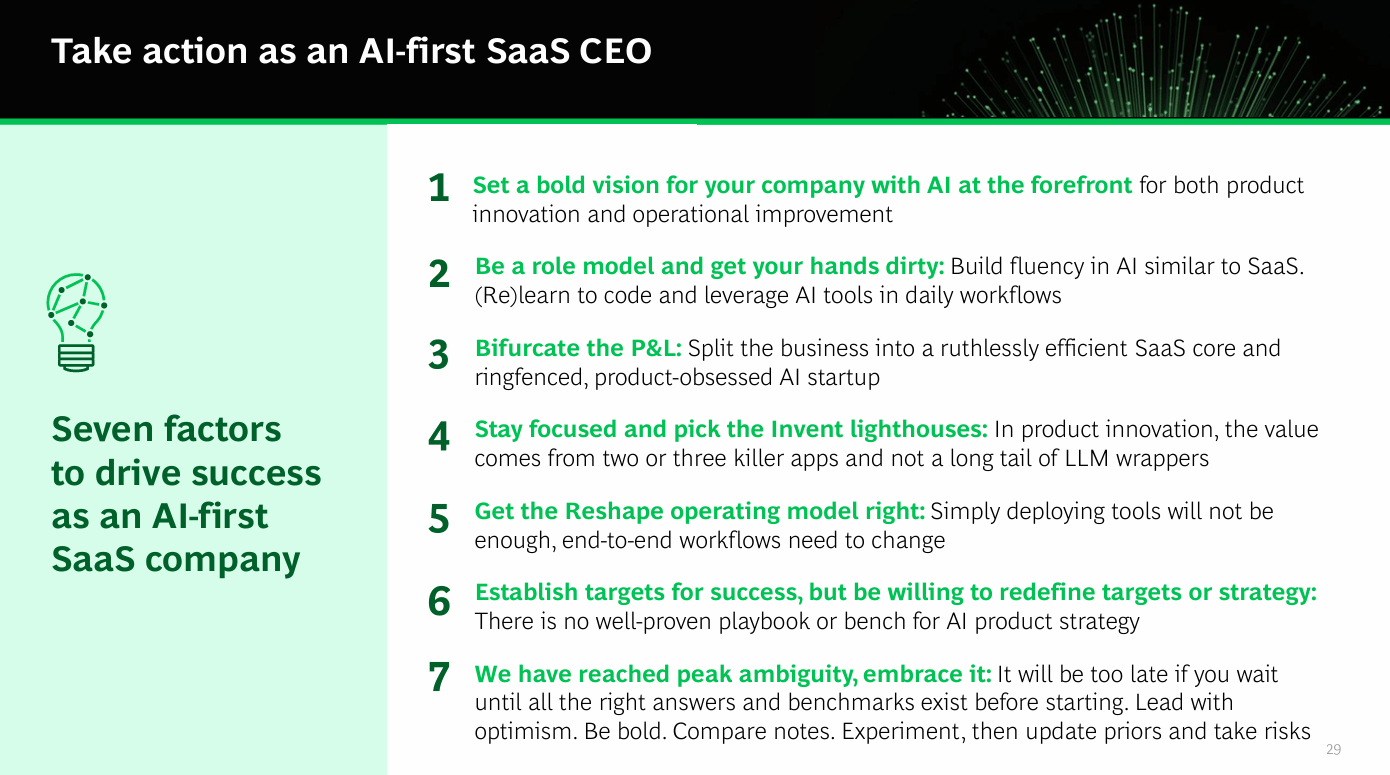
Image source: Boston Consulting Group
Brief: BCG released a 32-slide executive playbook on capturing the future of software, including how leaders should make three distinct plays, with the greatest emphasis on Invent and Reshape, to transform P&L in light of AI.
Breakdown:
Invent: Build AI-first products and agents that expand TAM, with ringfenced teams targeting 1.5-2x annual contract value (ACV) uplift.
Incumbents should fund the AI P&L separately from the core SaaS business: expect lower near-term margins (50%-60% gross margins).
Reshape: Prioritize redesigning internal functions that represent the highest P&L share: software R&D and GTM (~20 EBITDA points possible).
Deploy: Roll out general-purpose AI tools enterprise-wide to lift productivity, but alone this rarely creates substantial P&L impact.
Why it’s important: AI is the greatest-value creation opportunity for enterprise software since cloud: unlocking over $3T TAM. At the same time, fast-moving AI-native startups are pressuring incumbents. Leaders who act decisively in the next 6-12 months have a clear opportunity to win.
ENTERPRISE INNOVATION
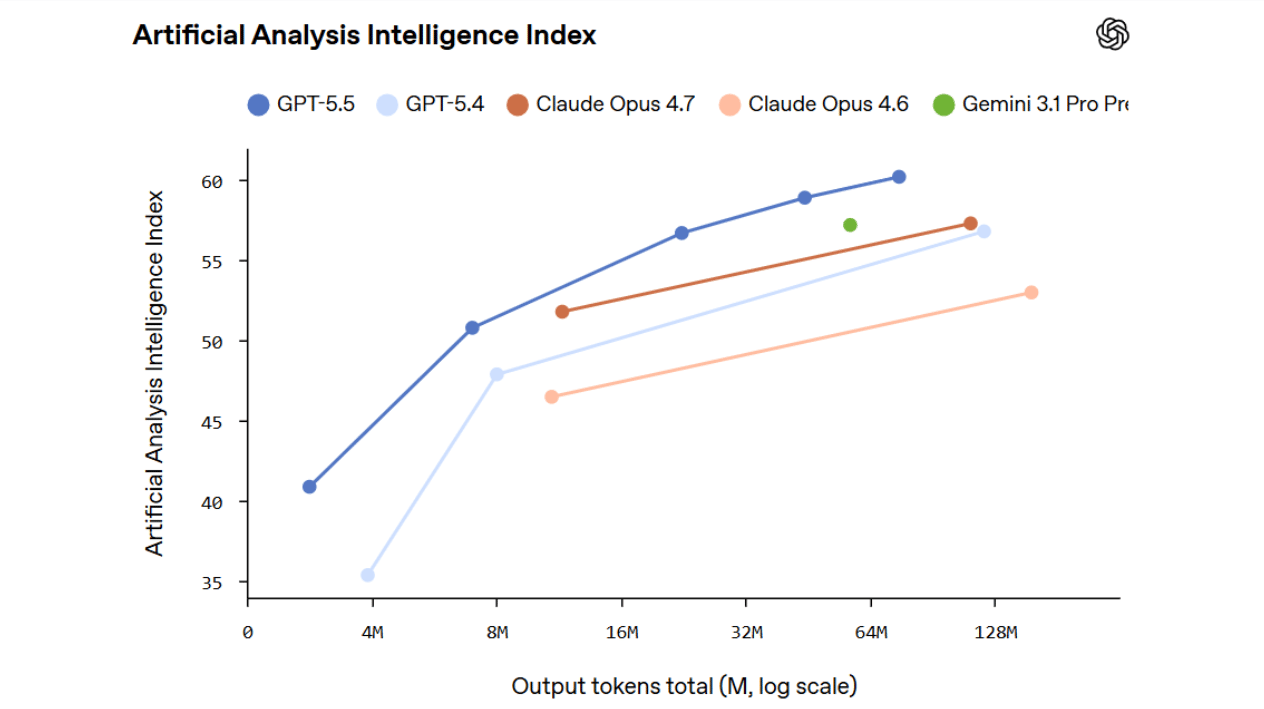
Image source: Artificial Analysis / OpenAI
Brief: OpenAI launched GPT-5.5, codenamed Spud, its long-awaited upgrade, calling it a "new class of intelligence." The model leads major benchmarks and moves ahead of Anthropic at the frontier of public AI model performance.
Breakdown:
GPT-5.5 posts top scores across reasoning, agentic use, computer use, and coding for public models, with several comparable to Claude Mythos.
The model keeps GPT-5.4 speed while improving efficiency, with OpenAI saying Codex and 5.5 helped rewrite its own GPU code.
5.5 is priced at $5/$30 per million input/output tokens for API pricing, pitched as “half the cost of competitive frontier coding models.”
5.5 is rolling out across ChatGPT plans and Codex in Thinking and Pro variants, with OpenAI continuing to highlight ‘generous usage.’
Why it’s important: After months of Anthropic momentum, sentiment appears to be shifting again. OpenAI is shipping fast, restoring excitement that seemed muted around previous releases. With Anthropic facing complaints on rate limits and quality consistency, this is a strong week for OpenAI.
BEST PRACTICE INSIGHT

Image source: McKinsey & Company
Brief: McKinsey outlined a five-layer framework for planning, measuring, and managing AI investments, and how to operationalize it through a simple management cadence and a set of project phases.
Breakdown:
Typically, AI projects move through four main phases, similar to other technology projects: Pilot, MVP, Initial Scaling, and Full Scale.
Taken together, these stages show how the five-layer framework moves from concept to operating model (see article for full details).
Early phases emphasize technical performance (layer 5) and adoption (layer 4), proving the system is safe, reliable, and used in work.
As deployments mature, measurement shifts to operational impact (layer 3), strategic outcomes (layer 2), and financial performance (layer 1).
Why it’s important: Decision gates ensure that progress up the pyramid is evidence based: projects advance only when signals at one layer credibly support moving to the next. In this way, the framework does more than track AI performance. It creates a structured path to durable enterprise value.

BCG published executive playbooks on AI-first aerospace and defense firms, and AI-first refineries winning in volatile markets.
IBM published a 32-page report on how orchestrating AI governance drives value, while many firms are still governing AI with outdated tools.
Futurum Group shared insights on governing and scaling the agentic enterprise with Gemini Enterprise and cloud-native security.
Infosys released its 2026 AI-first GCC Index, surveying 500 GCCs on adoption patterns, outcomes, and success factors.
Wharton published a 47-page report on psychological frictions slowing adoption and evidence-based ways leaders can overcome them.
IBM assessed what OpenClaw reveals about agentic AI security risks and what organizations can do to reduce exposure.

Google released Deep Research and Deep Research Max, agents that use Gemini 3.1 Pro to generate reports, charts, and infographics.
White House memo accused Chinese firms of industrial-scale distillation targeting U.S. frontier AI labs before Trump-Xi talks in Beijing.
OpenAI introduced Workspace Agents in ChatGPT, new Codex-powered bots built to tackle multi-step workflows.
Anthropic traced Claude Code quality complaints to three separate bugs and reset subscriber usage limits after the issues.
SpaceX announced a new partnership with Cursor and secured an option to buy the startup for $60B later this year.
Anthropic’s Claude analysis found biggest AI productivity gains came from workers most worried about job loss, especially juniors.

Unlock Executive AI Index: The top 233 AI playbooks, by industry and function, with direct links to each. Updated weekly.
Get the extended version of Enterprise AI Executive, delivered twice weekly.

CAREER OPPORTUNITIES
OpenAI - Head of Industries
Accenture - AI Strategy & Governance Leader
Kearney - AI Strategy Vice President
EVENTS
Agentic Enterprise Summit - June 3-4, 2026
Snowflake Summit - June 1-4, 2026
Chief AI Officer Summit - June 9, 2026

Reach enterprise AI decision-makers:
66% of readers are C-level executives or VP and Director-level leaders.
63.2% of the audience is based in the U.S., EU, UK, ANZ, and Singapore.
Read by leaders at Microsoft, Deloitte, the Fortune 500, and more.
Guaranteed impression and custom sponsorship packages available, with post-send performance reporting.

The marketplace for trusted enterprise AI services, technology, and talent.
Transformation - Enterprise AI strategy, operating model, discovery, implementation, & managed services. Buy services. Sell services.
Technology - Enterprise AI technology from GPU providers and foundation models to agentic frameworks and beyond. Buy tech. Sell tech.
Talent - Executive and delivery talent, business and technical, from enterprise AI strategy to execution. Recruit Talent. Get Hired.

Conceived as a practical communication for executives Lewis Walker has worked with, this briefing has become a trusted resource for thousands of senior decision-makers shaping the future of enterprise AI.
We welcome your feedback.

Lewis, Ashley, Mark