- Enterprise AI Executive
- Posts
- Deloitte SFL CTO reveals 5 lessons building agentic AI
Deloitte SFL CTO reveals 5 lessons building agentic AI
Plus, Microsoft Ignite, OpenAI engineering, and more.

Lewis Walker
November 23, 2025

Welcome executives and professionals. While it is easier than ever to prototype AI solutions, success at scale requires rigorous validation, thoughtful change management, agile development, and user-centric design.
Since the previous edition, we have reviewed hundreds of the latest insights in agentic and generative AI, spanning best practices, case studies, market dynamics, and innovations.
This briefing outlines what is driving material value — and why it’s important.
In today’s briefing:
Deloitte’s lessons building agentic AI.
OpenAI: Agents accelerating the SDLC.
Microsoft Ignite 2025 highlights.
Google: 260 pages on building AI agents.
Transformation and technology in the news.
Career opportunities & events.
Read time: 4 minutes.

BEST PRACTICE INSIGHT
Image source: Deloitte SFL Scientific
Brief: SFL Scientific, a technical AI arm of Deloitte, saw its CTO Michael Luk and other specialists share five lessons on deploying generative/agentic AI. As generative AI is central to agentic AI, they refer to both simply as "agentic AI."
Breakdown:
Agentic AI should start small; its broad potential makes focus hard, and tight scoping prevents misaligned expectations while driving steady value.
Evaluation is challenging (unstructured/novelty of outputs); define success early and build feedback loops to avoid optimizing the wrong goals.
Strong UX and change management matter; intuitive workflows often outperform technical accuracy in driving user adoption and business value.
Shipping AI requires addressing uncertainty and hallucinations; pairing LLMs with RAG, citations, ReAct, etc. drives reliability that scales.
Agentic AI is evolving rapidly; new protocols, governance models, and solution patterns unlock value but also introduce added complexity.
Why it’s important: Agentic AI succeeds where RPA/traditional ML fall short, particularly with large amounts of unlabeled/unstructured data. Prototyping AI is faster than ever, but full enterprise deployment still takes time. Effort shifts from data prep to post-hoc validation, guardrails, and change management.
AI-NATIVE ENGINEERING
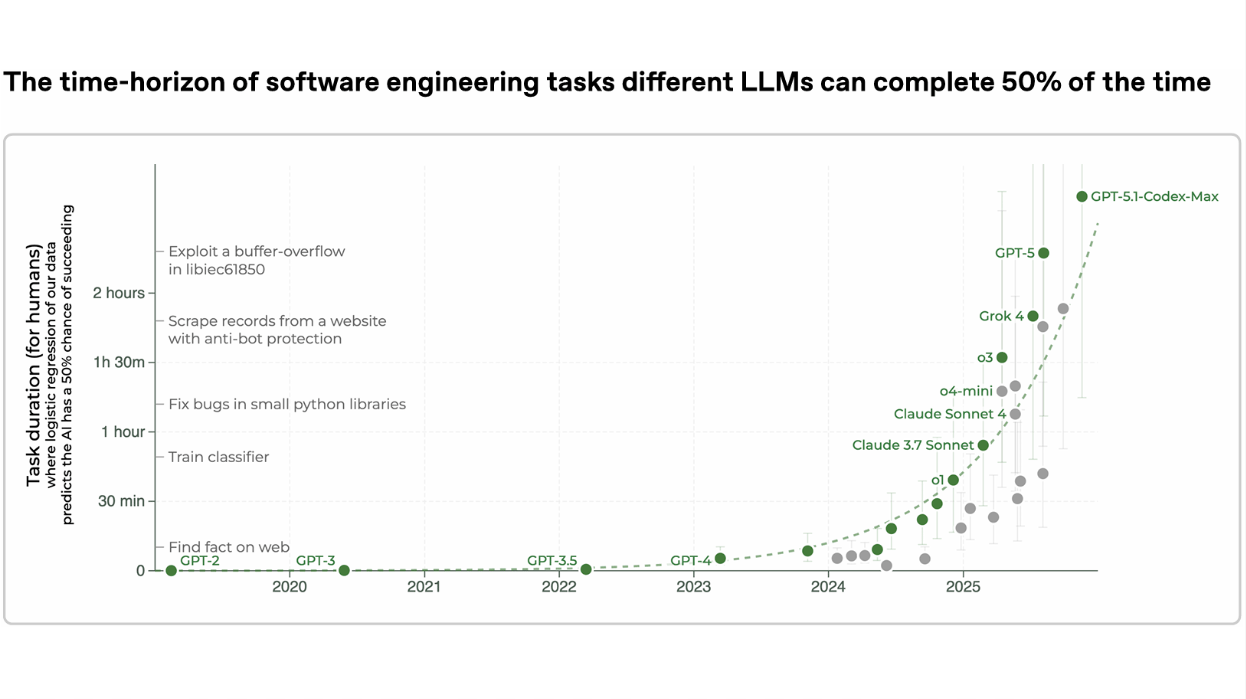
Image source: OpenAI / METR
Brief: OpenAI released a 20-page guide showing how coding agents support stages of the SDLC, what engineers focus on instead, enterprise examples, and steps leaders can take to start building AI-native engineering teams.
Breakdown:
As models sustain longer reasoning chains, the entire SDLC is in scope for agents to help plan, design, build, test, review, and deploy & maintain.
Coding agents deliver the greatest impact in the build phase, reducing hours engineers spend converting specs into code, even for small features.
Agents produce full features end-to-end, including data models, APIs, UI components, tests, and documentation, in a single coordinated run.
Instead of translating a feature spec into code, engineers concentrate on correctness and maintainability, areas where human context matters.
In deploy & maintain, Virgin Atlantic uses the Codex VS Code Extension to inspect logs, trace issues, and review changes through Azure DevOps MCP.
Why it’s important: Coding agents are transforming the SDLC by automating repetitive, multi-step tasks that slow engineering teams. With sustained reasoning, full-codebase context, and tool execution, they now support scoping, prototyping, implementation, and testing, accelerating delivery at scale.
ENTERPRISE INNOVATION
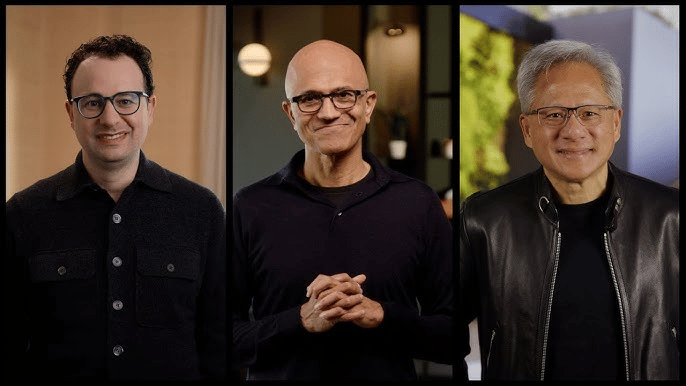
Image source: Microsoft
Brief: Microsoft’s Ignite 2025 in San Francisco drew 20,000 attendees, highlighting deeper partnerships and new capabilities aimed at making it easier for enterprises to deliver AI agents and become “frontier firms.”
Breakdown:
Day 1 centered on a major Microsoft–Anthropic–NVIDIA deal, with Anthropic committing $30B to secure access to 1 GW of Azure compute.
Microsoft/NVIDIA will invest $15B in Anthropic (now the only major model provider on all U.S. hyperscalers) while expanding Azure’s model options.
Microsoft previewed Work IQ, Fabric IQ, and Foundry IQ, products designed to address context limitations that reduce agent effectiveness.
Agent 365 was introduced to help manage AI agents, providing identity, policy, governance, and lifecycle controls across deployments.
Agent Factory offers a pre-purchased path for firms to deliver agents, adding simplified licensing and forward-deployed Microsoft engineers.
Why it’s important: Microsoft’s announcements aim to reduce the friction organizations face when building agents by improving data access, controls and simplifying deployment. These steps address challenges many organizations are having deploying agents at scale, although it is still early days.
BEST PRACTICE INSIGHT
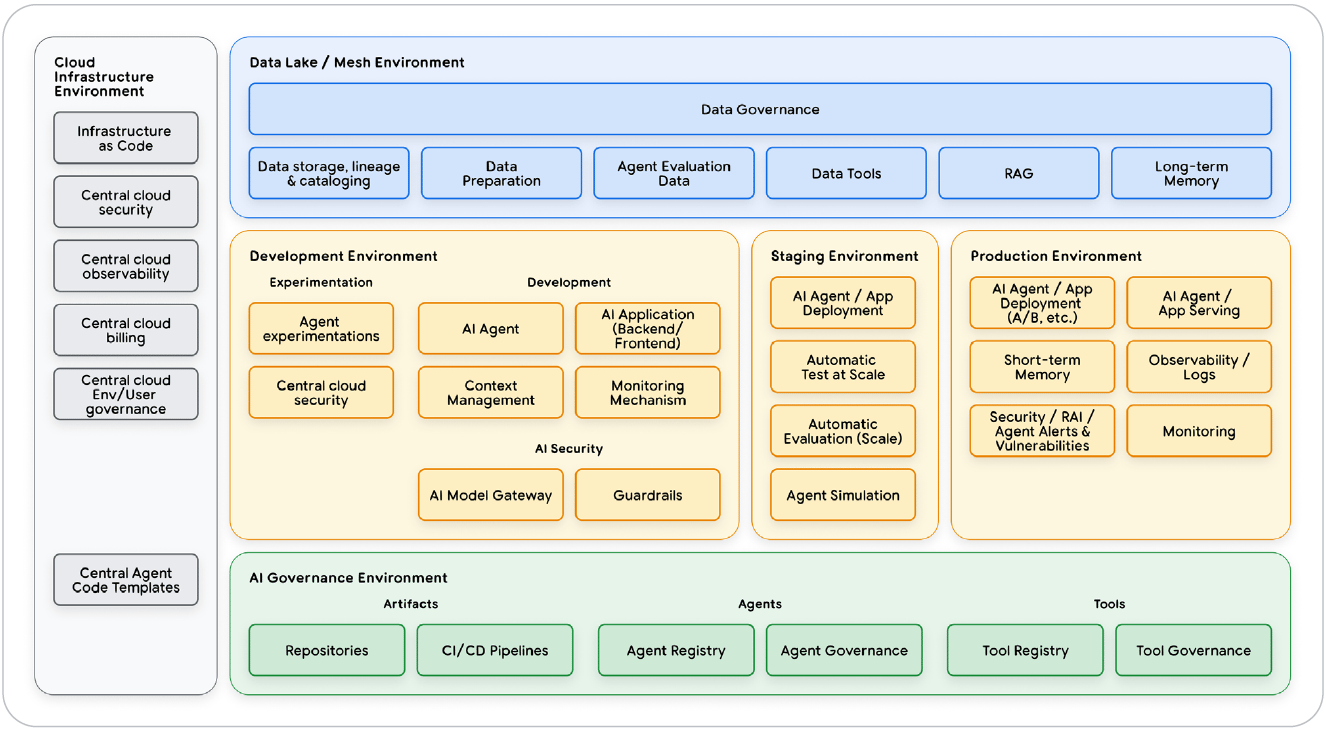
Image source: Google - Prototype to Production
Brief: Google published five new guides on building AI agents, spanning 260 pages of practical insights on agent tools, the Model Content Protocol (MCP), context engineering, agent quality, and production deployment.
Breakdown:
Intro to AI Agents (50 pages) explains the five agent levels, from basic reasoning to self-evolving systems, including scalable architectures.
Agent Tools & Model Context Protocol (50 pages) covers tool design, MCP, and security, including MCP servers adding tools without approval.
Context Engineering & Memory (70 pages) teaches building memory that actively curates context, so each session isn’t treated as the first.
Agent Quality (50 pages) explains why traditional QA fails, the four pillars (effectiveness, efficiency, robustness, safety) and evaluating reasoning.
Prototype to Production (40 pages) focuses on building the trust to move agents into production with CI/CD pipelines and scalable infrastructure.
Why it’s important: The shift continues from AI that predicts or generates content to systems that autonomously solve problems. Google’s guides help enterprises move beyond prototypes, building robust agentic systems that perform reliably at scale in production environments.

McKinsey shared a 23-slide deck on limited AI P&L impact and why the next three years should be different, plus insights on the evolution of neoclouds.
Andreessen Horowitz shared insights on enterprise AI product sales, including the "new rhythm of the enterprise sale" and AI-first lessons.
MIT Sloan and BCG published a 40-page report showing 35% of companies use agentic AI while highlighting challenges like scalability vs. adaptability.
Menlo Ventures examined AI-native security startups emerging as incumbents struggle against AI threats and AI agents enable autonomy at scale.
OpenText published a 217-page enterprise AI guide covering the evolution of data, agentic AI, governance, sovereign AI, and more across 11 chapters.
AWS unveiled specialized professional services AI agents, and the Agentic AI Security Scoping Matrix mapping architectures by autonomy and connectivity.
Gartner published its Magic Quadrant for AI Application Development Platforms, and the 2025 Innovation Guide for Gen AI model providers.
Forrester shared insights on agentic payments and forecasted that neoclouds will capture $20B in revenue in 2026, challenging hyperscaler AI dominance.

Google released Gemini 3, trained on Google's TPUs and topping the LMArena Leaderboard. It’s now available in Gemini Enterprise and Vertex AI.
Google introduced Antigravity, an agentic development platform enabling developers to operate at a higher, task-oriented level by managing agents.
OpenAI rolled out its group chat feature across all tiers, launched GPT-5.1-Codex-Max, and began deploying a more capable GPT-5.1 Pro.
Cloudflare acquired Replicate, adding its 50k-plus model catalog to its Workers platform while maintaining Replicate’s existing APIs and community.
Google launched Nano Banana Pro, its image model built on Gemini 3, and expanded NotebookLM to create infographics and slide decks.
Replit launched Design, a new AI UI experience for creating polished website designs within the platform, powered by Google’s Gemini 3 model.
Humain announced new AI partnerships with xAI, Nvidia, and others, outlining plans to build a 500+ MW data center, and deploy Grok across Saudi Arabia.
Amazon founder Jeff Bezos is returning from semi-retirement to co-lead Project Prometheus, a startup building advanced AI for manufacturing.

CAREER OPPORTUNITIES
Anthropic - Head of Industry, Insurance
J.P. Morgan - AI Transformation Executive Director
Takeda - Head of AI & Data
EVENTS
IBM - Data for Enterprise AI - November 25, 2025
Stanford - Enterprise AI Agents - December 2, 2025
Gartner - Agentic Compass - December 10, 2025

Originally conceived as a practical communication for executives the editor, Lewis Walker, has worked with, this briefing now serves as a trusted resource for thousands of senior decision-makers shaping the future of enterprise AI.
If your AI product or service adds value to this audience, contact us for information on a limited number of sponsorship opportunities.
We also welcome feedback as we continue to refine the briefing.

Lewis Walker, Editor