- Enterprise AI Executive
- Posts
- Deloitte's 6-pillar AgenticAdopt framework
Deloitte's 6-pillar AgenticAdopt framework
Plus, NVIDIA GTC, why the world still runs on SAP, and more.

Lewis Walker
March 18, 2026

Edition sponsored by

Welcome executives and professionals. Agentic AI is moving fast, leaving C-level leaders facing tough questions: how to secure write-enabled agents, draw sovereignty lines, and scale without losing control.
Since the previous edition, we have reviewed hundreds of the latest insights in agentic and generative AI, spanning best practices, case studies, market dynamics, and innovations.
This briefing outlines what is driving material value — and why it’s important.
Go beyond the brief with Executive+
Unlock Executive AI Index: The top 205 AI playbooks, by industry and function, with direct links to each. Updated weekly.
Get the extended version of Enterprise AI Executive, delivered twice weekly.
In today’s briefing:
Deloitte's AgenticAdopt framework
Enterprise-grade agentic AI.
NVIDIA GTC 2026 highlights.
Why the world still runs on SAP.
Transformation and technology in the news.
Insights for Executive+ members.
Career opportunities & events.
Read time: 4 minutes.

BEST PRACTICE INSIGHT
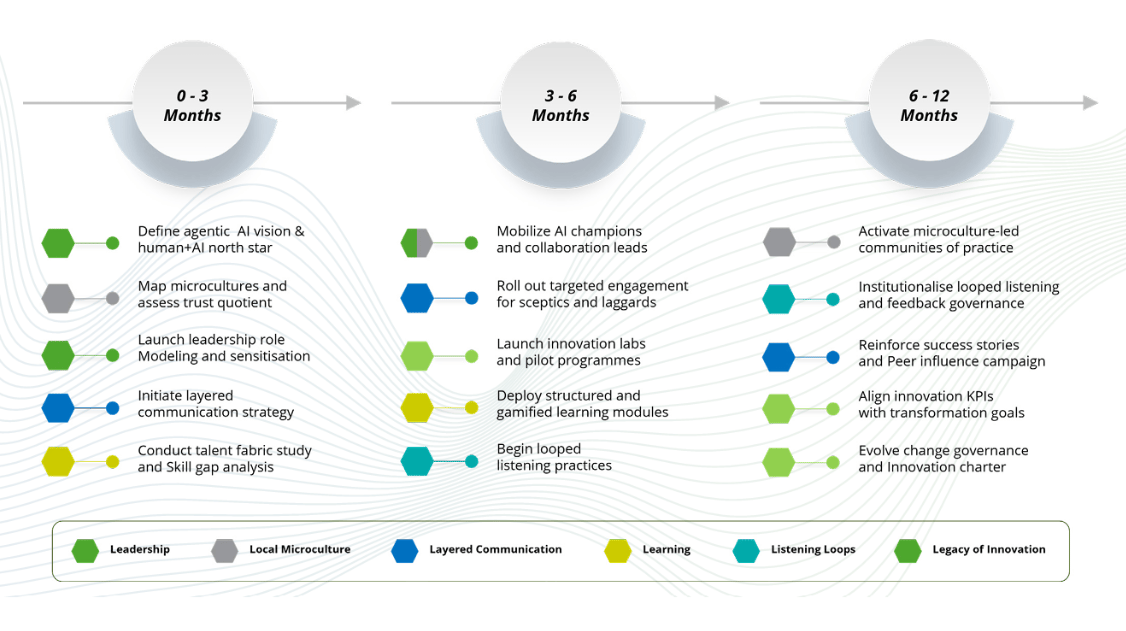
Image source: Deloitte
Brief: Deloitte shared its AgenticAdopt Kompass™ framework, outlining six interconnected pillars that guide firms through the agentic AI journey, ensuring alignment, adaptability and impact at every stage of AI change.
Breakdown:
The framework pillars include leadership for strategic alignment and local microcultures to build trust and adoption.
It highlights layered communication for explainability and learning models focused on role design in agentic workflows.
Listening loops enable human-in-the-loop feedback, while “legacy of innovation” supports simulation environments for testing agentic AI.
These pillars are activated across transformation stages, guiding organisations through adoption and scale-up (image above).
Why it’s important: This framework outlines strategies for CXOs to build trust, embed governance, and lead the agentic AI shift as a human-centred evolution. In this era, success will not be defined by how much AI can do, but by how humans and AI evolve together.
TOGETHER WITH DEX
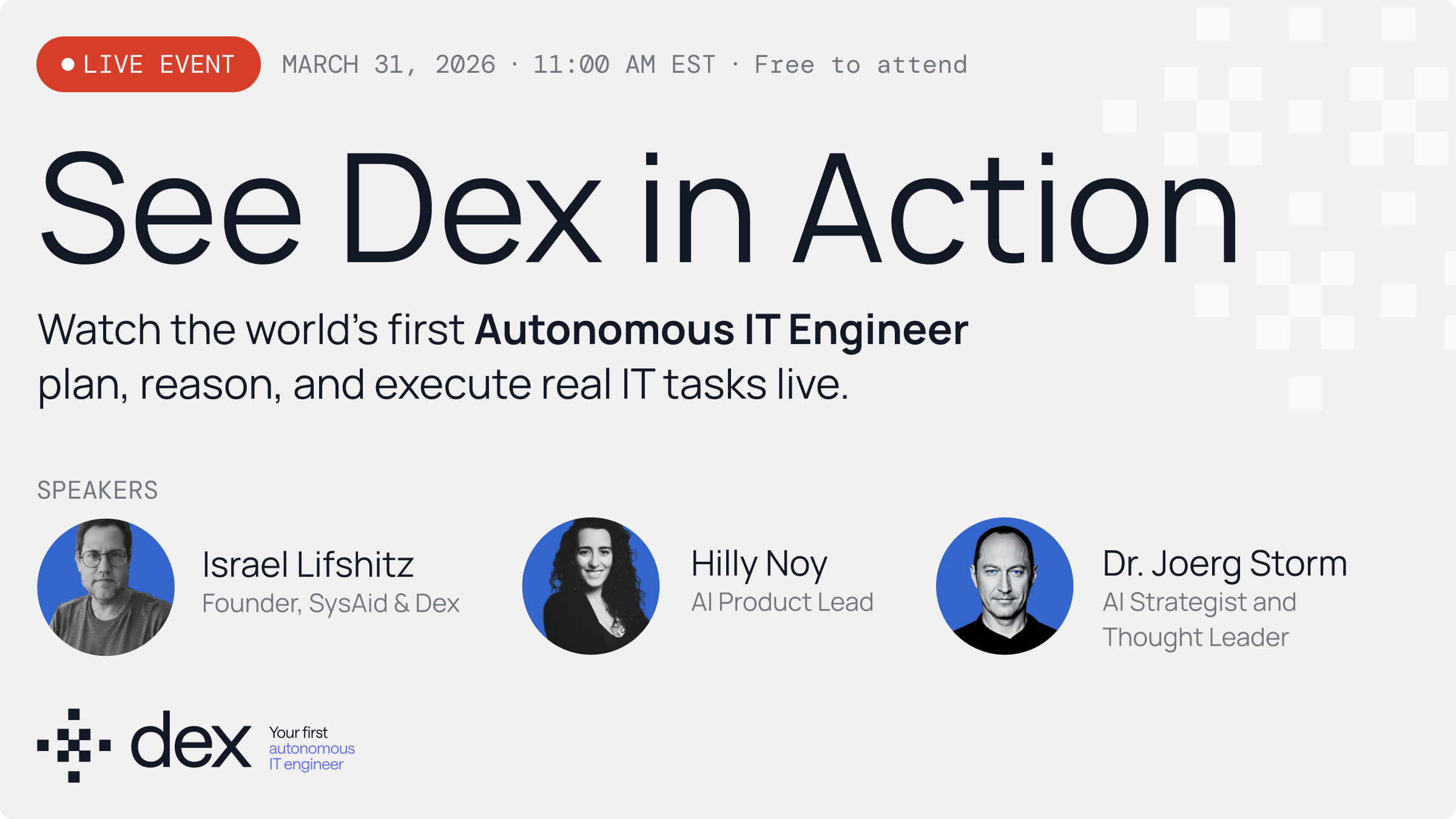
Brief: Dex doesn’t just assist IT; it investigates, plans, and executes tasks with controlled autonomy. Dex reasons through IT issues across your environment. Built by a team with rare depth, trusted by 3,000+ organizations and millions of users worldwide.
The Dex advantage:
Specialized AI agent built for complex, end-to-end IT tasks.
Resolve issues through plain-language conversations.
Maintain control: Approve all actions before execution.
Resolve 90% of IT issues before they become tickets.
See the first public demonstration of Dex on March 31.
BEST PRACTICE INSIGHT & CASE STUDY
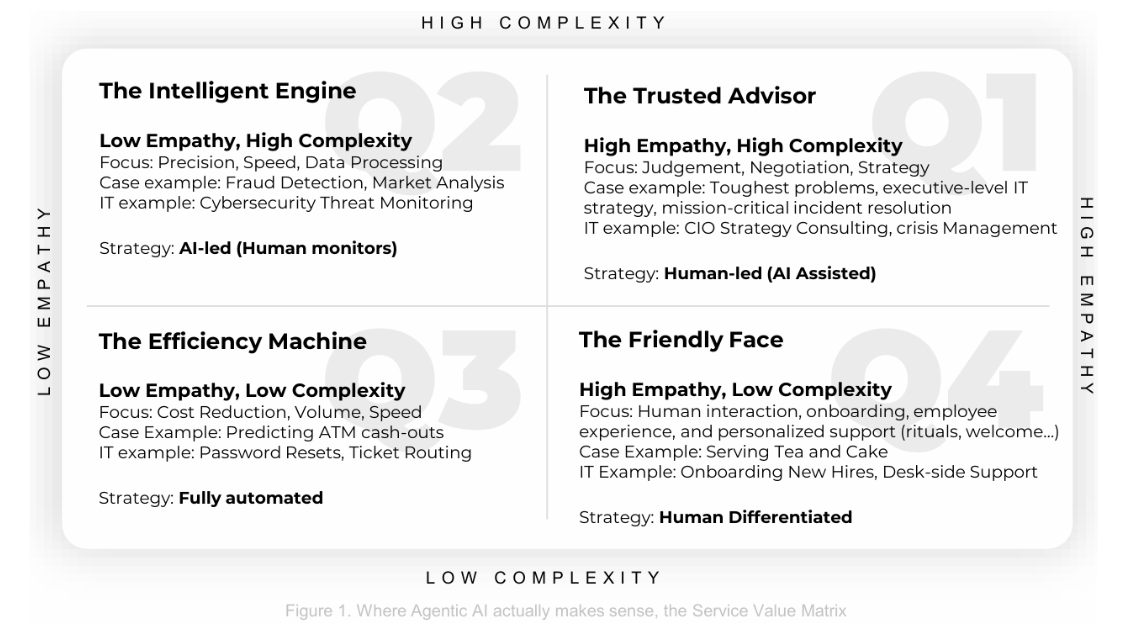
Image source: Atos - Service Value Matrix
Brief: Atos published an 18-page white paper on enterprise-grade agentic AI, as the technology advances rapidly but enterprises still face challenges around defensible value, security, sovereignty, and scaling in production.
Breakdown:
Introduces a “Services as Software” blueprint using Atos’ Sovereign Agentic Studio to turn workflows into software-driven outcomes.
Defines a trust control plane with runtime governance, zero-trust access, behavioral security, kill switches, observability, and audit trails.
Explains sovereignty by design while embedding AgentOps and FinOps from day one with unit economics, and strong data readiness.
Includes do's and dont's for scaling agentic AI and a production case study on incident resolution, showing how autonomy can scale with control.
Why it’s important: Most agentic AI efforts fail when moving from demo to production due to gaps in governance, security, and cost discipline. This framework provides a path to scale autonomy, aligning deployments with enterprise risk, compliance, and economic accountability requirements.
ENTERPRISE INNOVATION

Image source: NVIDIA
Brief: Nvidia CEO Jensen Huang announced a range of innovations at GTC 2026, including NemoClaw for secure agents, the Vera Rubin AI platform, DLSS 5 for photorealistic games, and enterprise and robotics tools.
Breakdown:
NemoClaw introduces security and privacy guardrails for OpenClaw agents, supporting enterprise adoption of agentic AI.
The Vera Rubin platform launches seven new chips for AI training, with hints of space-based data centers in future deployments.
DLSS 5 brings AI-powered photorealistic lighting and materials to games in real time, with Bethesda, Capcom, and Ubisoft onboard.
A new open-source Agent Toolkit allows enterprises to build secure AI agents, alongside partnerships for robots, vehicles, and more.
Why it’s important: Huang positioned Nvidia as “vertically integrated but horizontally open.” Announcements from chips to agents, game graphics, and robotics, reinforce its strategy to own the infrastructure layer beneath AI workloads while enabling open innovation on top.
BEST PRACTICE INSIGHT
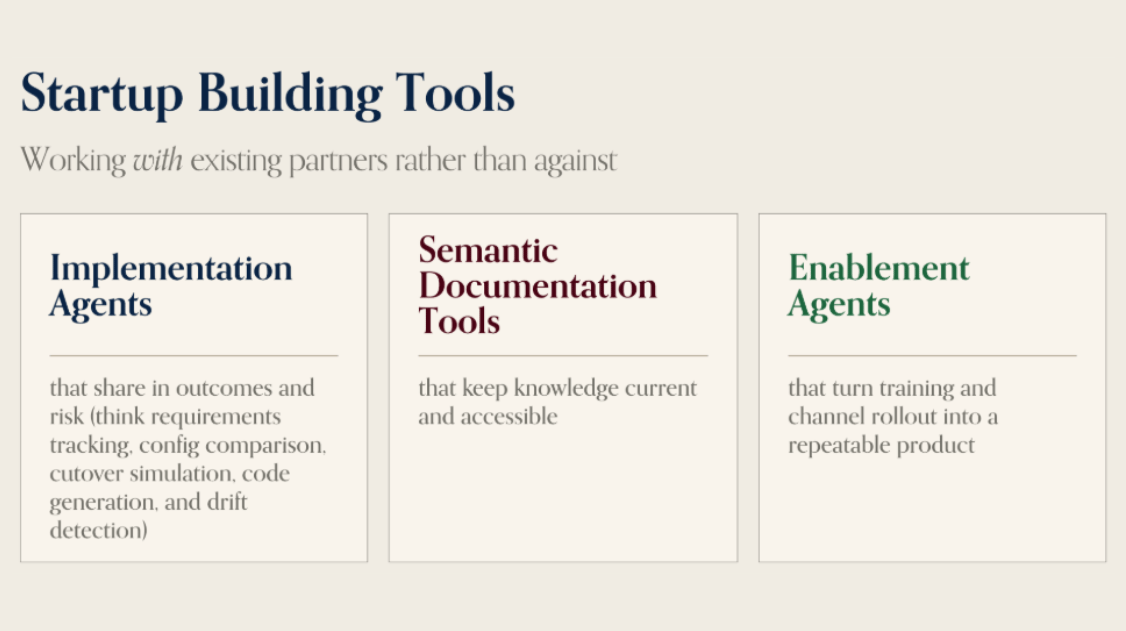
Image source: Andreessen Horowitz (a16z)
Brief: a16z’s article examined how SAP endures by capturing critical business data, workflows, and custom logic, making replacement costly and risky, while AI enables smarter, incremental modernization
Breakdown:
AI innovation has focused on net-new capabilities including voice agents, workflow automation tools, and text-to-app platforms.
However, a less glamorous but more valuable opportunity lies in helping firms extract more value from systems like SAP.
Legacy systems persist as they store important data and undocumented processes, make migration complex, and risky for enterprises.
AI unlocks the opportunity to upgrade, customize, and better use the data captured in these systems of record (image above).
Why it’s important: AI may not completely replace core systems like SAP, ServiceNow, or Salesforce, but instead make them more programmable and accessible. This shifts innovation to the interface, automation, and extension layers, where new value is created while systems of record remain intact.

Oliver Wyman outlined how agentic AI can reimagine compliance, enabling proactive governance in complex, fast-changing regulatory environments.
MIT Sloan showed how Schneider Electric scales AI, avoiding pilot purgatory by advancing with confidence over certainty.
IDC argued agentic AI is now critical infrastructure, as systems accessing proprietary data and tools shift from productivity layers to core operations.
IBM shared guidance on building and evaluating AI agents that perform reliably across real-world environments, from early prototypes to full production.
Palo Alto Networks explored how agentic AI is forcing a rethink of identity, and why emerging coding approaches need resilient, self-healing foundations.
Microsoft shared 10 strategies for using AI to improve thinking, from surfacing best practices to generating alternatives and refining decisions.

OpenAI is overhauling its strategy to focus on coding and businesses, after leadership called Anthropic’s enterprise dominance a "wake-up call."
Mistral launched Forge, giving enterprises its internal training recipes and infrastructure to build custom models on proprietary data securely.
Microsoft merged its Copilot teams, shifting AI CEO Mustafa Suleyman’s focus to its five-year mission of building superintelligence in-house.
OpenAI launched GPT-5.4 mini and nano, smaller and faster models designed for coding assistants and multi-agent system deployments.
Meta signed a $27B deal with Nebius to deploy AI cloud infrastructure, including large-scale deployments of Nvidia’s Vera Rubin platform.
Anthropic unveiled Dispatch, a Claude feature letting users message the assistant via phone while it runs tasks, code, and workflows on a PC.

Unlock Executive AI Index: The top 205 AI playbooks, by industry and function, with direct links to each. Updated weekly.
Get the extended version of Enterprise AI Executive, delivered twice weekly.

CAREER OPPORTUNITIES
OpenAI - Head of Education, Enterprise
U.S. Bank - Head of AI Strategy & Enablement
xAI - Head of GTM
EVENTS
Google Cloud Next - April 22–24, 2026
AWS Summit London - 22 April 2026
Microsoft AI Tour Atlanta - 29 April 2026

Reach enterprise AI decision-makers:
66% of readers are C-level executives or VP and Director-level leaders.
63.2% of the audience is based in the U.S., EU, UK, ANZ, and Singapore.
Read by leaders at Microsoft, Deloitte, the Fortune 500, and more.
Guaranteed impression and custom sponsorship packages available, with post-send performance reporting.

Conceived as a practical communication for executives Lewis Walker has worked with, this briefing has become a trusted resource for thousands of senior decision-makers shaping the future of enterprise AI.
We welcome your feedback.

Lewis Walker, Editor