- Enterprise AI Executive
- Posts
- Capgemini’s 5 tech shifts defining 2026
Capgemini’s 5 tech shifts defining 2026
Plus, CIO reinvention, AI-native infrastructure, and more.

Lewis Walker
February 18, 2026

Edition sponsored by

Welcome executives and professionals. After years of extraordinary acceleration across AI, cloud, and data, 2026 marks a shift toward strengthening foundations for the next decade.
Since the previous edition, we have reviewed hundreds of the latest insights in agentic and generative AI, spanning best practices, case studies, market dynamics, and innovations.
This briefing outlines what is driving material value — and why it’s important.
Go beyond the brief with Executive+
Unlock Executive AI Index: The top 189 AI playbooks, by industry and function, with direct links to each. Updated weekly.
Get the extended version of Enterprise AI Executive, delivered twice weekly.
In today’s briefing:
Capgemini’s 2026 Tech Trends.
EY’s AI-first managed services.
AI-native infrastructure done right.
The CIO’s moment of reinvention.
Transformation and technology in the news.
Insights for Executive+ members.
Career opportunities & events.
Read time: 4 minutes.

MARKET INSIGHT

Image source: Capgemini
Brief: Capgemini shared its Top Tech Trends for 2026 as AI advances to a new phase of maturity. The report equips business decision-makers with insight to assess critical technology inflection points and understand their future impact.
Breakdown:
AI becomes the backbone of the digital economy, evolving from isolated pilots to coherent, adaptive, and trusted value systems.
Software shifts from writing code to expressing intent, as AI translates outcomes into deployed, integrated, and maintained systems.
Cloud evolves from passive infrastructure to an active AI enabler, supporting portability, resilience, scalability, and sovereignty.
Tech sovereignty returns to the top of the agenda, emphasizing interdependence that balances open ecosystems with strategic autonomy.
Enterprise backbones evolve into intelligent, modular ecosystems that blend human oversight with autonomous AI agents.
Why it’s important: The Top Tech Trends report provides a timely, tactical snapshot of the trends approaching an inflection point in 2026. It’s accompanied by Capgemini’s 112-page TechnoVision, a playbook that contextualizes how these trends will transform the enterprise.
TOGETHER WITH RESOLVE

Brief: Resolve delivers enterprise-grade, multi-agent AI that orchestrates end-to-end issue resolution across tools, systems, and devices. Trusted to increase revenue, reduce total cost of ownership, and improve employee experience.
The Resolve edge:
Autonomous agents that detect, decide, and resolve issues.
From detection to remediation across IT, HR, Finance, and beyond.
Reduce operational spend and scale without adding headcount.
BEST PRACTICE INSIGHT

Image source: Ernst & Young
Brief: EY outlined how AI-first managed services transform critical functions from cost centers into strategic enablers, helping organizations close readiness gaps and apply proven frameworks to scale AI adoption.
Breakdown:
Technological disruption and a multipolar geopolitical landscape are accelerating change beyond what traditional operating models can sustain.
Many organizations struggle to realize AI’s potential in core functions due to readiness gaps in skills, data, and change management.
EY identifies three modernization pathways: in-house execution, full-service outsourcing, or a collaborative hybrid model.
The hybrid model gives organizations the benefit of managed services capabilities without relinquishing control.
EY presents a structured framework guiding AI adoption, from strategy through to scaling and ongoing maintenance (image above).
Why it’s important: The global services economy is being transformed by technological disruption and geopolitical fragmentation. To remain competitive, organizations should reinvent operating models, diversify revenue streams, and strengthen resilience across increasingly complex value chains.
CASE STUDIES

Image source: Crusoe
Brief: Crusoe, an AI-native cloud built for modern AI workloads, shared five examples of infrastructure “done right,” highlighting how purpose-built cloud environments enable reliable, high-performance AI innovation.
Breakdown:
As Windsurf scaled to 800,000 developers, it migrated GPU workloads to Crusoe Cloud, securing immediate access to NVIDIA H100 capacity.
Cartesia required sub-120ms latency for real-time voice AI and partnered with Crusoe to scale clusters without networking bottlenecks.
Neuralwatt needed deep NVIDIA SMI access to manage power states, telemetry many major cloud providers restrict or abstract.
PyTorch and Meta required a sandbox to validate techniques to make training faster and more efficient as models grow larger.
Union, creator of Flyte, sought enterprise-grade orchestration and reliability without the volatility of legacy cloud pricing.
Why it’s important: For many AI startups and enterprise innovators, the “generalist” cloud model is breaking. Waiting months for capacity, deciphering opaque pricing, and wrestling with legacy hardware that wasn’t designed for high-performance computing is no longer a viable roadmap.
CXO INSIGHT
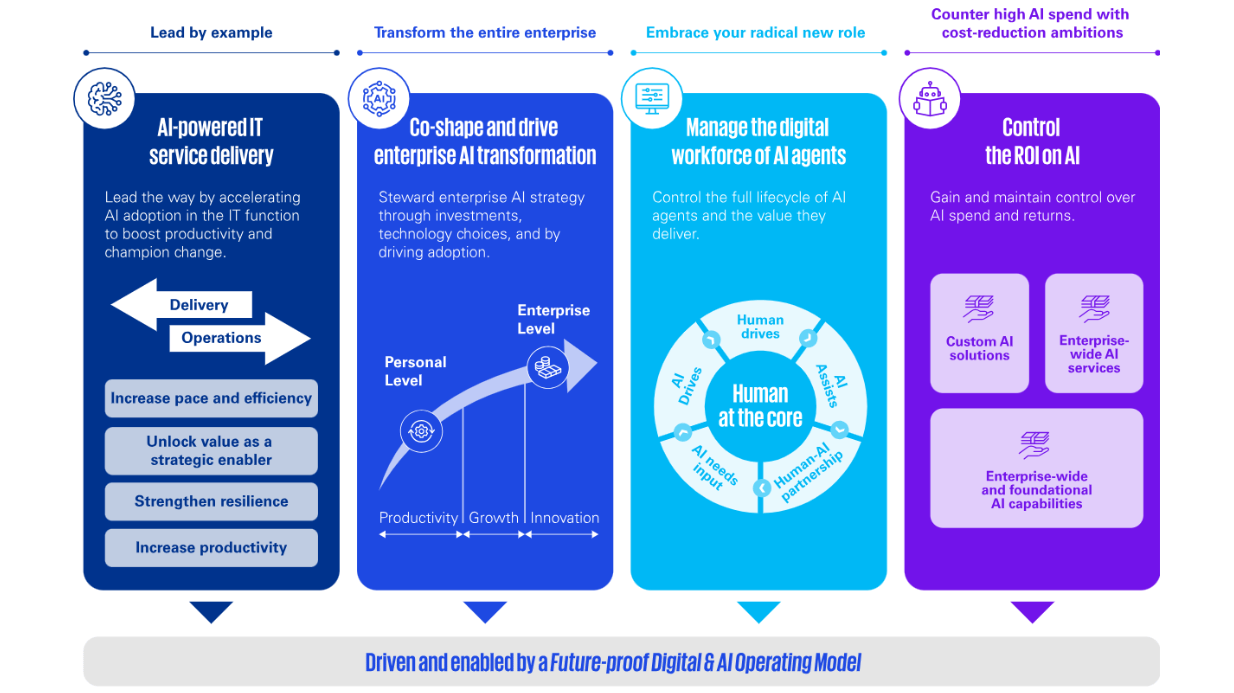
Image source: KPMG
Brief: KPMG outlined how for many enterprises the CIO has become central to translating AI ambition into value, steering human-centered adoption across the entire organization.
Breakdown:
To unlock AI value enterprise-wide, technology leaders should embrace four roles that influence the target operating model.
Enhance IT service delivery with AI-driven productivity use cases to deliver value quickly and build enterprise credibility.
Evolve from platform provider to co-strategist by shaping governance, data foundations, cross-function portfolios, and AI standards.
Establish a digital labor model defining how AI agents are onboarded, governed, trained, monitored, and integrated with human roles.
Act as guardian of AI investment by tracking spend, validating savings, and ensuring productivity gains translate into leverage.
Why it’s important: IT can accelerate enterprise AI adoption by aligning strategy, governance, and human-centered change under a unified operating model. Without coordinated leadership, fragmented initiatives create duplication, increase risk exposure, and undermine long-term value.

Forrester shared how the SaaS-pocalypse is driving consolidation and contemplated whether AI will eat your revtech stack.
Deutsche Bank shared how AI is driving a “great rebalancing” with some sectors transforming deeply while others remain insulated.
Deloitte explained how XaaS adoption is straining IAM models, and how agentic AI streamlines licensing with a customer-centric approach.
KPMG examined how AI is transforming risk management, easing pressure on risk leaders while strengthening oversight and resilience.
Caylent explored how Claude Opus 4.6 is transforming enterprise AI on AWS and the broader implications for scale and governance.
Improving shared its AI Strategy & Roadmap Assessment, outlining how enterprises can avoid 88% of common AI failures.

Anthropic launched Claude Sonnet 4.6, matching or beating Opus 4.6 across benchmarks at one-fifth the price with a 1M token window.
OpenClaw creator Peter Steinberger is joining OpenAI, where Sam Altman says he’ll help “drive the next generation of personal agents.”
Figma introduced “Code to Canvas” with Anthropic, turning Claude Code interfaces into fully editable design files within Figma.
xAI began rolling out Grok 4.2 in public beta, introducing a four-agent workflow designed to research, reason, and execute tasks in parallel.
Meta and Nvidia announced a multiyear AI chip deal covering millions of GPUs and CPUs to accelerate Meta’s AI infrastructure expansion.
The Pentagon may cut off Anthropic’s $200M defense contract after the firm refused to let the military use Claude for “all lawful purposes.”

Unlock Executive AI Index: The top 189 AI playbooks, by industry and function, with direct links to each. Updated weekly.
Get the extended version of Enterprise AI Executive, delivered twice weekly.

CAREER OPPORTUNITIES
CVS Health - Agentic AI Executive Director
Anthropic - Head of Azure Partnership
Cantor Fitzgerald - AI Transformation Lead
EVENTS
C-Vision - AI Customer Experience - February 25, 2026
NVIDIA - GTC 2026 - March 16-19, 2026
KPMG - The Real Value of AI - March 17, 2026

Reach enterprise AI decision-makers:
66% of readers are C-level executives or VP and Director-level leaders.
63.2% of the audience is based in the U.S., EU, UK, ANZ, and Singapore.
Read by leaders at Microsoft, Deloitte, the Fortune 500, and more.
Standard and custom sponsorship packages available, with post-send performance reporting.

Conceived as a practical communication for executives Lewis Walker has worked with, this briefing has become a trusted resource for thousands of senior decision-makers shaping the future of enterprise AI.
We welcome your feedback.

Lewis Walker, Editor